AMERICA UNDER ICE: How the Migration War Is Reshaping the United States in 2026
Mass ICE raids, protests, a border crisis, and a new America that is no longer confident in its own immigration model.
A few years ago, the United States was still widely seen as the global symbol of immigration and opportunity.A country that attracted millions of people — students, engineers, workers, entrepreneurs, and asylum seekers from every continent.
In 2026, that image is no longer stable.
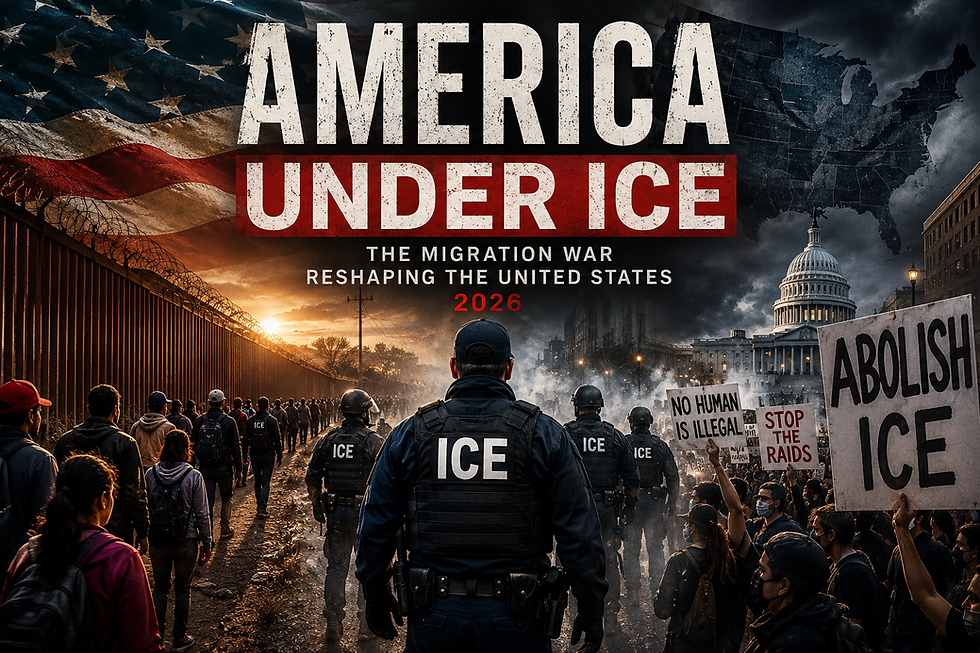
The United States increasingly looks like a nation going through an internal migration conflict — a slow-burning political and social fracture where the main dividing line is no longer just ideology, but movement of people itself.
This is no longer a debate about borders. It is not just about illegal immigration.And it is not only a policy issue.
Migration has become one of the core forces reshaping American politics, economy, and identity.
The US Border Has Become a Political Front Line
For years, the southern border of the United States has been one of the most tense migration corridors in the world. Flows of migrants from Latin America, Venezuela, Haiti, parts of Africa, and Asia have reached levels that overwhelmed the system’s capacity to process them efficiently.
At peak periods, US immigration courts have been dealing with millions of pending cases — one of the largest backlogs in modern American history.
For many Americans, this has created a perception of lost control over the system.
In response, federal authorities have significantly increased enforcement pressure:
faster deportation procedures
more frequent ICE raids
tighter employer inspections
expanded cooperation between federal and state agencies in some regions
increasingly strict political rhetoric around immigration
What was once a slow administrative system has become a high-pressure enforcement environment.
ICE Has Become the Symbol of the New America
One of the most visible institutions in this transformation is ICE — Immigration and Customs Enforcement.
Once largely invisible to the general public outside the United States, ICE has become one of the most discussed federal agencies in the country.
To supporters of strict immigration policy, ICE represents the restoration of order and sovereignty. To critics, it has become a symbol of fear, surveillance, and excessive state power.
According to multiple media reports, enforcement operations and arrests have increased significantly over the past year, with deportation processes becoming faster and more systematic in practice. (novayagazeta.eu)
In several cities, ICE operations have triggered large-scale protests and political tension, particularly in Minnesota, New York, California, and Texas.
“America Is No Longer Sure Who Controls the Country”
This is a phrase that appears more and more often in public debate inside the United States.
Because in practice, the country now functions as two different political realities.
One side of society believes that immigration enforcement has been too weak for too long.They argue that restoring control over the border is essential to maintaining national stability.
The other side sees the current direction as a dangerous expansion of federal enforcement power and a threat to civil liberties.
In 2026, the United States experienced one of the largest waves of anti-ICE protests in recent years. (en.wikipedia.org)
Thousands of people took to the streets in cities such as Minneapolis, New York, San Francisco, and Los Angeles.In some cases, demonstrations escalated into direct confrontations with federal agents. (pap.pl)
The political divide over migration is increasingly becoming a structural divide inside the country itself.
The Economic Impact Is Becoming Visible
For decades, the US economy relied heavily on immigrant labor — often more than it publicly acknowledged.
Construction, agriculture, logistics, hospitality, delivery services, caregiving, and food industries have all depended significantly on foreign workers.
Now parts of the economy are beginning to feel the pressure.
Employers report:
labor shortages in key sectors
higher compliance and legal risks
increased operational uncertainty
rising costs in low-wage industries
At the same time, migration pressure is no longer just an economic variable — it is becoming a political risk factor.
In everyday life, Americans are increasingly experiencing migration not as a distant policy debate, but as a local reality affecting housing, schools, healthcare systems, and public services.
A Story Repeated Across the Country
A 27-year-old migrant from Venezuela living in Texas recently told local journalists that he now avoids traveling between cities due to fear of document checks and enforcement actions.
Just two years ago, he was planning to buy a home in the United States and build a long-term future there.
Today, he says he is seriously considering Canada and Europe instead.
Stories like this are becoming increasingly common.
And they no longer apply only to undocumented migrants.Even people with legal visas, work permits, or pending immigration status are reporting growing uncertainty.
Changes in regulations, administrative delays, enforcement expansion, and political pressure are creating a sense of instability that is difficult to quantify but easy to feel.
The World Is Reconsidering Migration Itself
The United States is not alone in tightening migration policy.
Europe has been moving toward stricter asylum rules.Canada has reduced immigration targets in several categories.The United Kingdom has increased visa restrictions.Australia has adjusted requirements for foreign workers and students.
But the United States remains the most symbolic case.
For decades, it represented the idea of open mobility and opportunity.
That is why its current transformation carries global significance.
The world is gradually entering a phase where migration is no longer viewed purely as economic growth — but also as a potential source of political and social instability.
The American Dream Is No Longer Guaranteed
Perhaps the most important change is not legal — but psychological.
The perception of the United States is shifting.
For generations, America was seen as a place where people could restart their lives. Today, a different question is emerging:
“Is it still safe to build a future there?”
This is especially true among new migrants.
Even legal status is no longer perceived as absolute security.Administrative errors, policy changes, fast-track enforcement systems, and political pressure all contribute to a growing sense of uncertainty.
Media reports increasingly highlight cases of long-term residents unexpectedly entering deportation proceedings after years of living in the country. (novayagazeta.eu)
The United States Is Entering a New Migration Era
The United States is not closing itself completely.
But it is clearly moving away from the model of open-ended migration expansion that defined much of its modern history.
A country that once built part of its strength on global inflows of people is now attempting to re-engineer its borders — physically, politically, and culturally.
And the consequences of this shift will likely extend far beyond the United States itself.
If America begins to fundamentally rethink its migration model, it signals a broader global transition — one where migration is no longer just a pathway, but a contested geopolitical force shaping the future of entire nations.
Disclaimer:


Komentarze