Bangladesh Beat Measles. Then One of the World's Biggest Public Health Success Stories Started Unraveling
- 9 lip
- 4 minut(y) czytania
Just a few years ago, Bangladesh was widely recognized as one of global public health's quiet success stories.
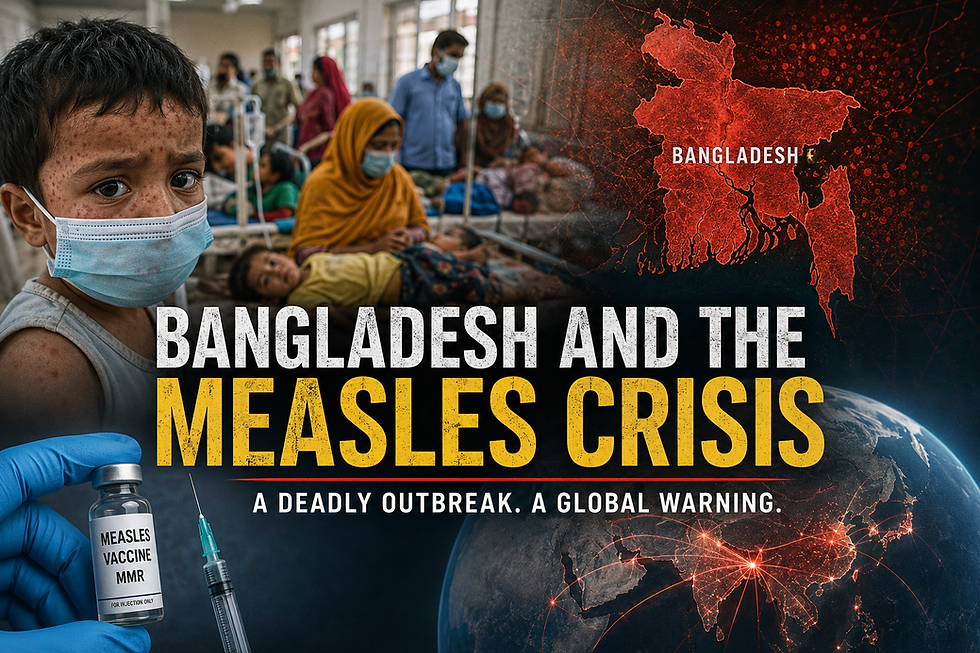
Through decades of nationwide vaccination campaigns, the country had pushed childhood immunization rates above 90 percent and made remarkable progress toward eliminating measles—a disease that once claimed thousands of young lives every year.
Today, that progress is rapidly unraveling.
Since mid-March 2026, Bangladesh has recorded more than 120,000 confirmed and suspected measles cases, according to government figures. Nearly 750 people have died, the vast majority of them children. International organizations, including UNICEF, warn that the true number of infections and deaths is likely significantly higher, particularly in rural communities where many cases are never officially reported.
The outbreak has become one of the country's most serious public health emergencies in years.
But this story is about more than Bangladesh.
It is a warning to every country that believes vaccine-preventable diseases have become a problem of the past.
A Model for the Developing World
For years, Bangladesh demonstrated what determined public health policy could achieve.
Despite limited resources, the country built one of South Asia's strongest childhood immunization programs. Health workers reached remote villages, parents increasingly trusted vaccination campaigns, and measles cases steadily declined.
The World Health Organization had described Bangladesh as making substantial progress toward measles elimination.
That success took decades to build.
It has taken only months for the disease to return on a devastating scale.
Why Measles Comes Back So Quickly
Unlike many infectious diseases, measles spreads with extraordinary efficiency.
A single infected person can transmit the virus to numerous susceptible individuals, making it one of the most contagious diseases known to medicine.
That is why even relatively small declines in vaccination coverage can trigger explosive outbreaks.
Public health experts point to several factors that likely contributed to the current crisis:
disruptions to routine immunization services;
missed childhood vaccinations;
increasing pressure on healthcare systems;
unequal access to medical services in rural areas;
the gradual accumulation of unvaccinated children over several years.
When enough children remain unprotected, the virus needs very little opportunity to spread.
Why Experts Believe the Crisis Is Larger Than Official Figures
Disease surveillance becomes increasingly difficult during major outbreaks.
Many families never reach hospitals.
Some children die at home without laboratory confirmation.
Remote communities often remain underrepresented in official statistics.
For that reason, UNICEF has cautioned that the true scale of the outbreak is likely considerably larger than government data currently reflects.
Official numbers measure only the visible portion of a much larger public health emergency.
Why This Matters Far Beyond Bangladesh
The outbreak is not simply a national crisis.
It is an international public health concern.
Millions of people travel every year between South Asia, the Gulf states, Europe, North America, Australia, and other regions. Infectious diseases move more easily in a highly connected world—not because migration causes outbreaks, but because viruses travel wherever susceptible populations exist.
Public health authorities have repeatedly documented imported measles cases leading to localized outbreaks in countries that had previously eliminated endemic transmission.
The lesson is straightforward.
Eliminating measles does not eliminate the risk of measles returning.
What Families Moving Abroad Should Know
For international migrants, vaccination records are becoming increasingly important.
Many countries require proof of routine immunization for school enrollment, while certain immigration medical examinations may include a review of vaccination history depending on the visa category and destination.
Parents planning an international move should consider:
ensuring every recommended childhood vaccine has been completed;
keeping official vaccination records in both paper and digital form;
consulting healthcare providers well before departure if any immunizations were delayed;
understanding that vaccination schedules may differ between countries.
Preparing medical documentation before relocating can prevent unnecessary complications after arrival.
A Global Reminder
Bangladesh's outbreak highlights a difficult reality about modern public health.
Successful vaccination programs often become invisible because they prevent tragedies that never happen.
When coverage weakens, however, the consequences appear with alarming speed.
Measles is a disease that modern medicine knows how to prevent.
The challenge is not scientific.
It is maintaining strong healthcare systems, consistent immunization programs, and public confidence over many years.
Bangladesh's experience is a reminder that public health victories are never permanent. They must be protected continuously—or they can disappear far faster than anyone expects.
Watch the BBC Report
The BBC's South Asia Correspondent, Azadeh Moshiri, recently reported from a pediatric measles ward in Mymensingh, Bangladesh, documenting the human impact of the ongoing outbreak. We've embedded the report below for readers who want to see firsthand coverage from the affected region.
What Health Organizations Are Saying
World Health Organization (WHO): Before the current outbreak, Bangladesh had made substantial progress toward eliminating measles, supported by childhood vaccination coverage exceeding 90 percent.
UNICEF: The agency believes the real number of infections and deaths is likely higher than official figures because many cases remain undiagnosed or unreported.
Bangladesh Ministry of Health: Since mid-March 2026, authorities have reported more than 120,000 confirmed and suspected measles cases, with nearly 1,000 new suspected infections being identified each day.
Editorial Perspective
The Bangladesh measles outbreak is a reminder that migration and public health are deeply connected—not because people who move create health crises, but because diseases do not recognize borders.
International mobility has reached historic levels. Families relocate for work, education, safety, and new opportunities every day. In such a connected world, maintaining strong vaccination programs is not only a national responsibility but part of global public health security.
For migrants, this outbreak also highlights something practical: keeping vaccination records up to date and understanding healthcare requirements in a destination country is no longer just paperwork. It can make access to schools, medical care, and immigration procedures significantly easier.
At Immigrants.live, we believe immigration reporting should go beyond visas and border policies. Health, education, employment, and access to reliable information all shape the migration experience. Our goal is to explain not only what is happening, but why it matters to people building a life across borders.


Komentarze