Can ICE Arrest You in a Hospital? The Bushwick Incident That Changed the Immigration Debate
- 19 lip
- 4 minut(y) czytania
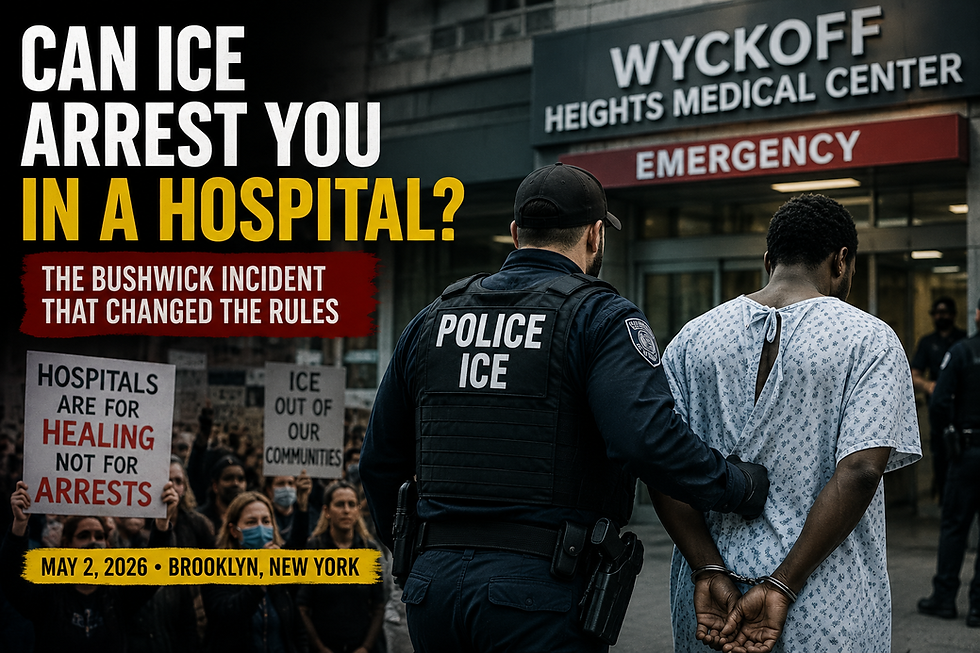
NEW YORK — A hospital is supposed to be one of the last places where people feel safe. But in the spring of 2026, an immigration arrest inside a Brooklyn medical center turned an emergency room into the center of a national political storm.
The incident, which unfolded at Wyckoff Heights Medical Center in Bushwick, reignited one of the most controversial questions in U.S. immigration policy:
Can ICE arrest someone while they are receiving medical care?
The answer is more complicated than many immigrants realize.
What Happened in Bushwick?
On May 2, 2026, ICE officers arrested Chidozie Wilson Okeke, a Nigerian national, during an enforcement operation in Brooklyn.
According to authorities, Okeke was later transported to Wyckoff Heights Medical Center after suffering injuries during the arrest. News of his presence inside the hospital quickly spread through local activist networks.
Within hours, nearly 200 protesters gathered outside the emergency department.
Videos circulating online showed demonstrators blocking exits, chanting against ICE, and demanding that the agency leave the hospital. Police officers were eventually deployed to control the growing crowd.
When ICE later removed Okeke from the hospital, confrontations broke out between protesters and law enforcement. Several demonstrators were arrested, while images from the scene spread rapidly across social media.
The story immediately became national news—not because of one arrest, but because of where it happened.
Why This Case Was Different
For years, many immigrants believed hospitals were effectively protected from immigration enforcement.
That belief came from the federal government's long-standing "sensitive locations" policy, introduced more than a decade ago.
Under those guidelines, immigration enforcement actions at hospitals, schools, churches, and places of worship were generally discouraged unless exceptional circumstances existed.
The policy never created an absolute legal ban.
Instead, it instructed officers to avoid enforcement in locations where public trust and access to essential services could be harmed.
For many immigrant communities, that distinction was rarely understood.
Hospitals simply became known as "safe places."
The Rules Changed
Everything changed after the federal government rescinded the sensitive locations guidance in early 2025.
The new approach gave ICE significantly broader discretion when deciding where enforcement operations could take place.
Hospitals were no longer treated as locations requiring special approval.
While ICE has stated that officers continue to exercise professional judgment and consider operational circumstances, the formal restrictions that once discouraged arrests in medical facilities were removed.
The Bushwick incident became one of the most visible examples of what this policy change looks like in practice.
Why Immigrant Communities Reacted So Strongly
For immigration advocates, the issue extends beyond a single arrest.
Medical organizations have repeatedly warned that fear of immigration enforcement may discourage people from seeking emergency treatment.
Doctors, nurses, and public health experts argue that delaying medical care can increase health risks—not only for undocumented immigrants but for entire communities during infectious disease outbreaks and other public health emergencies.
Supporters of stricter immigration enforcement respond that immigration laws should apply regardless of where an individual is located, particularly if officers are pursuing someone already targeted for arrest.
The Bushwick case brought these competing priorities into direct conflict.
A New Symbol in America's Immigration Debate
The protests outside Wyckoff Heights Medical Center quickly evolved into something larger than one enforcement operation.
Questions emerged about:
whether local police coordinated with ICE;
how sanctuary city policies interact with federal immigration enforcement;
whether hospitals should receive additional legal protections;
and whether fear of arrest could prevent immigrants from seeking lifesaving medical care.
Local politicians demanded investigations, while immigrant rights organizations used the incident as evidence that stronger protections for hospitals are needed.
Federal officials defended the legality of the enforcement action.
What Immigrants Should Know
One important lesson from the Bushwick incident is that many commonly repeated assumptions about immigration enforcement are outdated.
Today:
Hospitals are not automatically off-limits for ICE operations.
Every enforcement action depends on the specific circumstances of the case.
State and local policies may influence how local agencies cooperate with federal authorities, but they generally do not prevent ICE from enforcing federal immigration law.
Individuals facing immigration proceedings should seek advice from a qualified immigration attorney rather than relying on rumors shared on social media.
Understanding the current rules is more important than ever.
Editorial Perspective
The Bushwick hospital incident was about far more than one arrest.
It marked a turning point in how many immigrants view places they once considered safe.
Whether one supports stricter immigration enforcement or stronger protections for immigrant communities, one fact is difficult to dispute:
When immigration officers and protesters confront each other inside or outside a hospital, the debate is no longer only about immigration.
It becomes a question about public trust, access to healthcare, and how far governments should go when enforcing the law.
For millions of immigrants across the United States, Bushwick became a reminder that the landscape of immigration enforcement has changed—and understanding those changes may be just as important as understanding immigration law itself.


Komentarze