Can the U.S. Revoke Your Citizenship?
The Justice Department has opened new denaturalization cases against 10 naturalized Americans. Here's what every immigrant should know—and who is actually at risk.
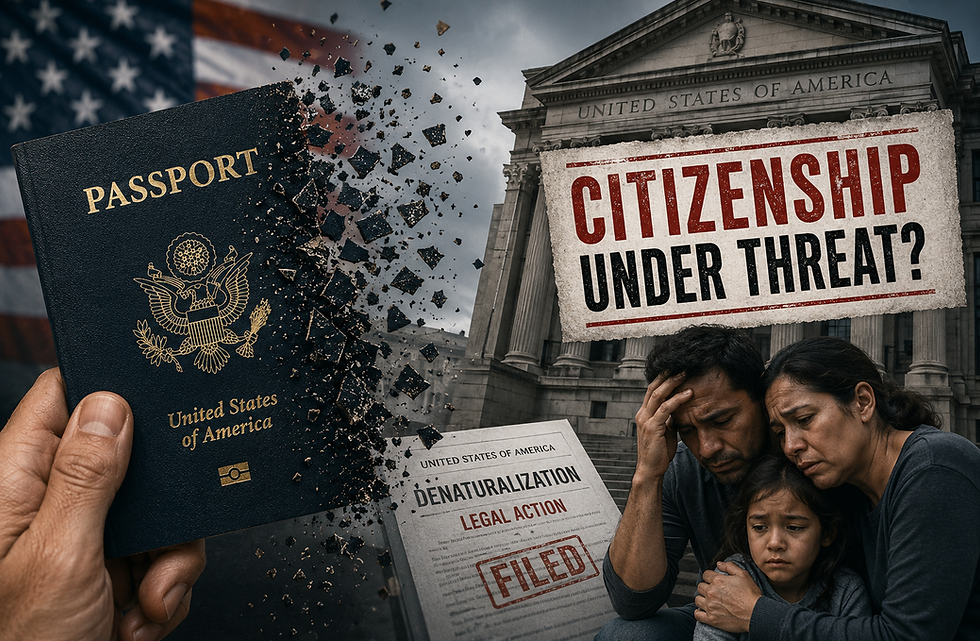
The U.S. Just Took the First Step to Revoke the Citizenship of 10 Naturalized Americans. Here's What It Means for Millions of Immigrants.
For many immigrants, becoming a U.S. citizen is the end of a journey that can take years—or even decades. It is often seen as the moment when uncertainty finally ends.
Today's announcement from the U.S. Department of Justice reminds everyone of one important legal reality: in very limited circumstances, even naturalized U.S. citizenship can be challenged in court.
A New Announcement That Is Raising Questions
On July 20, 2026, the U.S. Department of Justice announced that it has filed legal actions seeking to revoke the citizenship of 10 naturalized U.S. citizens.
The cases involve people accused or convicted of serious offenses, including:
Child sexual abuse
Large-scale healthcare fraud
Bank and wire fraud
Drug trafficking
Immigration fraud
The government argues that these individuals either obtained U.S. citizenship through fraud or concealed information that would have made them ineligible for naturalization.
This process is known as denaturalization.
What Is Denaturalization?
Many immigrants have never heard this word.
Denaturalization is not the same as deportation.
It is a legal process in which the U.S. government asks a federal court to cancel someone's citizenship because it believes that citizenship should never have been granted in the first place.
This is an important distinction.
The government is not claiming that these people simply committed crimes after becoming citizens.
Instead, prosecutors argue that citizenship itself was obtained unlawfully—typically because of fraud, false statements, or intentionally hiding important information during the immigration process.
Only a federal judge can decide whether citizenship should actually be revoked.
Does This Mean Any Naturalized Citizen Can Lose Citizenship?
No.
This is the question many immigrants immediately ask after reading headlines like today's.
For the overwhelming majority of naturalized Americans, the answer is reassuring.
If you legally obtained U.S. citizenship, answered immigration questions truthfully, and completed the naturalization process honestly, today's announcement does not create a new risk for you.
The government must prove its case in court.
These are not automatic decisions.
Why This News Still Matters
Even though these cases involve a small number of individuals, today's announcement is significant.
It shows that the Department of Justice continues expanding one of the largest denaturalization efforts in modern U.S. history.
In recent years, federal authorities have increasingly focused on reviewing cases involving alleged immigration fraud connected to naturalization.
Today's announcement follows earlier actions targeting additional naturalized citizens accused of similar conduct.
While the numbers remain very small compared with the millions of naturalized Americans living in the United States, the policy itself has become far more visible than it was a decade ago.
The Difference Between Headlines and Reality
Social media often reduces complicated legal issues to one frightening sentence:
"America is taking away immigrants' citizenship."
That statement leaves out the most important facts.
The government cannot simply cancel someone's citizenship because it wants to.
A legal process must take place.
Evidence must be presented.
A federal judge must decide whether citizenship was obtained illegally.
That is very different from revoking citizenship as punishment for an ordinary crime committed years after naturalization.
Understanding this difference is essential.
What Should Immigrants Take Away From This?
For millions of immigrants who became U.S. citizens honestly, today's announcement should not cause panic.
Instead, it serves as a reminder of how important honesty is throughout every stage of the immigration process.
Every document submitted to immigration authorities...
Every answer during an interview...
Every signature on an application...
These records can remain legally significant for years.
Why This Story Matters Beyond These 10 Cases
This announcement is about more than ten individuals.
It reflects a broader shift in how immigration enforcement is evolving.
In recent years, immigration policy has expanded beyond visas, border security, and deportation to include closer scrutiny of past immigration records—even years after someone became a U.S. citizen.
For immigrants around the world watching U.S. policy, that is an important development to understand.
Editorial Opinion
Citizenship is one of the strongest legal protections a person can receive.
Because of that, revoking citizenship should remain one of the rarest actions any government takes.
When citizenship was obtained through fraud, courts have a legitimate role in correcting that mistake.
At the same time, millions of immigrants who followed every rule, waited patiently, and became Americans through lawful naturalization should not feel that today's announcement places their own citizenship in doubt.
The distinction matters.
Strong immigration enforcement and legal certainty for honest immigrants are not opposing ideas—they depend on each other.
The challenge for every democratic society is maintaining both.
What Happens Next?
The Justice Department has filed civil denaturalization actions, but no citizenship has been revoked as a result of today's announcement.
Each case will now proceed through the federal court system, where judges will determine whether the government has met the high legal standard required to cancel a person's naturalized U.S. citizenship.
For now, today's announcement is the beginning of a legal process—not the final outcome.



Komentarze