Chancenkarte 2026: Germany’s Most Ambitious Migration Reform Explained
Created: July 6, 2026
Last updated: July 6, 2026
Editorial Introduction: Why Chancenkarte Matters More Than Germany Expected

Germany has spent decades wrestling with a paradox: it is one of the world’s wealthiest, most technologically advanced nations — yet one of the slowest to adapt its migration system to the realities of a shrinking workforce. For years, the country relied on rigid rules, employer‑driven visas, and bureaucratic labyrinths that discouraged talent rather than attracting it.
Chancenkarte changes that.
It is not just another visa category. It is Germany’s first real attempt to compete globally for skilled workers, to open the door before the job offer arrives, and to trust migrants to navigate the labor market on their own terms. In many ways, Chancenkarte is Germany’s admission that the old system failed — and that the future belongs to countries that treat migrants as partners, not petitioners.
This article explains how Chancenkarte works in 2026, why it exists, who benefits, and what challenges migrants still face. It is not a checklist. It is a full narrative of the system, its logic, and its consequences.
1. What Chancenkarte Actually Is — Beyond the Official Definition
Chancenkarte is a points‑based residence permit that allows non‑EU skilled workers to enter Germany without a job offer and stay for up to 12 months while searching for employment. It is part of the reformed Skilled Immigration Act, which aims to modernize Germany’s approach to labor migration.
But the deeper purpose is strategic:
Germany wants to reverse demographic decline.
It wants to fill 1.8 million unfilled jobs.
It wants to compete with Canada, Australia, and the UK.
It wants to simplify entry for people with experience rather than perfect paperwork.
Chancenkarte is Germany’s first visa that says: “Come first. Find your job later.”
2. Why Germany Created Chancenkarte: The Real Backstory
2.1. A shrinking workforce
Germany loses around 400,000 workers every year due to aging. By 2030, one in three workers will be over 55.
2.2. Employers cannot wait months for visas
The old system required:
a job offer,
recognition of qualifications,
employer paperwork,
consulate processing.
This often took 6–12 months, and employers simply hired elsewhere.
2.3. Germany finally accepted a global truth
Countries that allow migrants to arrive first and job‑hunt locally attract more talent.
Chancenkarte is Germany’s answer to Canada’s Express Entry and Portugal’s job‑seeker visa — but with German structure and predictability.
3. Eligibility Explained: The Logic Behind the Requirements
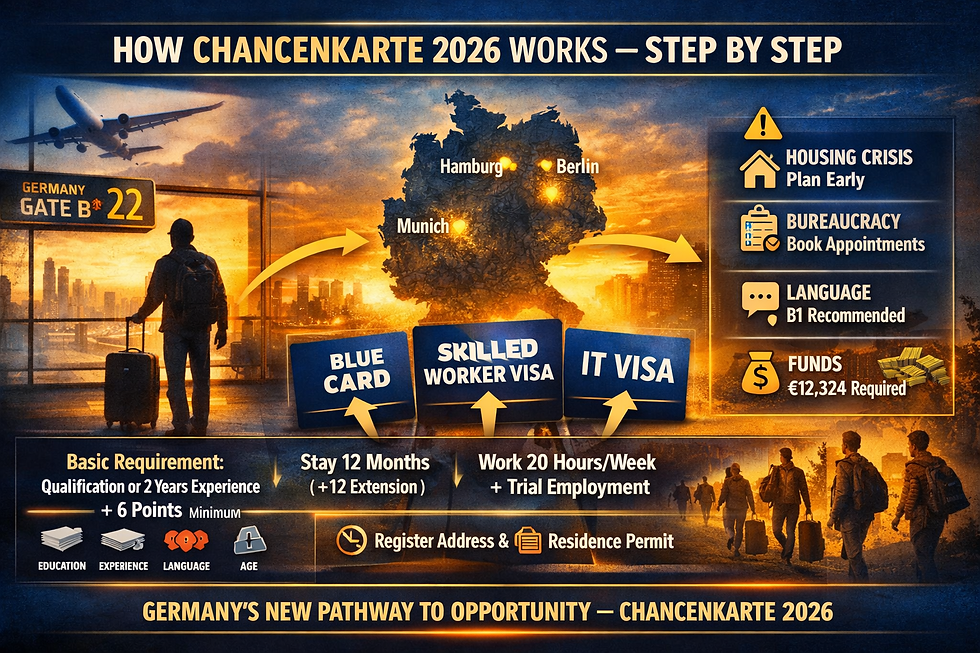
To apply, you must meet one basic requirement and score at least 6 points.
3.1. The Basic Requirement (the “Gatekeeper”)
You must fit into one of these categories:
A. Recognized qualification (Anerkennung)
Your foreign degree is officially accepted in Germany.
B. Foreign degree + 2 years of experience
Even without recognition, your education counts.
C. Vocational training + 2 years of experience
For skilled trades and technical professions.
D. IT specialists without a degree
Germany accepts experience instead of formal education.
This requirement ensures Germany receives skilled workers, not random job‑seekers.
3.2. The Points System (2026 Version)
You need 6 points. Here is the full breakdown with explanations:
Education — up to 4 points
Germany rewards formal training but does not punish those without recognition.
Work experience — up to 3 points
Experience is treated as proof of competence.
German language — up to 3 points
Even A2 helps; B1–B2 significantly increases chances.
Age — up to 2 points
Younger applicants are prioritized due to long‑term labor market potential.
Connection to Germany — up to 2 points
Past stays show integration potential.
Shortage occupation — 2 points
If your field is in demand, Germany wants you faster.
3.3. Real Applicant Examples
Example 1: Ukrainian engineer, 32, B1, 5 years experience
Education: 2
Experience: 2
Language: 2
Age: 1
Shortage: 2 Total: 9 points → eligible
Example 2: Indian IT specialist, 27, A2, 4 years experience
Experience: 2
Language: 1
Age: 2
Shortage: 2 Total: 7 points → eligible
4. What Chancenkarte Allows You to Do
4.1. Stay in Germany for 12 months
With a possible extension to 24 months if you show active job search.
4.2. Work part‑time
Up to 20 hours per week.
4.3. Trial employment
You may take short trial jobs (up to 2 weeks) to demonstrate skills.
4.4. Transition to long‑term residence
Once you secure a job, you can switch to:
Blue Card
Skilled Worker Visa
IT Specialist Visa
Work‑based residence permit
Chancenkarte is not the final status — it is the entry point.
5. Financial Requirements: Why They Exist and How They Work
Germany wants to ensure migrants can support themselves during job search.
5.1. Required funds
Approx. €1,027 per month Total for 12 months: €12,324
5.2. Accepted proof
Bank account
Blocked account (Sperrkonto)
Sponsor (Verpflichtungserklärung)
Part‑time job income (after arrival)
5.3. Why Germany insists on this
The government wants to avoid situations where job‑seekers fall into social assistance before employment.
6. The Application Process — Explained Step by Step
6.1. Document preparation
This is not just paperwork — it is your professional narrative:
Passport
CV in German format
Diplomas + translations
Proof of experience
Language certificates
Proof of funds
Health insurance
Motivation letter explaining your job search plan
6.2. Consulate submission
You submit your application and attend an interview.
6.3. Interview logic
Officers want to see:
a realistic job search strategy
financial stability
understanding of your profession in Germany
basic integration readiness
6.4. Arrival in Germany
You must:
find accommodation
register your address (Anmeldung)
obtain a residence permit at Ausländerbehörde
begin job search
7. The Hidden Challenges Migrants Face (Unfiltered Reality)
7.1. Housing
Finding accommodation for Anmeldung is the biggest obstacle.
7.2. Bureaucracy
Appointments at Ausländerbehörde may take weeks.
7.3. Language
Even B1 is often not enough for customer‑facing roles.
7.4. Competition
Chancenkarte is popular; many applicants arrive simultaneously.
7.5. Psychological pressure
Job‑hunting in a foreign country without guaranteed income is stressful.
8. Who Benefits Most from Chancenkarte
Top winning professions:
IT
Engineering
Construction
Electrical work
Mechanics
Welding
Healthcare
Logistics
Hospitality
These sectors have chronic shortages and hire migrants readily.
9. Chancenkarte vs Blue Card — A Practical Comparison
Feature | Chancenkarte | Blue Card |
Job offer required | ❌ | ✔️ |
Salary threshold | ❌ | €45–50k+ |
Work rights | Limited | Full |
Points system | ✔️ | ❌ |
Best for | Job seekers | High‑skilled professionals |
10. What Changed in 2026
1. Faster processing (target: 2–3 months)
2. Expanded shortage occupation list
3. Digital application pilot
4. Extension up to 24 months
5. Simplified recognition rules
Germany is actively improving the system based on feedback from migrants and employers.
Editorial Opinion: What Chancenkarte Means for Germany’s Future
Chancenkarte is more than a visa — it is a cultural shift. For decades, Germany treated migration as a bureaucratic transaction. Now it treats it as an investment.
The country finally acknowledges that talent does not always come with perfect paperwork, that experience can matter more than diplomas, and that migrants should be trusted to navigate the labor market independently.
But the reform is only half‑complete.
Germany still struggles with housing, slow bureaucracy, and inconsistent regional practices. Chancenkarte opens the door — but what happens after migrants walk through it depends on whether the country can modernize its institutions fast enough.
If Germany succeeds, Chancenkarte will be remembered as the moment the country stopped resisting migration and started shaping it.
If it fails, the visa will become another good idea buried under administrative delays.
Right now, in 2026, the story is still being written.


Komentarze