China Green Card Backlog 2026: EB-2 & EB-3 Priority Dates Explained
Your I-140 is approved. Your priority date is years old. So why are you still waiting for a U.S. Green Card?
For many employment-based immigrants born in mainland China, the hardest part of the U.S. Green Card process is not getting an employer to sponsor them.
It is waiting for an immigrant visa number to become available.
You may have an approved I-140. You may have been working in the United States for years. You may have watched the Visa Bulletin move forward — only to see it slow down, stop, or move backward.
And one question keeps coming back:
When will my priority date finally become current?
In September 2026, China-born applicants in the EB-2 and EB-3 categories are still dealing with multi-year cut-off dates.
But understanding the backlog requires more than looking at one date in the Visa Bulletin.
You need to know your category, your priority date, which chart applies to you, and what the dates actually mean for your case.
Here is the practical breakdown.
China Green Card Backlog: September 2026 Snapshot
The U.S. Department of State publishes monthly Visa Bulletins showing when immigrant visa numbers may become available.
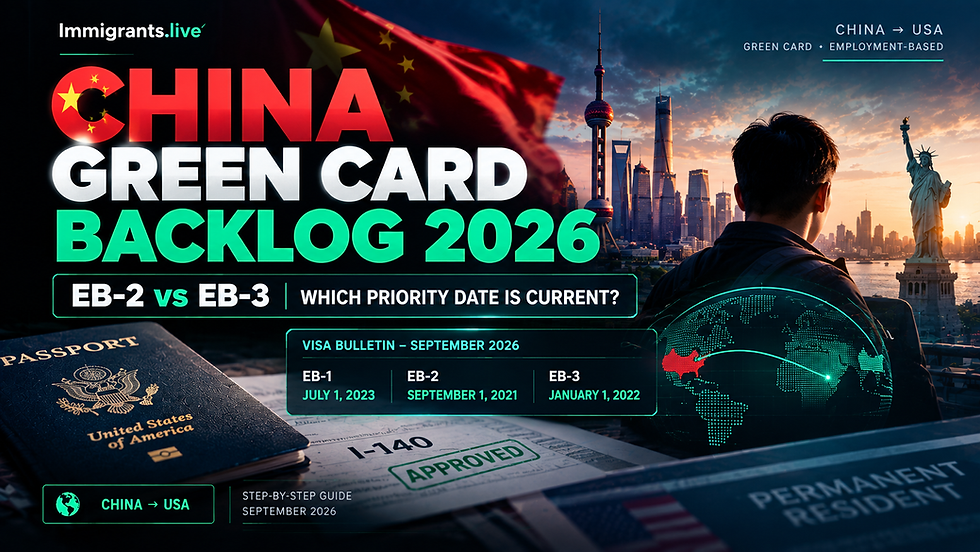
For employment-based applicants chargeable to China-mainland born, the September 2026 Final Action Dates are:
Employment category | September 2026 Final Action Date |
EB-1 | July 1, 2023 |
EB-2 | September 1, 2021 |
EB-3 | January 1, 2022 |
These dates are cut-offs — not guaranteed Green Card approval dates.
If your priority date is earlier than the applicable Final Action Date, your case may be eligible to move forward, subject to the remaining requirements and visa availability.
If your priority date is later than the cut-off, you generally must continue waiting for the date to advance.
Important: These are September 2026 dates. The Visa Bulletin changes monthly, and future movement is not guaranteed.
Official source: U.S. Department of State, September 2026 Visa Bulletin.
1. Why China Has a Separate Green Card Queue
The U.S. employment-based immigration system has annual numerical limits and per-country limits.
When demand from a particular chargeability area exceeds the available visa numbers, the Department of State may establish a separate cut-off date for that area.
China-mainland born applicants have separate dates in several employment-based categories, including EB-1, EB-2, EB-3 and EB-5 Unreserved.
One important detail:
Visa Bulletin chargeability is generally based on country of birth — not simply citizenship or current residence.
For example, a Chinese citizen born in another country may not necessarily be chargeable to China.
In certain circumstances, applicants may also be able to use a spouse’s country of chargeability through cross-chargeability rules. Whether that is available depends on the individual case.
This is why two people with Chinese citizenship may not necessarily have the same Visa Bulletin category or cut-off date.
2. EB-2 China: What Does the September 2021 Date Mean?
In September 2026, the EB-2 China Final Action Date is:
SEPTEMBER 1, 2021
EB-2 generally covers members of the professions holding advanced degrees or persons of exceptional ability who qualify under the applicable immigration rules.
For many employer-sponsored applicants, the process involves:
PERM labor certification, when required;
an I-140 immigrant petition;
waiting for visa availability;
and, when eligible, filing or completing the final Green Card stage.
The priority date is often tied to the PERM filing date when labor certification is required. In cases that do not require PERM, the applicable priority-date rules may differ.
Example
Imagine your EB-2 priority date is:
March 15, 2022
The September 2026 EB-2 China Final Action Date is:
September 1, 2021
Your priority date is later than the cut-off.
That means your priority date is not current under the September 2026 Final Action chart.
Even if your I-140 has been approved, you generally cannot receive an employment-based immigrant visa or final adjustment approval until a visa number is available and the other requirements are met.
I-140 approval and visa availability are two different milestones.
3. EB-3 China: Is It Moving Faster Than EB-2?
In September 2026, the EB-3 China Final Action Date is:
JANUARY 1, 2022
EB-3 generally includes skilled workers, professionals and certain other workers who meet the relevant requirements.
At first glance, the EB-3 China cut-off date is later than the EB-2 China cut-off date in September 2026.
But that does not mean EB-3 will always move faster.
Visa Bulletin dates can advance, remain unchanged, or retrogress. The Department of State manages visa number usage within annual limits, and future movement depends on demand and availability.
What should applicants compare?
If you are considering EB-2 versus EB-3, do not compare only the current Final Action Dates.
You should also understand:
whether you qualify for the relevant category;
your existing priority date;
whether your employer can support the appropriate process;
whether a category change is legally and procedurally available;
and what happens to your priority date if a new petition is filed.
A later cut-off date in one month is not a guarantee that changing categories will shorten your personal wait.
4. Final Action Dates vs. Dates for Filing: The Difference Can Matter
The Visa Bulletin contains two employment-based charts.
They do not serve the same purpose.
Final Action Dates
This chart indicates when immigrant visa numbers may be authorized for final action.
If your priority date is earlier than the applicable Final Action Date, your case may be eligible for final processing, assuming all other requirements are met.
Dates for Filing
This chart indicates when applicants may be able to begin submitting documentation to the National Visa Center or, in eligible adjustment-of-status cases, proceed under the filing chart USCIS has authorized for that month.
For September 2026, the China employment-based Dates for Filing include:
Category | September 2026 Date for Filing |
EB-1 | December 1, 2023 |
EB-2 | January 1, 2022 |
EB-3 | January 8, 2022 |
For applicants filing Form I-485 inside the United States, USCIS determines which chart may be used for employment-based adjustment of status in a given month.
Do not assume that the Dates for Filing chart automatically allows you to submit I-485.
Always check USCIS’s monthly filing-chart announcement before acting.
5. Your I-140 Is Approved. Why Can't You Get a Green Card?
This is one of the most misunderstood parts of employment-based immigration.
An approved I-140 is an important step. But it does not, by itself, grant permanent residence.
You may still be waiting because:
your priority date is not current;
a visa number is not available;
you have not yet filed I-485, where eligible;
your adjustment-of-status case is still pending;
or additional requirements remain before final approval.
For applicants processing through a U.S. consulate, immigrant visa processing and visa availability must also be completed.
The key distinction:
An approved immigrant petition does not guarantee that an immigrant visa number is immediately available.
6. What If Your Priority Date Is Almost Current?
Suppose your priority date is:
August 2021
And the September 2026 EB-2 China Final Action Date is:
September 1, 2021
Your priority date is earlier than the published cut-off.
That may indicate that your date is current under the Final Action chart for that month.
But do not treat the Visa Bulletin as the only requirement.
You still need to confirm:
that the correct category and chargeability area are being used;
that your priority date is correctly recorded;
that you meet the requirements for the next stage;
and that the relevant agency can proceed with your case.
If you are filing I-485, confirm the applicable USCIS chart and filing instructions for that month.
7. What If Your Priority Date Is Years Away From the Cut-Off?
If your priority date is later than the current Final Action Date, your case may remain in the queue.
That does not automatically mean your petition is in trouble.
It may simply mean that visa numbers are not yet available for your priority date.
While waiting, applicants should keep track of:
their approved I-140;
the priority date shown in their records;
their current immigration status;
their employer and job circumstances;
any pending I-485;
and monthly Visa Bulletin updates.
If you are in the United States on a temporary status, remember that an approved I-140 does not itself extend that status or authorize employment.
Your ability to remain and work in the United States depends on the rules governing your current immigration status and any applicable extensions or other benefits.
8. Can You Keep Your Priority Date If You Change Employers?
This is an important question for applicants who have been waiting for years.
In many cases, an approved I-140 can allow an applicant to retain the priority date for a later employment-based petition, subject to the applicable rules and exceptions.
But priority-date retention is not the same as transferring an entire Green Card case to a new employer.
Changing employers may raise separate questions about:
whether a new PERM process is required;
whether a new I-140 is needed;
whether an I-485 has been pending long enough for AC21 portability to apply;
whether the new job meets the relevant requirements;
and whether the original petition remains valid for priority-date retention.
Do not assume that changing employers automatically preserves every part of the original case.
The details matter, especially when your priority date is close to becoming current.
9. Could EB-3 Be an Alternative to EB-2?
Some applicants ask whether moving from EB-2 to EB-3 could help them reach the Green Card stage sooner.
The answer depends on the case.
EB-2 and EB-3 have different eligibility requirements, and changing categories may involve a new or amended petition and employer participation.
A category with a more favorable cut-off date in one Visa Bulletin is not necessarily a better option for every applicant.
Before making a change, applicants should understand:
whether they qualify for EB-3;
whether their employer is willing and able to support the process;
whether the priority date can be retained;
how the new category’s dates have behaved;
and what happens if the Visa Bulletin later changes.
A category change should be evaluated using the applicant’s actual facts — not just one month’s cut-off date.
10. What Could Change in October 2026?
The U.S. government’s fiscal year begins on October 1.
That is why applicants closely watch the October Visa Bulletin.
A new fiscal year can bring changes in visa availability and cut-off dates. But applicants should not assume that every category will advance or that a specific priority date will become current.
The Department of State can advance dates, hold them, or move them backward depending on demand and visa-number availability.
For China EB-2 and EB-3 applicants, the October 2026 Visa Bulletin should be checked as soon as it is officially published.
Do not make immigration decisions based on predicted October movement. Use the published bulletin and applicable USCIS filing instructions.
11. Your China EB-2 / EB-3 Green Card Checklist
If you are waiting for an employment-based Green Card, keep these details together:
Item | Your information |
Country of birth | __________ |
Chargeability area | __________ |
Employment category | EB-1 / EB-2 / EB-3 |
Priority date | __________ |
I-140 status | __________ |
I-140 approval date | __________ |
Current immigration status | __________ |
I-485 filed? | Yes / No / N/A |
I-485 receipt date | __________ |
Current Visa Bulletin cut-off | __________ |
Applicable USCIS filing chart | __________ |
This makes it easier to identify what you are waiting for and which official information applies to your case.
12. Where to Check Official Updates
Use official sources rather than relying only on social media posts or third-party Visa Bulletin summaries.
U.S. Department of State — Visa Bulletin
Check the monthly Final Action Dates and Dates for Filing.
USCIS — Adjustment of Status Filing Charts
If you are in the United States and plan to file I-485, confirm which chart USCIS permits employment-based applicants to use that month.
USCIS — Form I-140
Review official petition information and relevant case guidance.
USCIS — Form I-485
Review adjustment-of-status requirements and filing instructions.
The Visa Bulletin is updated monthly. Always use the bulletin for the month relevant to your intended action.
Immigrants.live Analysis
For China-born employment-based applicants, the Green Card backlog is not just a question of how many years have passed.
It is a question of where your priority date sits in the system today.
In September 2026:
EB-2 China Final Action Date: September 1, 2021
EB-3 China Final Action Date: January 1, 2022
These dates show why an approved I-140 may still leave an applicant waiting.
But the cut-off date is only one part of the case.
Your category, priority date, chargeability, current status, employer situation and the applicable filing chart can all matter.
The most useful question is not simply:
“How long is the China Green Card backlog?”
It is:
“What does the current Visa Bulletin mean for my exact priority date?”
That is the question applicants should return to every month — using official dates, not promises or predictions.
Last checked: September 2026


Komentarze