Could Public Benefits Put Your Green Card at Risk? The New U.S. Public Charge Rule Explained
A family needs medical care. A parent applies for food assistance. A worker loses a job and struggles to pay rent. At the same time, someone in the household is preparing a green card application.
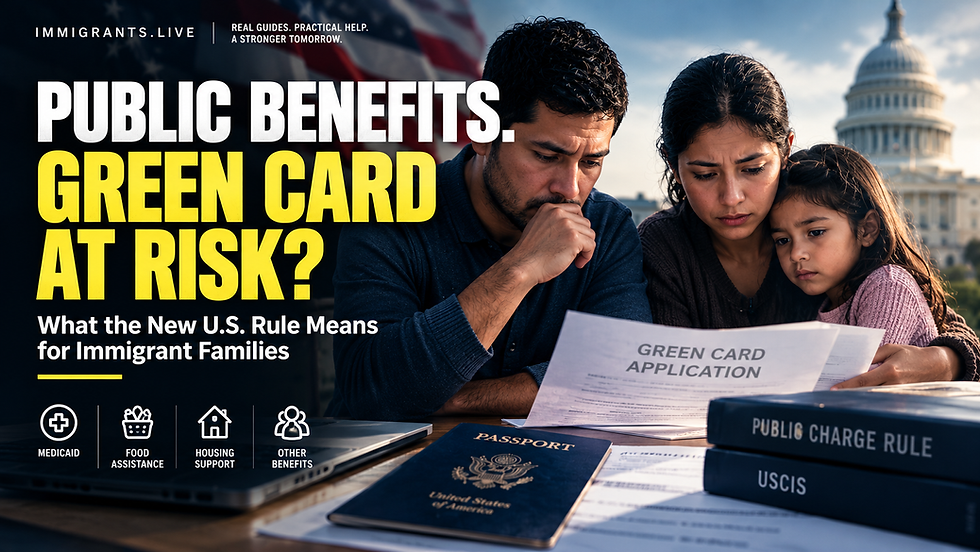
Could accepting public benefits affect that immigration application?
For some applicants, the answer now requires more careful attention.
On September 18, 2026, a new U.S. public charge rule took effect, replacing the regulatory framework adopted in 2022. The change gives immigration officers broader discretion to assess whether certain applicants are likely to become a “public charge” — a ground of inadmissibility under U.S. immigration law.
The change does not mean that every immigrant who receives government assistance will lose immigration eligibility. It does mean that some applicants may need to consider their benefit history, financial circumstances, family situation and the rules that apply to their particular immigration category.
For families planning to apply for permanent residence, misunderstanding the rule can create unnecessary fear — or lead to decisions that carry serious consequences.
Here is what changed, who may be affected, and what applicants should do before making an immigration decision.
1. What Is the Public Charge Rule?
“Public charge” is a concept in U.S. immigration law used to assess whether a person seeking admission to the United States or certain immigration benefits is likely to become primarily dependent on government support.
The public charge ground of inadmissibility is not a universal rule covering every immigrant, every benefit or every immigration application. Its application depends on the type of application and whether a statutory exemption applies.
For applicants seeking adjustment of status to lawful permanent residence — commonly called a green card — immigration officers must consider the circumstances required by law and evaluate the evidence relevant to the individual case.
The statutory factors include:
Age.
Health.
Family status.
Assets, resources and financial status.
Education and skills.
Officers may also consider other relevant evidence under the applicable framework, including qualifying public-benefit history and an Affidavit of Support, where relevant.
The key point: Public charge is an individualized immigration assessment, not a simple test in which receiving one benefit automatically determines the outcome.
2. What Changed on September 18, 2026?
The Department of Homeland Security rescinded the 2022 public charge regulations. The final rule became effective on September 18, 2026.
Under the earlier framework, regulations limited which benefits could be considered and established more specific rules for making public charge determinations.
The new framework removes those regulatory restrictions and gives officers broader discretion to consider relevant evidence in the totality of an applicant’s circumstances.
According to USCIS guidance, the revised approach allows officers to consider a wider range of means-tested public benefits, alongside the statutory factors and other relevant evidence.
The rule generally applies to covered applications for admission made on or after September 18, 2026, and covered adjustment-of-status applications postmarked or submitted electronically on or after that date.
The timing matters. Benefit history from before the effective date is not treated identically to benefit receipt after it.
For benefits received before September 18, 2026, USCIS states that it will consider public cash assistance for income maintenance and long-term institutionalization at government expense under the prior framework. For covered benefits received on or after the effective date, the new framework allows broader consideration.
Applicants should not assume that an application filed earlier and one filed after the effective date will necessarily be assessed under identical rules.
3. Does Receiving Medicaid Put a Green Card at Risk?
This is one of the questions families are most likely to ask.
Under the new framework, USCIS says officers may consider Medicaid received on or after September 18, 2026, when relevant to a covered public charge determination.
But Medicaid receipt does not automatically make someone inadmissible or disqualify them from a green card.
The officer may consider the circumstances surrounding the benefit, including the applicant’s employment, age, health, the timing and duration of benefit receipt, whether other benefits were received, and other relevant evidence.
This distinction is important. A benefit may be part of the record without being decisive by itself.
Before changing health coverage or refusing medically necessary care out of fear about immigration consequences, applicants should obtain advice from a qualified immigration attorney or accredited representative who understands their specific immigration category and circumstances.
The consequences of withdrawing from a program can affect a family’s health and finances. Do not make a major decision based only on a social media post or a general article.
4. What About SNAP, Food Assistance, Housing Assistance or Other Benefits?
The new framework allows officers to consider a broader range of means-tested public benefits received on or after September 18, 2026, where the public charge ground applies.
Depending on the program and the individual circumstances, potentially relevant evidence may include benefits such as:
SNAP or food assistance.
Housing assistance.
Certain forms of financial assistance.
Medicaid.
Other means-tested public benefits.
This is not a definitive list of every benefit that will count in every case. USCIS has not established an exhaustive list that resolves every possible program or situation. The relevance of a benefit must be assessed under the applicable rules and the evidence in the individual record.
It is also important to distinguish benefits received by the green card applicant from benefits received by another member of the household.
USCIS guidance focuses on the applicant’s circumstances. Benefits received by another person are generally not relevant to the applicant’s public charge determination, although specific circumstances may require closer legal analysis.
Do not assume that every benefit used by a household is automatically attributed to every family member.
5. Who Is Affected by the Public Charge Rule?
The rule is relevant to certain people applying for admission to the United States or adjustment of status to permanent residence, unless an exemption applies.
Potentially affected applicants can include certain:
Immediate relatives of U.S. citizens, such as spouses, parents and children.
Family-preference immigrants.
Employment-based applicants adjusting status.
Other applicants in categories subject to the public charge ground.
However, eligibility and exemptions depend on the precise immigration category and governing law. The fact that a person is applying for a green card does not, by itself, establish that the public charge ground applies to them.
Some humanitarian and other categories are exempt under statute. The scope of an exemption must be checked against the actual category and facts; it should never be assumed based only on a broad description such as “refugee,” “family member” or “humanitarian applicant.”
If you are unsure whether your category is covered, verify it before making decisions about benefits or filing strategy.
6. Are Refugees, Asylees and Other Humanitarian Applicants Exempt?
Certain humanitarian categories are exempt from the public charge ground under federal law.
The exact treatment depends on the category and the stage of the immigration process. A person applying for asylum, someone who has already been granted asylum, a refugee applying for permanent residence, and a person applying under a different humanitarian provision may not be subject to identical rules.
Do not assume that the new public charge framework applies to every humanitarian applicant. Equally, do not assume that every person with a humanitarian history is exempt from every immigration requirement.
Check the statutory exemption and the relevant USCIS guidance for your particular category. When a pending application or deadline is involved, seek qualified legal advice.
7. Can Public Charge Affect a Family-Based Green Card?
It can be relevant to certain family-based applications, but the outcome depends on the applicant’s circumstances and the applicable rules.
A sponsor’s financial support may be important. In cases where an Affidavit of Support, Form I-864, is required, the sponsor generally makes a legally significant commitment to support the intending immigrant.
USCIS may consider the Affidavit of Support as part of the public charge assessment where applicable. It does not mean that a sponsor’s income alone automatically determines the result.
Applicants should review the financial evidence, the sponsor’s obligations and any additional information relevant to the case. If the applicant’s circumstances have changed since the petition was filed, professional advice can help identify what needs to be disclosed and documented.
Never submit misleading information or omit information because you assume it will not matter.
8. What Evidence May Matter in a Public Charge Assessment?
There is no single document that guarantees approval. The evidence that matters depends on the applicant and the immigration category.
Relevant information may include:
Financial circumstances
Income and employment records.
Available assets and resources.
Household financial obligations.
Evidence of financial support where relevant.
Personal circumstances
Age and health.
Family composition and responsibilities.
Education, qualifications and employment skills.
Immigration and benefit records
The exact immigration category and filing date.
Records of benefits received by the applicant.
The timing and duration of benefit receipt.
Any required Affidavit of Support and supporting documentation.
Keep records accurate and consistent. If an application asks a question about a benefit, answer according to the actual wording and instructions. If you are uncertain how a question applies to your circumstances, obtain legal advice before submitting the form.
9. Can USCIS Deny a Green Card Because of Public Charge?
A public charge finding can lead to inadmissibility for an applicant subject to the ground, unless a legally available exception, waiver or other applicable provision changes the outcome.
The new framework gives officers broader discretion to review relevant evidence, but it does not establish that every applicant who has received public assistance must be denied.
The decision is case-specific. It depends on the legal category, the relevant statutory factors, the evidence in the record and the applicable rules.
In some circumstances, USCIS guidance describes a possible public charge bond process. This is not an automatic option available to every applicant. An officer may invite a qualifying applicant to post a bond through the applicable procedure; applicants cannot assume they can simply pay a fee to overcome a problem.
A bond is not a universal solution or a guarantee of approval. Follow the actual notice and official instructions if USCIS raises this issue in your case.
10. What Should You Do Before Applying for a Green Card?
If you are preparing an adjustment-of-status application, take these practical steps.
Step 1: Identify your exact immigration category.
Do not rely on a general description of your situation. Confirm whether your category is subject to the public charge ground or exempt.
Step 2: Check the filing date.
The September 18, 2026 effective date matters. Confirm which framework applies to your application and how the rules treat any prior benefit history.
Step 3: Gather accurate records.
Organize your income, employment, household, sponsorship and benefit records where relevant. Do not hide or alter documents.
Step 4: Review the current USCIS instructions.
Make sure you are using the correct form edition and following the current instructions. USCIS announced that revised Form I-485 requirements would accompany implementation of the rule. Verify the current form directly before filing.
Step 5: Get qualified legal advice if the situation is complicated.
This is especially important if you have received benefits, have an unusual immigration history, are relying on a sponsor, or are unsure whether an exemption applies.
Step 6: Do not make drastic decisions based on rumors.
Do not automatically cancel health coverage, stop seeking essential assistance, withdraw an application or move money around because someone online claims that a particular action will guarantee immigration approval.
There is no universal strategy that fits every applicant.
11. What If You Already Filed Form I-485?
First, determine when the application was postmarked or submitted electronically and whether the public charge ground applies to your category.
The new rule generally applies to covered adjustment-of-status applications submitted on or after September 18, 2026. Earlier applications are generally assessed under the framework applicable to their filing date, subject to the governing rule and agency guidance.
Do not assume that every pending application automatically changes treatment simply because the rule has taken effect.
If you receive a Request for Evidence, a Notice of Intent to Deny or another notice raising public charge concerns, read the deadline carefully and respond according to the instructions. Consider consulting a qualified immigration lawyer promptly.
Ignoring an official notice or missing a response deadline can create additional problems.
12. Common Mistakes to Avoid
Mistake 1: Believing any public benefit automatically destroys green card eligibility.
The rule is more complicated. Applicability, exemptions and individual circumstances matter.
Mistake 2: Assuming that no benefits can ever be considered.
The framework changed on September 18, 2026. Applicants should not rely on outdated explanations of the 2022 rule.
Mistake 3: Confusing your benefits with those received by another family member.
The distinction may matter. Get advice if household circumstances are complicated.
Mistake 4: Hiding information or submitting false documents.
Misrepresentation can create serious immigration consequences. Answer questions accurately and seek advice when unsure.
Mistake 5: Relying on old forms or outdated online advice.
Check the current USCIS form edition, instructions and policy guidance.
Mistake 6: Stopping necessary medical care because of fear.
Do not make health or financial decisions based solely on generalized immigration commentary. Seek reliable, individualized advice.
Frequently Asked Questions
Does Medicaid automatically disqualify someone from a green card?
No. Under the framework effective September 18, 2026, Medicaid received on or after that date may be considered in a covered public charge determination. Receipt does not automatically mean denial; the applicant’s circumstances and applicable rules matter.
Can SNAP or food stamps affect a green card application?
Potentially, for applicants subject to the public charge ground. The new framework allows broader consideration of means-tested public benefits received on or after the effective date. The specific facts and legal category must be reviewed.
Does the new rule apply to every immigrant?
No. The public charge ground applies to certain applications, and statutory exemptions remain. Verify the rules for your exact immigration category.
Does it apply to applications filed before September 18, 2026?
The new rule generally applies to covered adjustment-of-status applications postmarked or submitted electronically on or after September 18, 2026. Earlier applications are generally assessed under the prior applicable framework. Confirm your filing date and situation.
Will benefits received by my U.S.-citizen child count against me?
Do not assume that benefits received by another household member are automatically attributed to you. USCIS guidance generally focuses on the applicant’s own circumstances, although specific cases may require legal analysis.
Can a financial sponsor solve a public charge concern?
A required Affidavit of Support may be relevant, but it does not automatically guarantee approval. USCIS evaluates the applicable evidence and circumstances.
Can I pay a bond instead of being denied?
A public charge bond may be possible in limited circumstances if USCIS invites an eligible applicant to use the process. It is not an automatic right or a guaranteed solution.
Should I stop receiving public benefits before applying?
Do not make that decision based on a general article. The consequences depend on your eligibility, the benefit, your immigration category and your family’s circumstances. Seek individualized advice before making major decisions.
The Bottom Line
The U.S. public charge framework changed on September 18, 2026. For some people seeking permanent residence, financial circumstances and public-benefit history may now receive broader consideration than under the 2022 regulatory framework.
But the change is not a rule that every benefit automatically disqualifies every immigrant.
The most important steps are to identify the exact immigration category, verify the applicable filing-date rules, keep accurate records and obtain qualified legal advice before making consequential decisions.
Do not let rumors make your immigration decisions for you. Understand the rule that actually applies to your case.
Editorial disclaimer: This article provides general educational information, not individualized legal advice. Public charge rules, exemptions and procedures depend on the applicant’s immigration category, filing date and circumstances. Verify current USCIS guidance and consult a qualified immigration attorney or accredited representative before making decisions about benefits or an immigration application.


Komentarze