Ebola Is Spreading in Africa Again. Should Europe Be Worried?
- 7 sie
- 4 minut(y) czytania
A deadly virus has returned. But the biggest question is not only how dangerous Ebola is — it is how diseases move in a world of open borders, global flights and unprecedented human mobility.
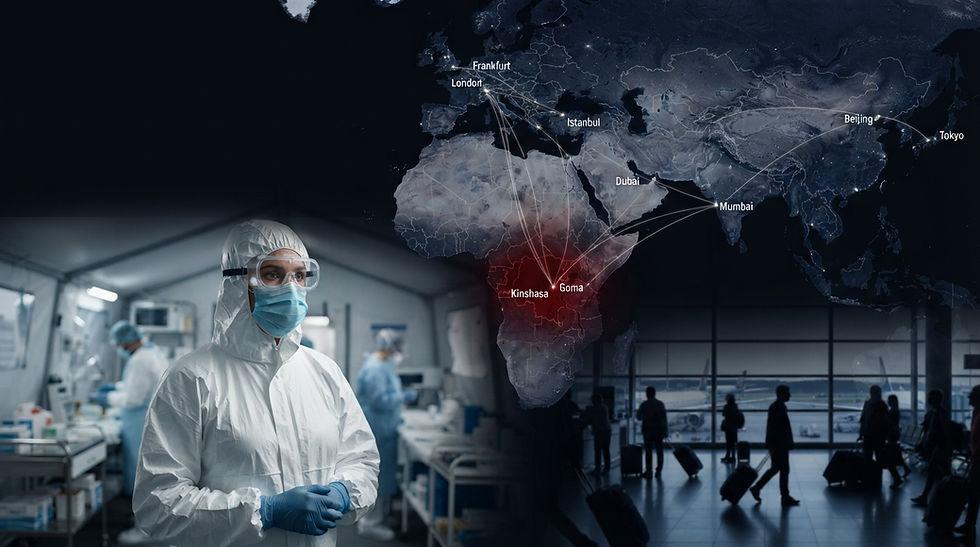
Ebola Returns: Why the 2026 Outbreak Is Raising Global Questions
For many people around the world, the word Ebola immediately brings memories of the devastating West Africa epidemic of 2014–2016.
Images of medical workers in protective suits, emergency treatment centers and closed borders created one of the biggest public health fears of the modern era.
Now, years later, Ebola is again spreading in Africa.
A new outbreak in the Democratic Republic of Congo has renewed concerns about:
how quickly infectious diseases can cross borders;
whether international travel increases risks;
how prepared countries are for new health emergencies;
what travelers, migrants and international workers need to know.
The situation has triggered a familiar question:
Could Ebola reach Europe or other regions of the world?
The answer is more complicated than simple headlines suggest.
What Is Happening in Africa Right Now?
The current Ebola situation is centered in the Democratic Republic of Congo (DRC), a country that has experienced multiple Ebola outbreaks over decades.
The region faces unique challenges:
remote areas with limited healthcare access;
difficult transportation networks;
population movement across borders;
humanitarian and security problems.
Unlike COVID-19, Ebola does not spread through casual everyday contact such as simply sharing air in public spaces.
The virus is mainly transmitted through:
direct contact with infected body fluids;
contact with contaminated materials;
exposure during healthcare or caregiving situations.
This makes Ebola extremely dangerous during outbreaks but much harder to spread globally compared with respiratory viruses.
The Real Question: Can Ebola Reach Europe?
The short answer:
A single imported case is possible. A large European outbreak is considered unlikely.
Modern travel means that viruses can theoretically move between continents within hours.
A person infected in Africa could board an international flight before symptoms become obvious.
However, Ebola has several characteristics that limit worldwide spread:
1. People are usually most infectious when symptoms appear
Unlike some respiratory viruses, Ebola does not typically spread silently through large populations before symptoms develop.
2. Transmission requires close contact
Normal tourist activities — visiting cities, hotels, airports or public spaces — do not represent the same risk as direct contact with an infected person.
3. European health systems are prepared
Many countries have:
isolation procedures;
specialized medical teams;
infection control protocols.
Ebola and Global Mobility: The Bigger Issue
The 2026 outbreak highlights a reality of the modern world:
People move faster than ever before.
Every day:
millions cross international borders;
workers move between countries;
families reunite across continents;
tourists travel thousands of kilometers.
This does not mean migration causes disease outbreaks.
The real challenge is something else:
how governments manage health risks in a highly connected world.
Modern border systems must balance:
freedom of movement;
economic activity;
humanitarian needs;
public health protection.
Which Countries Are Most at Risk?
Risk is not equal everywhere.
The highest concern remains in:
Democratic Republic of Congo
Main outbreak area.
Neighboring countries
Countries sharing borders with affected regions require increased monitoring because of:
trade routes;
family connections;
daily cross-border movement.
International travel hubs
Major airports are usually focused on:
information sharing;
passenger awareness;
medical preparedness.
Could Ebola Become Another COVID?
This is one of the biggest fears online.
But Ebola and COVID are fundamentally different diseases.
Ebola | COVID-19 | |
Main transmission | Body fluids | Respiratory particles |
Spread speed | Slower | Very fast |
Silent transmission | Limited | Significant |
Global pandemic potential | Lower | Higher |
Fatality rate | Much higher | Lower but widespread |
The danger of Ebola is its severity.
The danger of COVID was its ability to spread invisibly.
What Should Travelers Know?
People planning travel to affected regions should:
Before travelling:
check official health recommendations;
understand local conditions;
know emergency contacts.
During travel:
Avoid:
contact with sick individuals;
contact with bodily fluids;
unsafe medical environments.
After returning:
Seek medical advice if symptoms appear and you have recently been in an affected area.
Symptoms may include:
fever;
fatigue;
muscle pain;
weakness;
vomiting;
diarrhea.
What About Migrants and Border Movements?
Migration routes are often discussed during disease outbreaks, but the reality is more complex.
People moving across borders are not automatically a health threat.
The real factors that influence disease spread are:
access to healthcare;
speed of detection;
medical monitoring;
information sharing;
living conditions.
A strong public health system protects both citizens and newcomers.
The Bigger Lesson From Ebola 2026
The Ebola outbreak is a reminder that the world has entered a new era.
Borders still exist.
But viruses do not recognize passports.
The challenge for governments is not stopping movement.
It is building systems capable of identifying risks early while keeping societies open.
The next global health crisis may not look like COVID.
It may not look like Ebola.
But the lesson remains the same:
In a connected world, preparedness is the first line of defense.
Editor’s Note
This article does not predict an Ebola spread to Europe or other regions.
Its purpose is to explain the real risks behind the outbreak and how global mobility changes the way the world responds to infectious diseases.
Fear spreads faster than viruses.
Accurate information is the best protection.


Komentarze