EU Border Reality Check 2026
7 Reasons You Can Be Stopped Even If You Did Nothing Wrong.
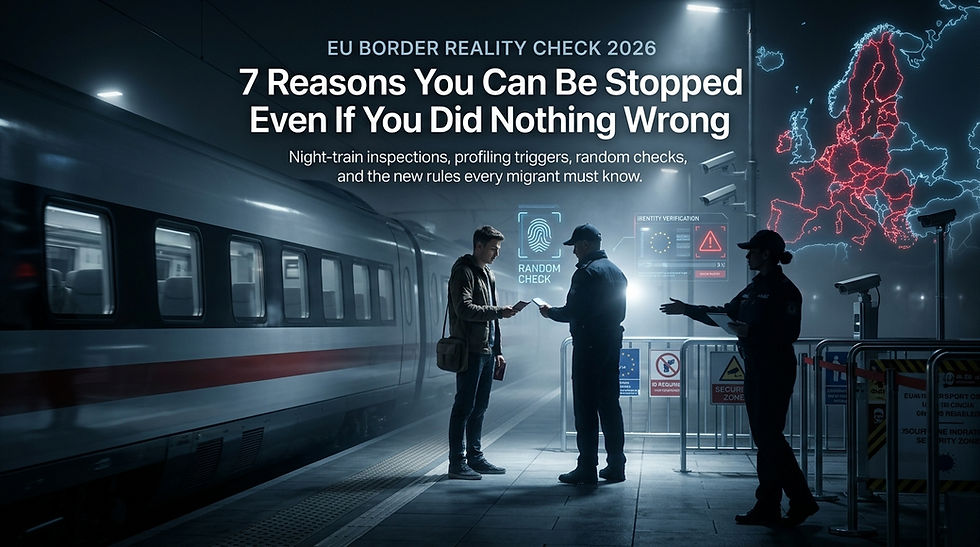
Border checks across Europe have intensified in 2026 — and thousands of travelers are being stopped for reasons that have nothing to do with illegal stay, expired visas, or criminal activity. The new reality is simple: you can be stopped even if your documents are perfect.
This guide explains the 7 triggers that cause border police to stop completely legal travelers — and why this is happening now.
1. Your passport is valid — but “looks suspicious”
Border officers increasingly flag passports that are:
worn or damaged
faded or scratched
have loose pages
have water stains
look “too old”
Even if the passport is fully valid, appearance alone can trigger an identity check.
This is one of the most common reasons for being stopped in Germany, Poland, Czechia, Austria, and France.
2. Your face “doesn’t match” your photo — according to the officer
This is subjective — and that’s exactly why it’s dangerous.
If an officer believes your appearance differs from your passport photo due to:
weight change
hairstyle
beard
aging
makeup
lighting
they can legally stop you for verification.
This is happening daily on cross‑border trains.
3. You are traveling at night
Night trains and buses are the highest‑risk zone in the EU.
Why?
fewer passengers
more officers
more time for checks
more irregular crossings
more smuggling operations
If you travel between 22:00 and 06:00, your chance of being stopped increases dramatically.
4. You are traveling alone
Solo travelers are checked more often because:
they are easier to isolate
they are statistically more likely to be relocating
they are easier to question
they attract attention in empty compartments
Families and groups are checked far less frequently.
5. You have large luggage — even if you’re a tourist
Border police use luggage size as a profiling tool.
Large suitcases = “relocation” Small bags = “tourism”
This is not written in any law — but it is standard practice.
If you carry:
two suitcases
oversized bags
heavy backpacks
you are far more likely to be stopped.
6. You “look like a migrant” — nationality profiling is rising
This is uncomfortable, but it is the reality of 2026.
People who appear to be from regions with high irregular migration rates are checked more often:
Ukrainians
Belarusians
Russians
Georgians
Indians
Pakistanis
Africans
This is not about legality — it’s about risk profiling.
7. Random checks — fully legal, no reason required
The most important point:
Border police do not need a reason to stop you.
Random checks are:
legal
common
unpredictable
increasing across the EU
You can be stopped even if:
your passport is valid
your visa is valid
your residence permit is valid
your travel is legal
your documents are perfect
This is the new Schengen reality.
Why is this happening now?
Three major forces:
1. Internal Schengen border controls are back
Germany, Austria, Poland, Czechia, France — all have reintroduced checks.
2. EU Migration Pact increases screening pressure
More biometric checks, more identity verification, more risk profiling.
3. Irregular migration numbers remain high
This drives political pressure and operational tightening.
How to avoid problems (even if you’re 100% legal)
Always carry your passport
Always carry your residence permit
Ukrainians: always carry PESEL UKR
Keep digital copies of all documents
Avoid night travel if possible
Avoid cross‑border trains without documents
Keep your passport in good physical condition
Travel with smaller luggage when possible
These steps reduce risk — but do not eliminate it.
You Can Be Stopped Even If You Did Nothing Wrong
This is not about guilt. This is not about illegality. This is not about visas.
This is about profiling, timing, appearance, luggage, and random checks.
The EU in 2026 is not the EU of 2016. Border checks are back — and they are here to stay.
FROM THE IMMIGRANTS.LIVE NEWSROOM
Europe in 2026 is not the Europe of open borders, predictable rules, and quiet train rides that many migrants remember. Schengen still exists on paper — but the lived reality has shifted dramatically.
Border checks are back. Profiling is back. Random inspections are back. And the idea that “if you did nothing wrong, you won’t be stopped” is no longer true.
This is not a political slogan. This is not fear‑mongering. This is what thousands of travelers experience every single week — on trains, buses, highways, and even inside cities.
The uncomfortable truth is this:
In today’s Europe, legality does not guarantee invisibility.
You can have a valid passport. You can have a valid residence permit. You can have perfect documents, perfect status, perfect compliance — and still be stopped, questioned, removed from a train, or sent into identity verification.
Why? Because the EU’s security logic has changed.
The system no longer operates on trust. It operates on suspicion. It operates on risk scoring. It operates on profiling — sometimes subtle, sometimes not.
This shift is not temporary. It is not a political mood swing. It is not a reaction to one crisis.
It is a structural transformation of European border policy — driven by migration pressure, geopolitical instability, and the EU Migration Pact’s new enforcement mechanisms.
And migrants feel this transformation first.
At immigrants.live, we believe it is our responsibility to document this reality clearly and honestly — not to scare people, but to prepare them. To give them knowledge instead of rumors. To give them clarity instead of panic. To give them tools instead of fear.
We do not dramatize. We do not sensationalize. We report what is happening — because ignoring it helps no one.
Europe is changing. Borders are changing. Checks are changing. And migrants deserve to know the truth before they step onto a train, cross a border, or hand over their documents.
This is why we publish guides like this. This is why we investigate. This is why we speak plainly. And this is why we will continue.
— Immigrants.live Editorial Team


Komentarze