EU Work Permit Reform 2026: What’s Changing for Foreign Workers and Employers
In 2026, Europe is quietly but decisively rewriting the rules of labour migration. Across the EU, work permit systems are being tightened, digitised, and re‑oriented toward highly skilled workers and “real” employers, while cracking down on abuse and fake jobs.
This is not one single law, but a convergence of reforms: national changes (like Sweden), the EU Migration & Asylum Pact, and new digital systems.
🧭 Big picture: What is the “EU work permit reform 2026”?
Several parallel processes are shaping the new landscape:
National reforms of labour immigration (e.g. Sweden from 1 June 2026)
Implementation of the EU Migration and Asylum Pact, including rules that affect legal labour migration and employer obligations
New EU‑level strategies on migration and visas, focused on “secure borders + talent mobility”
Together, they mean: 👉 stricter entry and stay conditions for low‑skilled work, 👉 more protection and faster paths for highly skilled workers, 👉 more responsibility and risk for employers.
🔑 Core trends in work permit rules for 2026
1) Stricter basic conditions for work permits
Countries are raising the bar for:
salary thresholds (must match real market levels or above)
minimum working hours (no more “fake” part‑time contracts)
employer credibility (tax, social security, real activity)
Some states explicitly target companies that exist only to generate permits.
2) Focus on highly skilled and shortage occupations
Reforms explicitly aim to attract and retain highly qualified workers, while limiting low‑skilled abuse:
priority for shortage occupations and strategic sectors
faster processing or better conditions for highly skilled profiles
more scrutiny for low‑wage sectors with high exploitation risk
3) New offences and sanctions for abuse
Several reforms introduce:
new criminal offences for trading in work permits
higher penalties for illegal employment and exploitation
broader powers to refuse or revoke permits if abuse is suspected
This shifts risk from the migrant alone to employers, intermediaries and “paper companies”.
4) More digitalisation and centralised control
Work and residence procedures are moving online:
mandatory online applications for many permits (e.g. Poland)
integration with EU‑level systems (EES, future ETIAS, databases)
easier cross‑checking of employer history, tax status, and previous cases
Digitalisation makes it harder to “hide” patterns of abuse.
5) Stronger link between work permits and real labour needs
Reforms increasingly tie permits to:
real vacancies and real working conditions
regional or national labour market priorities
lists of protected or sensitive roles (e.g. Poland’s regional lists)
This is a move away from “any job = permit” toward “strategic migration”.
🇸🇪 Sweden as a flagship example (from 1 June 2026)
Sweden’s 2026 reform is one of the clearest illustrations of this new model:
stricter basic conditions for work permits
new offences to combat exploitation and permit trading
higher penalties for illegal employment
improvements for highly skilled workers (easier entry, more stability)
It’s explicitly designed to protect foreign workers and clean up the system, not to close the door completely.
👤 What this means for migrants
If you are a highly skilled worker
You may actually benefit:
more targeted schemes and “talent” pathways
potentially faster or more predictable processing
better protection against abusive employers
But: you’ll need strong documentation of skills, salary and role.
If you are a low‑skilled or vulnerable worker
You face more risk:
stricter checks on your employer and contract
higher chance of refusal if salary or hours look unrealistic
more inspections in sectors known for exploitation
Choosing a serious employer becomes critical.
🏢 What this means for employers
Employers are moving into the spotlight:
more obligations to prove real activity, tax compliance, and genuine need
higher penalties for fake contracts, underpayment, or “permit factories”
more audits and cross‑checks across systems
For serious companies, this can level the playing field. For “shell” employers, 2026 will be a very bad year.
🌍 EU strategy: “secure borders + talent mobility”
The European Commission’s 2026 migration strategy explicitly combines:
tougher action against irregular migration and abuse, and
encouraging legal pathways and talent mobility for economies that need workers.
So the message is not “no migrants”, but “fewer loopholes, more skills, more control”.
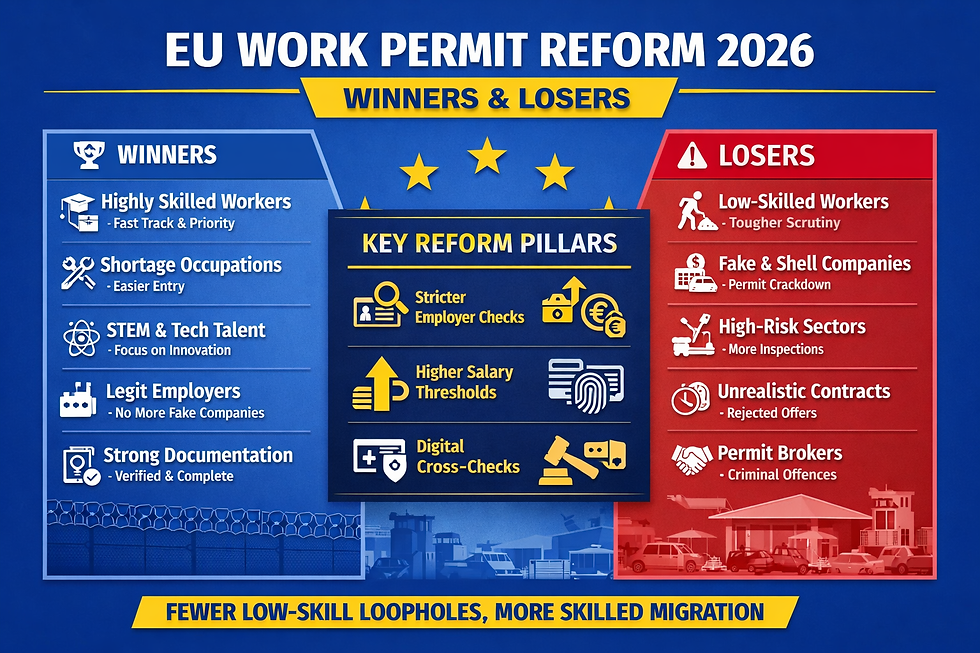
EU Work Permit Reform 2026 — Winners & Losers
(Infographic Content Blueprint — ready for generation)
🟦 Winners (Beneficiaries of the Reform)
Highly Skilled Workers — faster pathways, clearer rules, priority processing
Shortage Occupation Applicants — easier entry where labour gaps are critical
STEM & Tech Talent — EU actively competing for global specialists
Legitimate Employers — crackdown on fake companies levels the playing field
Workers with Strong Documentation — clean contracts, real salaries, verified skills
🟥 Losers (Groups Facing Stricter Rules)
Low‑Skilled Workers — more scrutiny, higher refusal rates
Fake or Shell Employers — new penalties, permit revocations
Sectors with High Exploitation Risk — construction, cleaning, hospitality under tighter checks
Applicants With Unrealistic Salaries/Hours — flagged by digital systems
Intermediaries Selling Permits — now criminalized in several countries
🧭 Core Reform Pillars (Center Section)
Stricter employer verification
Higher salary thresholds
Digital cross‑checking (EES, national systems)
New offences & penalties for abuse
Priority for skilled migration
🎨 Visual Style (for the generated infographic)
EU‑blue background (#003399)
Yellow accents (#FFCC00)
Line‑icons (your preferred style)
Split layout: Left = Winners, Right = Losers, Center = Reform Pillars
Clean, modern, policy‑analysis look
❓ SEO FAQ — EU Work Permit Reform 2026
1. What is the EU work permit reform 2026? It’s a combination of national reforms, the EU Migration & Asylum Pact, and new digital systems that tighten rules for labour migration while favouring highly skilled workers.
2. Who will find it easier to get a work permit in 2026? Highly skilled workers, people in shortage occupations, and those hired by credible, compliant employers.
3. Who will find it harder? Low‑paid workers in high‑risk sectors, applicants with unrealistic contracts, and those linked to “paper companies”.
4. How are employers affected? They face stricter checks, higher penalties for abuse, and more responsibility to prove genuine jobs and fair conditions.
5. Is Europe closing the door to migrants? No — the goal is to reduce abuse and irregularity, while keeping and even expanding legal, skills‑based migration.
⚠️ Neutral Legal & Political Disclaimer
This article is for informational and analytical purposes only. It does not support, endorse, or oppose any government, policy, or political position. Readers should always verify details through official EU and national sources.


Komentarze