Global Immigration Opportunity Index 2026
Where Is It Actually Easiest to Build a New Life?
The World's First Practical Ranking of Immigration Opportunities
By Immigrants.live Research
Introduction
Every year, millions of people search for the "best country to immigrate to."
Unfortunately, most rankings answer the wrong question.
Some rank the strongest passports.
Others rank the happiest countries.
Some compare quality of life.
But immigrants rarely ask:
"Which country has the highest quality of life?"
Instead, they ask something much more practical:
Can I actually qualify?
Can I get a residence permit?
How much money do I need?
Can I bring my family?
How long until permanent residence?
Can I eventually become a citizen?
What happens if I lose my job?
Those are the questions that determine whether immigration succeeds—or fails.
That is why we created the Global Immigration Opportunity Index 2026 (GIOI 2026).
Rather than measuring which countries are the richest or happiest, this index evaluates which destinations offer the most realistic pathways for ordinary immigrants to legally build a long-term future.
The result is a practical ranking based on immigration accessibility, long-term stability, and opportunity—not marketing slogans.
Why This Index Matters
Global migration is changing rapidly.
Across Europe, North America, Asia, and Oceania, governments are simultaneously:
tightening border controls,
addressing labour shortages,
redesigning skilled worker systems,
expanding digital nomad programs,
restricting asylum pathways,
creating new regional migration routes.
This has created an unusual reality:
Some countries are becoming significantly harder to enter, while others are quietly opening new legal pathways for workers, entrepreneurs, students, and families.
Understanding these shifts requires more than following headlines. It requires comparing policies across countries using a consistent framework.
Our Philosophy
This is not a ranking of "the best countries."
Instead, it measures one thing:
Where does an ordinary immigrant have the greatest realistic opportunity to legally build a permanent future?
A country with higher salaries may rank lower if immigration is nearly impossible.
Conversely, a country with moderate wages may rank higher if it offers clear, affordable, and predictable pathways to permanent residence.
Methodology
The Global Immigration Opportunity Index evaluates each country across 10 categories, each scored from 0 to 10, for a maximum total of 100 points.
Category | Weight |
Accessibility of immigration programs | 15 |
Speed of obtaining legal residence | 10 |
Pathway to permanent residence | 15 |
Pathway to citizenship | 10 |
Cost of immigration | 10 |
Labour market demand | 10 |
Family reunification | 10 |
Government transparency | 5 |
Long-term policy stability | 10 |
Flexibility of immigration routes | 5 |
Final Score = 100 points.
Countries Included
The inaugural 2026 edition evaluates 30 major immigration destinations, including:
Canada
Australia
New Zealand
Germany
Portugal
Spain
Ireland
Netherlands
France
Sweden
Norway
Denmark
Finland
Poland
Czech Republic
Austria
Switzerland
United Kingdom
United States
Japan
South Korea
Singapore
United Arab Emirates
Estonia
Latvia
Lithuania
Croatia
Italy
Greece
Malta
Data Sources
The Index combines publicly available information from:
OECD migration statistics
IOM (International Organization for Migration)
National immigration authorities
Government immigration legislation
Skilled worker program requirements
Residence permit regulations
Official visa processing policies
Permanent residence regulations
Citizenship legislation
Labour shortage occupation lists
No commercial sponsorships or paid partnerships influence the rankings. OECD and IOM remain the leading international references for migration statistics and policy trends.
How to Read the Rankings
Scores should not be interpreted as a guarantee of visa approval.
Instead, they compare the relative openness and practicality of each immigration system.
A score of 90 does not mean immigration is easy.
It means that, compared with other countries, the legal pathway is clearer, more predictable, and more attainable.
Four Core Principles
The Index evaluates immigration systems according to four principles:
Opportunity
Can a skilled individual realistically qualify?
Affordability
Can an average family afford the process?
Permanence
Does temporary residence lead to permanent residence?
Predictability
Can applicants understand the rules without hiring expensive lawyers?
Immigration systems evolve continuously. Governments adjust quotas, occupation lists, income thresholds, and residence requirements in response to labour market needs, demographics, and political priorities. OECD analyses show that migration policies across advanced economies have become increasingly dynamic, with many countries balancing tighter border controls against continued demand for skilled workers.
For that reason, the Global Immigration Opportunity Index is designed as an annual research publication, with methodology and scores reviewed and updated each year to reflect major legislative and policy changes.
TOP 30 COUNTRIES FOR IMMIGRATION IN 2026
Immigrants.live Research
The global immigration landscape has entered a new era.
For the first time in decades, many of the world's most popular destinations are moving in opposite directions.
Some governments are reducing immigration targets, tightening student and family migration, and increasing requirements for workers.
Others are quietly opening new pathways to address aging populations, labor shortages, and regional development needs.
The result is a migration map that looks very different from just a few years ago.
Our research shows that the "best country" is no longer necessarily the country with the highest salaries.
Instead, the leaders are those offering the best balance of:
realistic eligibility,
transparent immigration rules,
affordable pathways,
predictable processing,
and a genuine route to permanent residence.
Across OECD countries, migration policy has become more selective: skilled workers remain in demand while asylum, student, and some family pathways have tightened in many jurisdictions. At the same time, governments continue to expand targeted labor migration and regional programs to address demographic and workforce shortages.
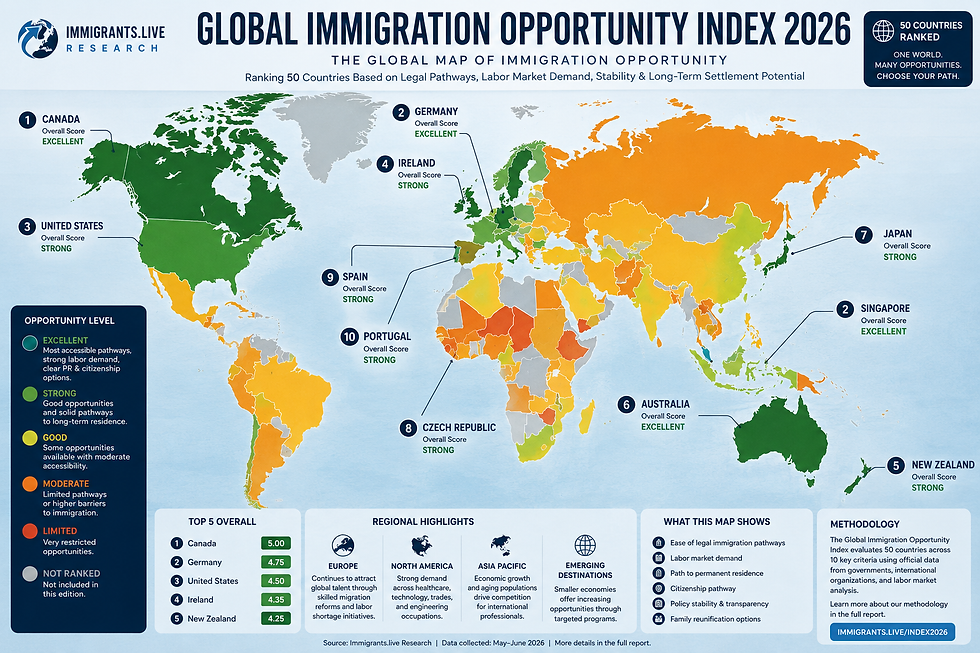
Global Ranking 2026
Rank | Country | Score (/100) | Rating |
1 | Canada | 92 | Exceptional |
2 | Australia | 90 | Exceptional |
3 | Germany | 89 | Exceptional |
4 | New Zealand | 88 | Excellent |
5 | Portugal | 87 | Excellent |
6 | Ireland | 86 | Excellent |
7 | Spain | 84 | Excellent |
8 | Estonia | 83 | Very Strong |
9 | Netherlands | 82 | Very Strong |
10 | Czech Republic | 81 | Very Strong |
11 | Sweden | 80 | Strong |
12 | Finland | 79 | Strong |
13 | Denmark | 78 | Strong |
14 | Poland | 78 | Strong |
15 | United Kingdom | 77 | Strong |
16 | Norway | 76 | Good |
17 | Austria | 75 | Good |
18 | Lithuania | 74 | Good |
19 | Croatia | 73 | Good |
20 | Latvia | 72 | Good |
21 | Italy | 71 | Moderate |
22 | Greece | 70 | Moderate |
23 | Malta | 69 | Moderate |
24 | France | 68 | Moderate |
25 | Singapore | 67 | Selective |
26 | Japan | 66 | Selective |
27 | South Korea | 64 | Selective |
28 | Switzerland | 63 | Highly Selective |
29 | United Arab Emirates | 61 | Temporary Opportunity |
30 | United States | 60 | High Opportunity — High Complexity |
Editorial Note: The scores above are an original analytical model developed by Immigrants.live. They combine publicly available policy information with the methodology described in this report. They are not official government rankings.
Why Canada Remains 1
Overall Score: 92/100
Despite reducing immigration targets compared with previous plans, Canada continues to offer one of the world's most structured immigration systems.
Strengths include:
✔ Multiple skilled worker pathways
✔ Provincial Nominee Programs
✔ Family sponsorship
✔ Predictable permanent residence
✔ Citizenship pathway
✔ Transparent point system
Weaknesses:
Higher financial requirements
Housing affordability
Longer processing in some streams
Canada is no longer the easiest destination—but it remains one of the most predictable.
Why Germany Climbed into the Top Three
Germany has transformed its immigration system more aggressively than almost any large European economy.
Key drivers include:
Opportunity Card (Chancenkarte)
Expanded Skilled Immigration Act
Faster recognition of qualifications
Major labor shortages
Regional demand
The country's bureaucracy remains challenging, but legal pathways are significantly broader than they were five years ago. OECD data also shows many countries are increasingly tailoring labor migration to shortage occupations while streamlining recruitment for needed skills.
Portugal Falls Slightly
Portugal remains attractive because of:
relatively accessible residence options,
family reunification,
long-term settlement opportunities,
quality of life.
However,
immigration demand has exploded,
processing times have increased,
several residence programs have changed.
Portugal is still among Europe's strongest opportunities—but no longer the hidden gem it once was.
Why Estonia Is This Year's Surprise
Estonia continues to outperform expectations.
Reasons include:
digital government,
startup ecosystem,
highly efficient administration,
transparent online services,
growing demand for international talent.
Few countries process immigration-related services as efficiently.
Why the United States Ranks Only 30
This may surprise many readers.
The United States remains one of the world's strongest economies and offers exceptional career opportunities.
However, our Index measures immigration opportunity, not economic power.
The U.S. system remains constrained by:
visa caps,
long employment-based waiting times,
country quotas,
high legal complexity,
expensive processes,
fragmented pathways.
For highly qualified professionals, founders, and investors, the U.S. remains an outstanding destination. For the average immigrant seeking a predictable route to permanent residence, many peer countries now provide clearer and more accessible pathways.
The Biggest Winners of 2026
⬆ Germany
⬆ Estonia
⬆ Czech Republic
⬆ Spain
⬆ Ireland
These countries expanded or improved practical immigration opportunities for skilled workers and addressed labor shortages with targeted reforms.
Countries Becoming More Difficult
⬇ Canada (higher selectivity despite remaining 1)
⬇ United Kingdom
⬇ Netherlands
⬇ Australia
These destinations remain among the world's best, but applicants increasingly face tighter eligibility rules, caps, or policy adjustments as governments seek to better align migration with labor market needs.
Key Takeaways
Our research identifies five global trends shaping immigration in 2026:
Skills over volume: Countries are favoring targeted recruitment in shortage occupations rather than broad increases in migration.
Permanent residence matters: Clear pathways to long-term status increasingly distinguish the strongest destinations.
Digital systems improve access: Faster, more transparent online processes are becoming a competitive advantage.
Policy stability attracts talent: Predictable rules reduce uncertainty for migrants and employers alike.
Opportunity is diversifying: Mid-sized European economies are becoming increasingly competitive alternatives to traditional destinations.
Decision Matrix
Which Country Is Right for You?
Choosing a destination is not about finding the "best" country. It's about finding the country that best matches your goals, qualifications, financial situation, and long-term plans.
This decision matrix summarizes which destinations stand out for different types of immigrants based on official immigration pathways, labor market demand, and settlement opportunities.
🏆 Best Overall for Skilled Professionals
Country | Why It Stands Out |
🇨🇦 Canada | Multiple PR pathways, transparent selection, strong worker protections |
🇩🇪 Germany | Large labor shortages, expanded skilled migration rules, strong economy |
🇦🇺 Australia | High salaries, structured skilled migration, excellent quality of life |
🇮🇪 Ireland | Rapidly growing economy, English-speaking labor market |
🇳🇿 New Zealand | Clear long-term settlement options and high quality of life |
💻 Best for IT Professionals
Country | Highlights |
Germany | Europe's largest tech labor shortage |
Estonia | Digital-first government and startup ecosystem |
Canada | Continuous demand across provinces |
Ireland | European headquarters of many global technology companies |
Netherlands | Strong international tech market |
🩺 Best for Healthcare Workers
Country | Opportunity |
Canada | Persistent shortages across multiple provinces |
Germany | Aging population driving long-term demand |
Australia | High demand in urban and regional areas |
Ireland | Active recruitment of international healthcare professionals |
New Zealand | Ongoing workforce shortages |
👷 Best for Skilled Trades
Canada
Germany
Australia
Czech Republic
Poland
Construction, manufacturing, logistics, electrical work, welding, plumbing, and heavy equipment operation remain among the occupations most frequently identified as facing shortages in many developed economies.
🚀 Best for Entrepreneurs
Country | Why |
Estonia | Digital business infrastructure |
Canada | Startup Visa Program |
Portugal | Startup ecosystem and international founders |
Ireland | Access to EU market |
Singapore | Business-friendly regulatory environment |
🌍 Best Digital Nomad Destinations
Country | Strength |
Portugal | Lifestyle and international community |
Spain | Long-term Digital Nomad framework |
Estonia | Pioneer in digital residency initiatives |
Croatia | Competitive cost of living |
Greece | Attractive climate and growing remote-work ecosystem |
👨👩👧 Best for Families
Countries that combine education, healthcare, family sponsorship options, and long-term residence pathways:
Canada
Australia
Germany
New Zealand
Finland
💰 Most Affordable Immigration Destinations
Countries where application costs and settlement expenses are generally lower than in many other high-income destinations:
Poland
Czech Republic
Portugal
Croatia
Latvia
Affordability varies significantly by region and city, particularly housing costs.
⚡ Fastest Routes to Residence
Countries known for comparatively efficient or streamlined legal pathways in selected programs:
Estonia
Germany (selected skilled-worker routes)
Ireland
Canada (certain provincial streams)
Portugal (program-dependent)
Processing times depend on the specific immigration program and individual circumstances.
🏡 Best Path to Permanent Residence
Countries offering clear, well-defined progression from temporary status to permanent residence:
Country | Assessment |
Canada | Excellent |
Australia | Excellent |
New Zealand | Excellent |
Germany | Strong |
Portugal | Strong |
🛂 Best Path to Citizenship
Countries where the legal route from residence to citizenship is relatively clear and established:
Canada
Australia
New Zealand
Portugal
Germany (subject to meeting legal requirements)
Applicants must satisfy residency, language, integration, and other statutory conditions.
Countries Becoming More Competitive
Several destinations remain attractive but have introduced tighter selection criteria, reduced quotas, or higher financial thresholds in recent years:
United Kingdom
Netherlands
Australia
Canada
Portugal
This does not necessarily make these countries less desirable; rather, successful applicants increasingly need stronger qualifications and better preparation.
Emerging Immigration Destinations
Beyond the traditional choices, several countries are gaining attention because of targeted labor shortages, digital administration, or expanding legal pathways:
Estonia
Czech Republic
Croatia
Lithuania
Latvia
These countries may not yet receive the same level of international attention as Canada or Australia, but they can offer practical opportunities for specific professions and industries.
Final Thought
There is no universally "best" country for immigration.
A software engineer, a nurse, a construction worker, a student, and an entrepreneur may each find that a different destination offers the strongest combination of opportunity, affordability, and long-term stability.
The purpose of the Global Immigration Opportunity Index is not to declare a single winner, but to help prospective migrants compare systems using transparent criteria and make more informed decisions based on their own goals.
The Great Immigration Shift

Why 2026 Marks the Beginning of a New Global Competition for Talent
For decades, global immigration followed a relatively simple pattern.
People moved from lower-income countries to higher-income economies in search of better wages, greater stability, and improved opportunities.
Governments largely viewed immigration through two separate lenses.
One focused on humanitarian protection.
The other addressed labor shortages.
In 2026, those two systems are no longer evolving together.
Instead, immigration policy has entered a period of strategic realignment.
Many governments are simultaneously tightening border enforcement while expanding carefully targeted legal pathways for workers with skills that support long-term economic growth.
This is not a contradiction.
It reflects a broader shift in public policy.
Countries increasingly distinguish between uncontrolled migration and managed economic immigration, treating them as separate issues with different objectives. OECD analyses show that many advanced economies have strengthened labor migration tools while also adopting stricter measures in other parts of their immigration systems.
The Demographic Challenge
Population aging has become one of the defining economic issues of the decade.
Across Europe, East Asia, and parts of North America, fertility rates remain below replacement levels while life expectancy continues to increase.
The result is a shrinking share of working-age people supporting a growing retired population.
Without additional workers, many countries face increasing pressure on healthcare systems, pension financing, and overall economic productivity.
Immigration has therefore become part of a broader demographic strategy rather than simply a border policy. OECD demographic and migration analyses consistently identify aging populations and labor shortages as key drivers of modern immigration policy.
Labor Shortages Are No Longer Temporary
Five years ago, many labor shortages were viewed as short-term disruptions.
Today, they are increasingly structural.
Demand extends far beyond software engineers and highly paid specialists.
Countries are actively seeking:
nurses,
doctors,
electricians,
welders,
truck drivers,
teachers,
construction workers,
care workers,
manufacturing technicians.
In many developed economies, these occupations underpin essential services and infrastructure.
As a result, immigration systems are being redesigned to attract workers who can fill long-term shortages rather than temporary gaps.
The End of One-Size-Fits-All Immigration
One of the most significant changes of the past decade is the diversification of legal pathways.
Traditional skilled worker visas remain important, but governments increasingly offer specialized programs designed for different groups.
Examples include:
regional migration initiatives,
digital nomad visas,
startup visas,
graduate retention schemes,
employer-sponsored routes,
occupation-specific fast-track programs.
Rather than competing with one another, these pathways create multiple entry points into the same immigration system.
For many applicants, success now depends less on finding the "best country" and more on identifying the program that best matches their profile.
Why Traditional Rankings Miss the Point
Many popular rankings focus on indicators such as GDP, passport strength, happiness, or quality of life.
While these metrics are valuable, they answer a different question.
A country can rank highly for quality of life while remaining extremely difficult to immigrate to.
Likewise, a country with moderate average incomes may provide a clearer, more affordable, and more realistic route to permanent residence.
That distinction forms the foundation of this report.
The Global Immigration Opportunity Index measures accessibility, predictability, and long-term opportunity, not national wealth or international prestige.
The Rise of Immigration Competition
For much of the twentieth century, governments primarily competed for investment.
Today, they are increasingly competing for people.
Engineers, healthcare professionals, entrepreneurs, researchers, skilled tradespeople, and international graduates are becoming strategic economic assets.
Countries that create transparent, efficient, and predictable immigration systems are better positioned to attract this global talent.
This emerging competition is likely to shape immigration policy throughout the remainder of the decade.
The central finding of this research is straightforward:
The future of immigration will not be determined by which countries accept the largest number of newcomers. It will be determined by which countries build the clearest, fairest, and most predictable legal pathways for the people they need.
That shift—from maximizing immigration to optimizing it—is the defining story of global migration in 2026.
Our Methodology

How the Global Immigration Opportunity Index Was Built
"A ranking is only as trustworthy as the methodology behind it."
Why We Created Our Own Framework
One of the first challenges we encountered while developing this report was surprisingly simple:
There is no universally accepted way to measure immigration opportunity.
International organizations publish excellent datasets on migration flows, labor mobility, demographics, and visa policies. Governments provide detailed information about their own immigration programs. Researchers analyze integration outcomes, labor shortages, and demographic trends.
Yet none of these sources answer the practical question that prospective immigrants ask every day:
"Which country gives someone like me the best chance to build a new life?"
That question is inherently multidimensional.
A country may have high salaries but almost no realistic pathway to permanent residence.
Another may offer a clear legal route to settlement but limited job opportunities.
A third may process visas quickly while imposing significant barriers to family reunification or citizenship.
The Global Immigration Opportunity Index was designed to bridge this gap. Instead of focusing on a single indicator, it evaluates immigration systems through the combined lens of accessibility, opportunity, predictability, and long-term settlement potential.
This is not a measure of national wealth, political influence, or quality of life. It is an assessment of how practical, transparent, and sustainable a country's legal immigration framework is for prospective migrants.
Our Research Principles
The Index is built on five guiding principles.
1. Opportunity Over Popularity
Some of the world's most desired destinations are also among the most difficult to immigrate to.
Popularity does not equal accessibility.
Our methodology therefore prioritizes realistic legal pathways over public perception or brand reputation.
2. Long-Term Outcomes Matter More Than Initial Entry
Receiving a temporary visa is only the first step in the immigration journey.
The more important questions are:
Can applicants renew their status?
Is there a defined route to permanent residence?
Can family members join?
Can newcomers eventually qualify for citizenship?
Countries offering stable long-term pathways receive stronger assessments than those relying primarily on temporary migration.
3. Transparency Is an Immigration Advantage
A transparent immigration system reduces uncertainty.
When eligibility criteria are publicly available, processing procedures are documented, and applicants can reasonably understand the process without relying entirely on legal representation, the overall immigration experience becomes more predictable.
Transparency is therefore treated as a measurable strength rather than a secondary administrative feature.
4. Multiple Pathways Increase Opportunity
Immigration systems that rely on a single route are inherently less resilient.
Countries offering several independent pathways—such as skilled worker, regional, entrepreneur, family, graduate, or employer-sponsored programs—provide greater flexibility for applicants with different backgrounds.
Diversification is therefore considered a major indicator of opportunity.
5. Policy Stability Builds Confidence
Immigration decisions often involve life-changing financial and personal commitments.
Applicants need confidence that the legal framework they apply under today will remain broadly consistent during the years required to obtain permanent residence.
Frequent policy reversals, abrupt suspensions, or unpredictable administrative changes reduce long-term certainty, even where immigration pathways remain legally available.
Evaluation Framework
Each country is assessed across ten dimensions that reflect different stages of the immigration journey.
1. Accessibility of Legal Immigration Pathways
We examine whether ordinary applicants can realistically qualify for available programs.
This includes factors such as:
diversity of visa categories,
qualification requirements,
language expectations,
employer sponsorship,
regional alternatives,
points-based systems.
Countries providing multiple accessible entry routes perform better than those relying on highly restrictive pathways.
2. Pathway to Permanent Residence
Temporary migration alone does not guarantee long-term stability.
This category evaluates whether residence permits can realistically lead to permanent status through clearly defined legal mechanisms.
3. Citizenship Pathway
Obtaining permanent residence is often not the final objective.
We therefore consider:
legal residence requirements,
language expectations,
integration conditions,
predictability of the naturalization process.
The Index does not reward countries for having the shortest timelines alone; it values clarity and consistency as well.
4. Labor Market Opportunity
Immigration succeeds only if newcomers can build sustainable careers.
Our assessment considers:
labor shortages,
demand across multiple sectors,
unemployment trends,
recruitment of international workers,
structural workforce needs.
Countries experiencing persistent demand for foreign professionals generally provide stronger long-term prospects.
5. Cost of Immigration
Financial barriers can significantly affect accessibility.
Rather than focusing solely on visa application fees, this category considers the broader cost of establishing legal residence, including typical administrative expenses and the practical financial requirements that applicants commonly encounter during the immigration process.
6. Family Reunification
Successful immigration is rarely an individual project.
The Index evaluates how clearly spouses, partners, dependent children, and, where applicable, other close family members may obtain legal status through family-based pathways.
7. Government Transparency
Applicants benefit when official guidance is publicly available, procedures are clearly explained, and immigration authorities provide accessible information.
Transparent systems reduce uncertainty and improve decision-making.
8. Policy Stability
We assess whether immigration frameworks demonstrate continuity over time or are subject to frequent, substantial changes that may affect long-term planning.
This criterion reflects institutional predictability rather than political ideology.
9. Diversity of Immigration Programs
Countries offering a wider range of lawful pathways—including skilled migration, business, study-to-work transitions, family sponsorship, and regional initiatives—provide more opportunities for applicants with different qualifications and circumstances.
10. Long-Term Integration Potential
Immigration is not only about crossing a border.
It is about establishing a sustainable life.
This criterion considers whether the legal framework supports long-term settlement through stable residence rights, integration mechanisms, and opportunities for social and economic participation.
Data Sources
The Global Immigration Opportunity Index is based on publicly available information from:
national immigration legislation and official government guidance;
labor market and demographic reports from international organizations;
immigration program rules published by competent authorities;
official visa and residence permit frameworks;
publicly available policy documents, strategic plans, and legislative updates.
Wherever possible, the analysis relies on primary government sources, supplemented by internationally recognized organizations such as the OECD and IOM for comparative context.
Important Limitations
No global ranking can fully capture every individual's circumstances.
Immigration outcomes depend on many personal factors, including education, work experience, language proficiency, family situation, health, financial resources, and occupation.
Accordingly, the Global Immigration Opportunity Index should be understood as a comparative analytical framework rather than a prediction of any individual's likelihood of visa approval.
The Index compares immigration systems—not applicants.
Editorial Independence
The Global Immigration Opportunity Index is an independent research initiative developed by Immigrants.live.
No government, law firm, immigration consultancy, employer, or commercial organization has influenced the methodology, country assessments, or editorial conclusions presented in this report.
Our objective is to provide prospective migrants with a transparent, practical, and evidence-informed comparison of legal immigration opportunities across major destination countries.
The Winners and Losers of Global Immigration in 2026

A New Global Map of Opportunity
For much of the last decade, the conversation around immigration focused on a single question:
Which countries are accepting more immigrants?
In 2026, that question is no longer sufficient.
The countries attracting the strongest international talent are not necessarily those admitting the largest numbers of newcomers. Increasingly, they are the countries offering the clearest, most predictable, and most strategically designed legal pathways.
This year's analysis reveals a world in transition.
Some governments are investing in immigration as an economic strategy.
Others are becoming significantly more selective.
Many are attempting to do both at the same time.
The result is a rapidly changing global map of opportunity.
🟢 The Biggest Winners
🇩🇪 Germany
From Bureaucratic Giant to Global Talent Competitor
For years, Germany's immigration system was known for complexity.
Strong economy.
High salaries.
But difficult procedures.
That image is changing.
Driven by an aging population, persistent labor shortages, and pressure from employers, Germany has introduced reforms designed to attract more international workers through expanded skilled migration pathways, faster recognition of foreign qualifications, and new options such as the Opportunity Card.
Germany has not simplified every aspect of immigration.
But it has fundamentally changed its direction.
For skilled professionals, it is now one of Europe's most ambitious destinations.
Key Strengths
✔ Massive labor demand
✔ Large economy
✔ Clearer skilled worker rules
✔ Long-term settlement opportunities
🇪🇪 Estonia
Small Country. Big Innovation.
No country in this report punches above its weight more than Estonia.
With a population of just over one million, Estonia cannot compete through size.
Instead, it competes through efficiency.
Digital government.
Fast online services.
Startup-friendly regulation.
Transparent administration.
While other countries continue relying on paper-based bureaucracy, Estonia has built much of its public administration around digital infrastructure.
For entrepreneurs, remote professionals, and technology specialists, that difference is significant.
🇨🇿 Czech Republic
Europe's Quiet Success Story
The Czech Republic rarely appears in international immigration rankings.
Yet employers continue to face shortages across manufacturing, engineering, logistics, and healthcare.
Combined with comparatively moderate living costs and central European location, the country has become increasingly attractive for skilled workers looking beyond the traditional destinations of Germany or the United Kingdom.
Its greatest advantage may be that it remains underestimated.
🇮🇪 Ireland
Europe’s English-Speaking Growth Engine
Ireland continues to benefit from its role as a European hub for technology, finance, pharmaceuticals, and international business.
For skilled professionals seeking an English-speaking environment within the European Union, Ireland occupies a unique position.
Demand remains particularly strong in software engineering, cybersecurity, life sciences, healthcare, and advanced manufacturing.
Competition for housing remains a challenge, but employment opportunities continue to make Ireland one of Europe's strongest destinations for highly qualified migrants.
🟡 Stable Leaders
Some countries continue to perform exceptionally well despite becoming more selective.
Their rankings remain strong because they combine mature immigration systems with clear long-term settlement pathways.
These include:
🇨🇦 Canada
🇦🇺 Australia
🇳🇿 New Zealand
🇪🇸 Spain
🇵🇹 Portugal
These countries continue to attract large numbers of applicants, but increasing demand means that successful immigration now requires stronger preparation, competitive qualifications, and careful program selection.
🔴 Countries Becoming More Selective
The findings of this report should not be interpreted as evidence that these countries are "closing."
Rather, they are refining who they admit and under what conditions.
🇬🇧 United Kingdom
Following major policy reforms over recent years, the UK has placed greater emphasis on higher salary thresholds, employer sponsorship, and tighter eligibility requirements across several immigration routes.
For highly skilled professionals, opportunities remain substantial.
For lower-skilled migration, options have become more limited.
🇳🇱 Netherlands
The Netherlands remains one of Europe's strongest economies.
However, rising political pressure surrounding migration, housing shortages, and increasing scrutiny of immigration policy have contributed to a more selective environment.
The country remains attractive, but applicants should expect higher competition and evolving requirements.
🇺🇸 United States
Opportunity Has Never Been the Problem
Complexity Has.
The United States remains the world's largest destination for many categories of international migrants.
It offers unmatched opportunities in innovation, higher education, entrepreneurship, and high-income careers.
Yet the immigration system is characterized by overlapping visa categories, annual numerical limits, country-specific backlogs, and significant procedural complexity.
For some applicants, particularly those sponsored by employers or immediate family members, the system works well.
For others, obtaining permanent status can involve years—or even decades—of waiting, depending on the immigration category and country of origin.
The challenge is not a lack of opportunity.
It is navigating one of the world's most intricate immigration systems.
🌍 The Rise of Regional Immigration
One of the most important developments identified in this report is the growing importance of regional migration programs.
Instead of directing newcomers exclusively to major metropolitan areas, governments are increasingly encouraging settlement in regions experiencing population decline or labor shortages.
Examples include:
provincial pathways in Canada;
regional skilled migration in Australia;
targeted labor initiatives in Germany;
regional employment programs in parts of Europe.
For many applicants, these pathways now represent a more realistic route to long-term residence than highly competitive national programs.
Five Defining Trends of 2026
1. Skills Are Becoming More Valuable Than Nationality
Countries are increasingly selecting migrants based on labor market needs rather than broad geographic preferences.
2. Permanent Residence Is the New Competitive Advantage
Temporary visas are common.
Clear and achievable pathways to permanent settlement are far less so.
3. Digital Government Is Reshaping Immigration
Countries investing in digital application systems and transparent online services are reducing administrative barriers and improving the applicant experience.
4. Medium-Sized Countries Are Becoming Stronger Competitors
Estonia, the Czech Republic, Croatia, Lithuania, and others are increasingly attracting international talent by combining targeted immigration policies with growing economic opportunities.
5. Immigration Is Becoming an Economic Strategy
Across many developed economies, immigration policy is no longer viewed solely through the lens of border management.
It is increasingly integrated into long-term strategies addressing workforce shortages, demographic change, innovation, and economic resilience.
Analysis
The most significant finding of the Global Immigration Opportunity Index 2026 is not that one country ranks above another.
It is that the nature of global immigration is changing.
The era in which a handful of traditional destinations dominated every conversation is giving way to a far more diverse landscape.
Today, success depends less on choosing the world's most famous immigration destination and more on choosing the country whose legal pathways, labor market, and long-term settlement options best match an individual's skills and goals.
For prospective migrants, that shift creates more choice—but also makes informed decision-making more important than ever.
The 10 Biggest Immigration Opportunities Most People Still

Don't Know About
Hidden Pathways That Could Define Your Future
Every year, millions of people compete for the same immigration programs.
The same visas.
The same destinations.
The same application streams.
As competition increases, many applicants overlook a simple reality:
The best opportunity is often not the most popular one.
Across Europe, North America, and Oceania, governments are quietly expanding targeted pathways to address labor shortages, demographic decline, and regional economic development.
Some receive little international attention.
Others are overshadowed by larger immigration systems.
Yet together, they represent some of the most practical routes available to skilled professionals, graduates, entrepreneurs, and families.
Below are ten of the most significant opportunities shaping legal migration in 2026.
1. Germany's Opportunity Card
A New Way to Enter Without a Job Offer
For decades, Germany generally expected many skilled migrants to secure employment before relocating.
The Opportunity Card changed that dynamic.
Eligible applicants can enter Germany to search for work if they meet requirements related to qualifications, language ability, professional experience, or other criteria defined by the points-based framework.
Why it matters:
✔ Access before securing full-time employment
✔ One of Europe's largest labor markets
✔ Persistent shortages across multiple sectors
✔ Potential pathway toward long-term residence
Who benefits most
Engineers
IT professionals
Healthcare workers
Skilled trades
Technical specialists
2. Canada's Provincial Nominee Programs
Canada's Hidden Immigration Engine
When people think about Canada, they usually think about Express Entry.
Yet every year, thousands of immigrants obtain permanent residence through provincial programs designed to meet local labor needs.
Many streams have selection criteria that differ from federal programs and may better match applicants with specific occupations or regional ties.
Why it matters:
✔ Hundreds of occupation-specific pathways
✔ Strong regional demand
✔ Clear long-term settlement options
3. Spain's Digital Nomad Visa
Remote work has fundamentally changed international mobility.
Spain's Digital Nomad framework allows eligible remote professionals working for foreign employers or clients to live in one of Europe's most attractive destinations while continuing international employment.
For many applicants, it also creates opportunities to establish longer-term residence if they continue to meet legal requirements.
4. Ireland's Critical Skills Employment Permit
Ireland has become one of Europe's strongest destinations for highly qualified professionals.
The Critical Skills Employment Permit targets occupations facing significant shortages and is designed to help employers recruit internationally where local supply is insufficient.
Demand remains especially strong in:
Information technology
Engineering
Healthcare
Pharmaceuticals
Financial services
For many eligible workers, it provides a structured route toward longer-term residence.
5. Estonia's Digital-First Immigration System
Estonia has demonstrated that immigration can be modern, efficient, and transparent.
Rather than relying heavily on paper-based administration, many government services are delivered digitally, making processes more predictable for applicants.
For startup founders, technology professionals, and remote workers, administrative simplicity can be a meaningful advantage.
6. Australia's Regional Migration Programs
Australia's largest cities remain popular.
But some of the country's strongest immigration opportunities now exist outside Sydney and Melbourne.
Regional programs are designed to support economic growth in areas experiencing workforce shortages and population challenges.
Applicants willing to settle in eligible regional locations may find additional pathways and incentives compared with standard metropolitan routes.
7. Portugal's Skilled Worker Opportunities
Portugal has become one of Europe's most internationally recognized immigration destinations.
While several residence programs have evolved in recent years, demand for skilled workers continues across sectors including technology, tourism, healthcare, engineering, and renewable energy.
Combined with a high quality of life and established international communities, Portugal remains attractive for long-term settlement.
8. The Czech Republic's Manufacturing and Engineering Demand
The Czech Republic is often overlooked in global immigration discussions.
However, employers continue to seek qualified workers across manufacturing, engineering, logistics, transportation, and industrial production.
For applicants willing to consider destinations beyond the most competitive markets, the Czech Republic represents a practical alternative with growing opportunities.
9. New Zealand's Green List Pathways
New Zealand has developed targeted immigration routes for occupations considered critical to the country's long-term economic needs.
Professionals working in eligible fields may benefit from clearer residence pathways than those available through general migration channels.
Healthcare, engineering, education, and construction remain among the sectors where demand has been particularly significant.
10. The Rise of Smaller European Economies
One of the clearest findings of this research is that opportunity is becoming more geographically diverse.
Countries such as:
Estonia
Lithuania
Latvia
Croatia
Slovenia
Czech Republic
are increasingly competing for international talent through targeted labor migration policies, digital administration, and specialized recruitment initiatives.
They may not yet receive the same global attention as Canada or Australia.
But for many applicants, they represent realistic, practical, and often less competitive alternatives.
What These Opportunities Have in Common
Although these programs differ considerably, they share several characteristics:
They address clearly identified labor shortages.
They provide lawful, structured immigration pathways.
They aim to support long-term economic development.
They are generally more targeted than broad migration programs.
They reward applicants whose qualifications align with national priorities.
Rather than asking, "Which country is easiest?", prospective migrants may achieve better outcomes by asking, "Which country's needs best match my skills?"
That shift in perspective is increasingly defining successful immigration in 2026.
Editor's Insight
One of the most persistent myths in global migration is that everyone competes for the same opportunities.
In reality, immigration systems are becoming more specialized every year.
The strongest applicants are not always those with the highest salaries or the most prestigious degrees.
They are often those who understand where demand exists, prepare strategically, and choose pathways aligned with their experience and long-term goals.
In that sense, successful immigration is becoming less about luck—and more about informed decision-making.
The Future of Immigration

Five Predictions That Will Shape Global Migration by 2030
Immigration has always evolved alongside economic cycles, demographic change, technological progress, and geopolitical events.
Yet the pace of change has accelerated.
Policies that remained stable for decades are now being revised within a few years.
New visa categories appear almost every year.
Governments are redesigning immigration systems in response to workforce shortages, aging populations, digital transformation, and shifting public expectations.
While no forecast can predict the future with certainty, the evidence reviewed throughout this report points toward five long-term trends that are likely to define the remainder of this decade.
Prediction One
Countries Will Compete for Skills More Than Ever Before
For much of modern history, immigration policy focused primarily on controlling entry.
That emphasis is shifting.
Many developed economies are moving toward systems designed not only to regulate migration, but to attract specific types of talent.
Competition for engineers, nurses, teachers, researchers, skilled tradespeople, artificial intelligence specialists, and advanced manufacturing professionals is expected to intensify.
Countries able to provide transparent legal pathways, efficient administration, and long-term settlement opportunities are likely to strengthen their competitive position.
The competition for talent may become as strategically important as competition for foreign investment.
Prediction Two
Regional Immigration Will Become More Important Than National Immigration
One of the clearest policy shifts is the growing role of regional migration.
Instead of concentrating newcomers in already crowded metropolitan areas, governments are increasingly encouraging settlement in regions facing labor shortages or population decline.
This trend is visible in provincial programs, regional employer initiatives, and occupation-specific recruitment outside major cities.
For many applicants, regional pathways may become the fastest and most practical route to long-term residence.
Prediction Three
Digital Immigration Systems Will Replace Traditional Bureaucracy
Immigration administration is becoming increasingly digital.
Online identity verification, electronic document submission, digital case management, and integrated government platforms are reducing administrative barriers in several countries.
Applicants will increasingly judge immigration systems not only by legal requirements, but also by how efficiently those requirements can be navigated.
Countries investing in digital public services are likely to improve both transparency and the applicant experience.
Prediction Four
Artificial Intelligence Will Become Part of Every Immigration Journey
Artificial intelligence is already reshaping how people prepare for migration.
Applicants use AI to:
compare immigration pathways,
understand eligibility criteria,
prepare documentation,
research occupations,
estimate costs,
organize relocation plans.
Governments are also exploring automated systems to assist with document processing, fraud detection, and administrative workflows.
Human decision-making will remain essential for legal determinations, but AI is likely to become a standard tool supporting applicants and public administration alike.
Prediction Five
Immigration Success Will Depend More on Preparation Than Luck
Perhaps the most important change is cultural rather than legal.
Successful immigration increasingly resembles a long-term project.
Applicants who research pathways carefully, improve language skills, gain relevant work experience, and align their qualifications with labor market needs are likely to enjoy more options than those relying on a single application or a last-minute opportunity.
Preparation is becoming one of the strongest competitive advantages in global migration.
Beyond 2030
By the end of this decade, the countries most successful at attracting international talent are unlikely to be those with the highest salaries alone.
They will be those that combine:
transparent legal systems,
predictable immigration policies,
responsive labor market strategies,
efficient digital services,
and meaningful opportunities for long-term integration.
For migrants, employers, and governments alike, immigration is becoming less about movement across borders and more about building sustainable futures.
A World of More Choices—and More Complexity
The central finding of the Global Immigration Opportunity Index 2026 is not that one country has "won" the global competition for immigrants.
It is that the landscape has become far more diverse than many people realize.
Traditional destinations remain influential, but they are no longer the only realistic options.
Mid-sized economies are expanding targeted programs.
Regional initiatives are creating new opportunities.
Digital government is reducing administrative barriers.
Employers are recruiting internationally in response to structural labor shortages.
At the same time, applicants face increasingly complex decisions.
Choosing where to immigrate is no longer simply a question of salary or passport strength.
It requires understanding legal pathways, labor market demand, long-term residence options, family considerations, and the stability of immigration policy itself.
This report was created to support that decision-making process.
Not by identifying a universal "best country," but by providing a transparent framework for comparing opportunity across different immigration systems.
Because the right destination depends not only on where opportunity exists—but on where opportunity matches the individual.
About This Research
The Global Immigration Opportunity Index is an independent annual research project published by Immigrants.live.
Its purpose is to help prospective migrants, policymakers, employers, researchers, and journalists better understand how legal immigration opportunities are evolving around the world.
Future editions will continue to monitor changes in immigration legislation, labor market demand, settlement pathways, and long-term policy trends, allowing readers to compare developments over time.
If you reference this report in research, journalism, academic work, or public policy analysis, please cite it as:
Immigrants.live Research. Global Immigration Opportunity Index 2026. First Edition. July 2026.
Acknowledgements
This report draws on publicly available legislation, government guidance, and comparative migration data published by national authorities and international organizations. It reflects the independent editorial analysis of the Immigrants.live Research team.


Komentarze