Grundsicherungsgeld 2026 in Germany
Grundsicherungsgeld 2026 in Germany: New Basic Benefit Explained for Migrants
Full practical guide for migrants and foreign residents

1. What is Grundsicherungsgeld?
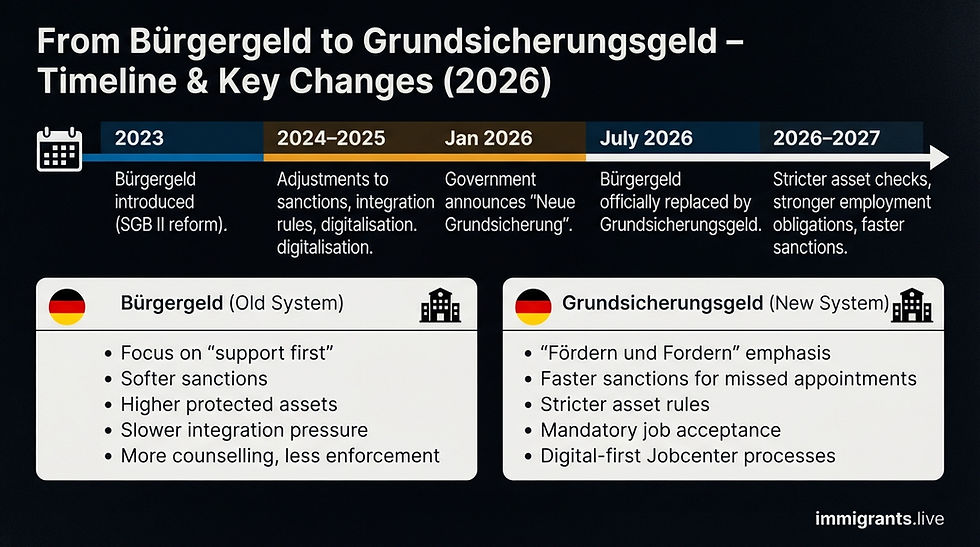
Grundsicherungsgeld is the new basic social benefit in Germany that replaces Bürgergeld from 1 July 2026. It is part of the “new basic security” system for people who can work but cannot secure their living costs on their own.
Legal basis: SGB II (same book as Bürgergeld)
Authority: Jobcenter (unchanged)
Goal: secure minimum living costs and push faster into employment (“Fördern und Fordern”).
Example Grundsicherungsgeld Amounts (2026)
Category | Single Adult | Family of 3 (2 adults + 1 child) |
Standard Rate | €563–€620 | €1,125–€1,240 |
Child Rate (6–13 y/o) | — | €390–€420 |
Housing + Heating | €550–€900 | €850–€1,400 |
Health Insurance | €120–€180 | €240–€360 |
Special Needs | €0–€200 | €0–€300 |
➡️ Total Estimated Monthly Support | €1,250–€1,900 | €2,600–€3,700 |
2. Who can get Grundsicherungsgeld?
2.1 Basic eligibility
You can usually get Grundsicherungsgeld if:
You live in Germany and are registered (Anmeldung).
You are able to work at least 3 hours per day (erwerbsfähig).
You are in need (your income and assets are not enough).
You are 15+ and below pension age.
2.2 Migrants and foreigners
Foreigners can receive Grundsicherungsgeld if:
You have a valid residence status (e.g. Aufenthaltstitel, EU freedom of movement).
You are not in the first months of certain asylum procedures where special asylum benefits apply.
You actually live in Germany (no “fake residence” abroad).
Typical groups:
Non‑EU workers who lost their job
EU citizens with insufficient income
Recognised refugees and people with protection status
Family members of German/EU citizens with low income
3. What does Grundsicherungsgeld cover?
3.1 Main components
Grundsicherungsgeld is not one single payment, but a package:
Standard rate (Regelbedarf): food, clothing, transport, basic personal needs
Housing costs (Kosten der Unterkunft): rent + basic heating, if “reasonable”
Health insurance contributions (if not covered by employer)
Special needs: e.g. school supplies for children, pregnancy, disability-related costs
3.2 Typical amounts (2026)
Exact numbers depend on age, family size and city, but structure is:
Standard rate per adult (similar level to Bürgergeld 2026)
Additional amounts for children by age group
Rent: covered up to local “reasonable” limits (Mietobergrenzen)
For an article on immigrants.live you can later plug in a table with current monthly rates per category.
4. What changed compared to Bürgergeld?
The reform is not only a name change—rules got stricter and more employment‑focused.
4.1 Key changes
Name: Bürgergeld → Grundsicherungsgeld (“new basic security”).
Stronger duty to work: if a job is available and reasonable, you must take it.
Sanctions: benefit cuts are clearer and tougher if you don’t cooperate.
Vermögen (assets): rules on savings and property are stricter and more detailed.
Meldetermine: missing Jobcenter appointments has more direct consequences.
Digitalisation: more online services, digital communication and applications.
4.2 What stayed the same
Jobcenter remains the main authority.
System still aims at integration into work, not long‑term passive support.
Basic structure: standard rate + housing + special needs.
5. Income, assets and “neediness”
5.1 Income
Jobcenter checks all income in your household (“Bedarfsgemeinschaft”):
Wages, mini‑jobs, self‑employment
Pensions, foreign income
Child benefit (Kindergeld) and some other social benefits
Part of income is offset against Grundsicherungsgeld; some small amounts are protected to make work worthwhile.
5.2 Assets (Vermögen)
The reform introduces stricter asset rules:
Savings above certain thresholds must be used before you get full benefits.
Expensive cars, second properties or large deposits can block entitlement.
There are protected assets (e.g. small savings, necessary household items).
For migrants this is crucial: foreign bank accounts and property can be counted if Jobcenter knows about them.
6. Rights and duties for migrants
6.1 Your rights
Right to basic security if you meet the legal criteria.
Right to counselling and translation help in many Jobcenters.
Right to a cooperation plan (Kooperationsplan) for integration into work.
6.2 Your duties
Cooperate with Jobcenter: attend appointments, answer letters.
Actively look for work and accept reasonable job offers.
Report changes: new job, moving, marriage, birth of a child, travel abroad.
Provide documents: contracts, bank statements, rental agreement, residence permit.
If you don’t comply, sanctions (benefit cuts) are faster and clearer than under Bürgergeld.
7. How to apply for Grundsicherungsgeld (step‑by‑step)
Step 1 — Check your status
Residence permit valid?
Are you registered at a German address?
Do you have no or very low income?
Step 2 — Find your Jobcenter
Use local city website or “Jobcenter + city name” search.
Each district has its own Jobcenter office.
Step 3 — Prepare documents
Passport / ID
Residence permit (Aufenthaltstitel / Fiktionsbescheinigung / EU card)
Registration certificate (Meldebescheinigung)
Rental contract + latest rent statement
Bank statements (usually last 3 months)
Employment contracts / termination letters
Insurance documents (health insurance)
Step 4 — Submit application
Online (where available) or paper forms at Jobcenter.
Ask explicitly for Grundsicherungsgeld (SGB II).
Step 5 — Attend appointments
You will be invited for a first interview.
They will discuss your situation, work options and cooperation plan.
Step 6 — Receive decision and payments
You get a written decision (Bescheid).
Payments usually go monthly to your bank account.
Check the Bescheid carefully—errors are common, especially with migrants.
8. Typical problems for migrants (and how to avoid them)
Unclear residence status: temporary or insecure status can delay or block benefits.
Missing documents from home country: Jobcenter may ask for proof of foreign income or assets.
Language barrier: misunderstanding duties → sanctions.
Not reporting travel abroad: leaving Germany for longer periods without informing Jobcenter can lead to repayment claims.
Grundsicherungsgeld 2026 — City‑Specific Amounts
Berlin
Category | Single Adult | Family of 3 |
Standard Rate | €563–€620 | €1,125–€1,240 |
Child Rate | — | €390–€420 |
Housing + Heating | €650–€850 | €950–€1,250 |
Health Insurance | €120–€180 | €240–€360 |
Special Needs | €0–€200 | €0–€300 |
➡ Total Estimated | €1,350–€1,850 | €2,700–€3,500 |
Munich
Category | Single Adult | Family of 3 |
Standard Rate | €563–€620 | €1,125–€1,240 |
Child Rate | — | €390–€420 |
Housing + Heating | €800–€1,050 | €1,200–€1,500 |
Health Insurance | €120–€180 | €240–€360 |
Special Needs | €0–€200 | €0–€300 |
➡ Total Estimated | €1,500–€2,050 | €2,950–€3,820 |
Hamburg
Category | Single Adult | Family of 3 |
Standard Rate | €563–€620 | €1,125–€1,240 |
Child Rate | — | €390–€420 |
Housing + Heating | €600–€850 | €900–€1,250 |
Health Insurance | €120–€180 | €240–€360 |
Special Needs | €0–€200 | €0–€300 |
➡ Total Estimated | €1,300–€1,850 | €2,650–€3,470 |
Cologne
Category | Single Adult | Family of 3 |
Standard Rate | €563–€620 | €1,125–€1,240 |
Child Rate | — | €390–€420 |
Housing + Heating | €550–€800 | €850–€1,200 |
Health Insurance | €120–€180 | €240–€360 |
Special Needs | €0–€200 | €0–€300 |
➡ Total Estimated | €1,250–€1,800 | €2,600–€3,420 |
Frankfurt am Main
Category | Single Adult | Family of 3 |
Standard Rate | €563–€620 | €1,125–€1,240 |
Child Rate | — | €390–€420 |
Housing + Heating | €700–€950 | €1,050–€1,350 |
Health Insurance | €120–€180 | €240–€360 |
Special Needs | €0–€200 | €0–€300 |
➡ Total Estimated | €1,380–€1,950 | €2,800–€3,670 |
Practical tip for your article:
Always recommend migrants to bring a German‑speaking friend or advisor to the first Jobcenter appointment and to keep copies of all documents and Bescheide.


Komentarze