H-1B 60-Day Grace Period 2026: What Happens If You Lose Your Job?
September 2026 Immigration Alert

STATUS: PROPOSED — NOT YET IN EFFECT
The U.S. Department of Homeland Security is proposing to eliminate the discretionary 60-day grace period currently available to certain employment-based nonimmigrant workers after their employment ends.
For H-1B workers, this could fundamentally change what happens after a layoff or job termination.
But the proposal is not the law yet.
As of September 14, 2026, the current 60-day grace-period regulation remains in effect. DHS has opened a formal public-comment period, with comments due by November 10, 2026.
That distinction matters.
If you are currently on H-1B and lose your job, you should not assume that the 60-day period has already disappeared.
But you also should not ignore this proposal.
If finalized, the change could dramatically shorten the amount of time many foreign workers have to find another immigration solution.
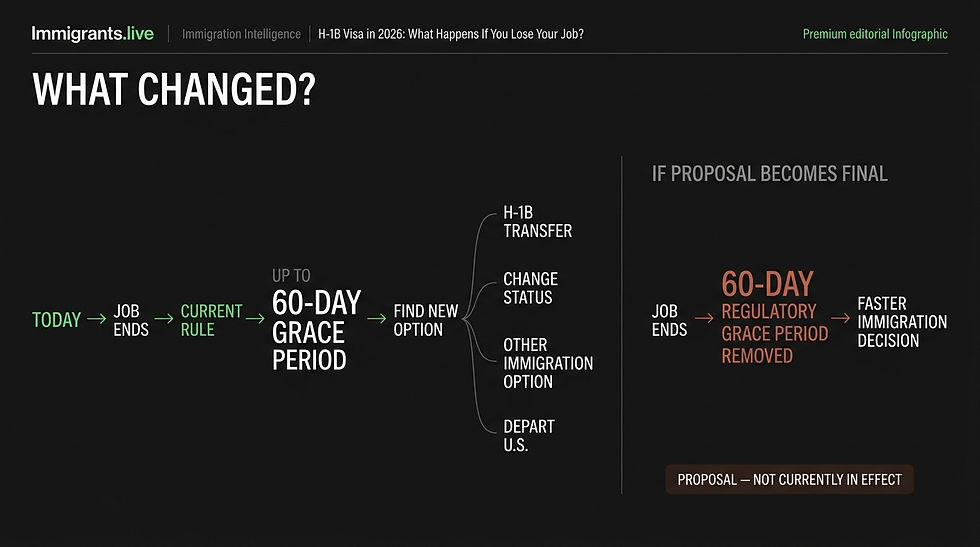
The Short Answer
If you lose your H-1B job today
The current 60-day grace period still applies, subject to the existing rules and the expiration of your authorized stay.
The current regulation generally allows eligible workers up to 60 days, or until the end of their authorized stay if earlier, after employment ends without being considered to have failed to maintain status solely because the qualifying employment stopped.
That period can give a worker time to:
find a new employer;
have a new H-1B petition filed;
pursue another eligible immigration status;
pursue an adjustment-of-status strategy where applicable; or
prepare to leave the United States.
If DHS finalizes the proposal
That safety net could disappear.
The proposed rule would remove the regulatory provision at 8 CFR 214.1(l)(2). DHS says that, under the proposed framework, workers in the affected classifications would generally be required to leave the United States immediately after they stop performing the employment or activity that supports their status, unless they have another independent basis to remain lawfully in the country.
What Is DHS Proposing?
The proposal is called:
“Eliminating the Discretionary 60-Day Grace Period.”
DHS published the proposed rule in the Federal Register on September 11, 2026.
The agency proposes removing the regulation that currently provides the discretionary grace period for certain employment-based nonimmigrant classifications and their dependents.
The affected categories include:
H-1B
H-1B1
L-1
O-1
E-1
E-2
E-3
TN
The proposal therefore goes beyond H-1B workers.
But H-1B is likely to receive the most attention because of the large number of foreign professionals who rely on the category to work in the United States.

Why Does the 60-Day Period Matter So Much?
Losing a job is already stressful.
For an H-1B worker, however, losing the job can also create an immigration deadline.
Under the current system, the grace period gives the worker time to find another solution.
That can mean:
Job lost
↓
Search for another employer
↓
New employer prepares H-1B filing
↓
Petition filed
↓
Worker maintains a path forward
Without the grace period, that sequence could become much more difficult.
A worker could face the need to leave the United States almost immediately after the employment supporting the status ends, unless another lawful basis for remaining exists.
What Has NOT Changed?
This is the most important part of the story.
The 60-day grace period has NOT been eliminated yet.
The September 2026 announcement is a proposed rule, not a final rule.
DHS is currently accepting public comments.
The comment deadline is:
November 10, 2026
The proposal is identified as:
DHS Docket No. USCIS-2026-0364
RIN 1615-AD22
Federal Register Document No. 2026-18631
Until a final rule changes the regulation, the current framework remains the one workers must deal with.

What Could Change If the Proposal Becomes Final?
Today, an eligible worker who loses the qualifying job may have a limited window to find another immigration solution.
Under the proposed rule, DHS wants to remove that regulatory grace period.
The agency argues that employment-based nonimmigrant status should remain directly connected to the employment or activity that formed the basis for the person's admission or status.
DHS also says eliminating the grace period would reduce administrative burdens and bring the regulations more closely into line with the statutory basis for these classifications.
For workers, the practical consequence could be much simpler:
Lose the qualifying job → immigration consequences begin much faster.
If You Lose Your H-1B Job Today
Do not panic.
But do not wait.
The current proposal does not mean that an H-1B worker who loses a job on September 14, 2026 automatically has to leave the United States that same day.
The existing rules still matter.
However, your individual situation can depend on factors including:
your I-94 expiration date;
the actual date your qualifying employment ends;
whether another employer is ready to file;
whether you have a pending immigration filing;
whether you have an approved or pending I-140;
whether an I-485 has been filed;
whether another immigration status may be available;
whether dependents are also affected.
This is why the phrase “60 days” should never be treated as a universal guarantee.
The regulation itself provides a period of up to 60 days, and the authorized stay can create a shorter deadline.
What Should H-1B Workers Do Now?
If your employment is stable, this proposal does not mean you should suddenly leave the United States.
But if you work in a vulnerable industry or your employer is conducting layoffs, preparation becomes more important.
1. Know your I-94 date
Do not rely only on the expiration date printed on your visa stamp.
Your authorized period of stay is a critical part of understanding your situation.
2. Know exactly when your employment ends
The relevant timing can depend on the actual cessation of the qualifying employment.
If you are being terminated, placed on garden leave, receiving severance or remaining on payroll, the exact facts can matter.
3. Keep your immigration documents organized
Have copies of:
H-1B approval notices;
I-94;
passport;
visa stamp;
recent pay records;
employment documents;
I-140 approval, if applicable;
I-485 receipt, if applicable.
4. Start thinking about alternatives before you need them
If you are worried about a possible layoff, waiting until the final day of employment to investigate your options can be risky.
5. Get individualized legal advice when the facts are complicated
An H-1B worker with a pending I-485 is not necessarily in the same position as someone whose only immigration basis is an H-1B petition.
The same applies to people with pending extensions, approved I-140s, spouses with independent status, or other potential immigration options.
What About H-4 Spouses?
The proposed rule also addresses dependents of the affected principal workers.
DHS's proposal is not limited to the H-1B employee alone; the grace-period provision being removed currently applies to the listed classifications and their dependents.
That means H-1B families should not look at this issue as an individual worker problem only.
A job loss could create questions about the immigration position of the entire family.
What About L-1, O-1, TN and Other Workers?
H-1B gets most of the attention, but it is not the only category covered.
The proposal specifically identifies:
E-1 / E-2 / E-3
H-1B / H-1B1
L-1
O-1
TN
The practical consequences will differ depending on the immigration category and the person's individual circumstances.
So the headline may be about H-1B, but the proposed change is broader.
The Timeline
2017
The current 60-day grace-period regulation became available for the affected employment-based classifications.
August 2026
DHS moved the proposal through the federal regulatory review process.
September 11, 2026
DHS published the proposed rule in the Federal Register.
November 10, 2026
Public comments are currently due.
What happens next?
DHS will have to consider the public comments before deciding whether and how to proceed.
The final outcome could therefore differ from the proposal.
Immigrants.live will track the rule as it moves through the process.
The Bottom Line
If you are on H-1B right now, there are two different realities.
TODAY
The 60-day grace period has not been eliminated.
IF THE PROPOSAL BECOMES FINAL
The regulatory grace period could disappear, making job loss a much more immediate immigration problem.
That is why this proposal matters.
The biggest change would not simply be losing a benefit.
It would be losing time.
And for an H-1B worker whose job suddenly disappears, time can be the most valuable part of the immigration process.
Immigrants.live Analysis
The most important thing to watch is not the headline saying “H-1B workers will have to leave immediately.”
That is a description of the proposed outcome, not the current law.
The real question is:
Will DHS finalize the rule, and if so, will the final version apply exactly as proposed?
That process has not finished.
For workers who could be affected, however, the proposal is a clear warning that the traditional assumption — “I have 60 days to figure things out if I lose my H-1B job” — may no longer be safe as a long-term planning assumption.
We will update this page when DHS publishes a significant development.
Frequently Asked Questions
Is the H-1B 60-day grace period ending?
Not yet. DHS has proposed eliminating it, but the proposal is not currently the final rule. The existing grace-period regulation remains in effect.
When would the H-1B grace period end?
There is no final effective date for an eliminated grace period at this time. DHS is currently accepting comments on the proposal through November 10, 2026.
Can I still use the 60-day grace period if I lose my H-1B job now?
The current regulation remains in effect, subject to its conditions and your individual immigration circumstances.
Does the proposal affect only H-1B workers?
No. DHS proposes removing the grace-period provision for E-1, E-2, E-3, H-1B, H-1B1, L-1, O-1 and TN classifications, as well as their dependents.
What happens if the rule becomes final?
The proposed rule would remove the regulatory grace period, meaning affected workers would generally be expected to depart after they stop the employment or activity supporting their status unless another lawful basis to remain applies.
Can I still change employers during the current grace period?
Potentially, depending on your circumstances and the applicable H-1B rules. A new employer generally needs to file the appropriate petition, and individual cases can involve important timing and status issues.
Should H-1B workers leave the United States now?
No general conclusion like that follows from this proposal. The proposal is not currently the law. Anyone facing an actual termination should evaluate their individual immigration situation promptly rather than relying on a general article.
Status: PROPOSED — NOT YET IN EFFECT


Komentarze