Is Central London Still Safe in 2026? We Checked the Data After the Covent Garden Stabbing
One shocking attack. Millions of visitors. What do the facts actually say?

Executive Summary
On August 5, 2026, four men were stabbed in London's Covent Garden—one of the city's busiest tourist districts. Within hours, videos from the scene spread across social media, prompting a familiar question: Has central London become unsafe?
The incident shocked residents and visitors alike. Yet isolated attacks and overall public safety are not always the same story.
To answer that question, Immigrants.live reviewed the latest information from the Metropolitan Police, official crime statistics, government reports and recent public safety guidance.
Our key findings:
The Covent Garden attack was a serious but isolated incident.
Police do not consider it terrorism.
Investigators believe the attack was linked to the suspect's mental health.
London's biggest everyday risk for tourists remains theft, not random violent attacks.
Millions of people continue to visit central London every month without becoming victims of violent crime.
Some risks have changed in recent years—but not always in the way headlines suggest.
The Attack That Reopened an Old Debate
At approximately 12:30 p.m. on August 5, emergency services rushed to Endell Street, just a short walk from Covent Garden Market and several West End theatres.
Witnesses described scenes of confusion as a woman armed with scissors attacked pedestrians before being restrained by police.
Four men suffered injuries.
Fortunately, none of the wounds were life-threatening.
Within hours:
police arrested a 47-year-old woman;
investigators stated there was no evidence of terrorism;
authorities indicated that the incident was likely connected to a mental health crisis;
officers confirmed there was no wider threat to the public.
For thousands of tourists walking through Covent Garden that afternoon, however, the reassurance came only after frightening images had already spread across social media worldwide.
Why One Attack Changes Public Perception
Humans do not evaluate danger using statistics.
We remember dramatic events.
A stabbing in one of Europe's most famous tourist districts immediately feels more significant than dozens of ordinary crime reports.
Psychologists call this the availability heuristic: people estimate risk based on vivid, memorable events rather than on overall probabilities.
This effect has become even stronger in the age of smartphones.
Within minutes of the Covent Garden attack:
eyewitness videos appeared online;
breaking-news alerts reached millions of phones;
clips were reposted across X, TikTok, Facebook and YouTube.
The result is understandable: many people begin to feel that violence is becoming common—even when one incident does not necessarily indicate a broader trend.
That is precisely why statistics matter.
London's Reputation: Safe City or Dangerous Capital?
London occupies a unique position among global cities.
Every year it attracts:
tourists,
international students,
skilled workers,
migrants,
business travelers,
families relocating from abroad.
The city is simultaneously:
one of Europe's largest financial centres;
one of the world's busiest tourist destinations;
home to more than nine million residents.
Large cities inevitably experience crime.
The real question is not whether crime exists, but what kind of crime visitors are actually most likely to encounter.
This distinction is often lost in online discussions.
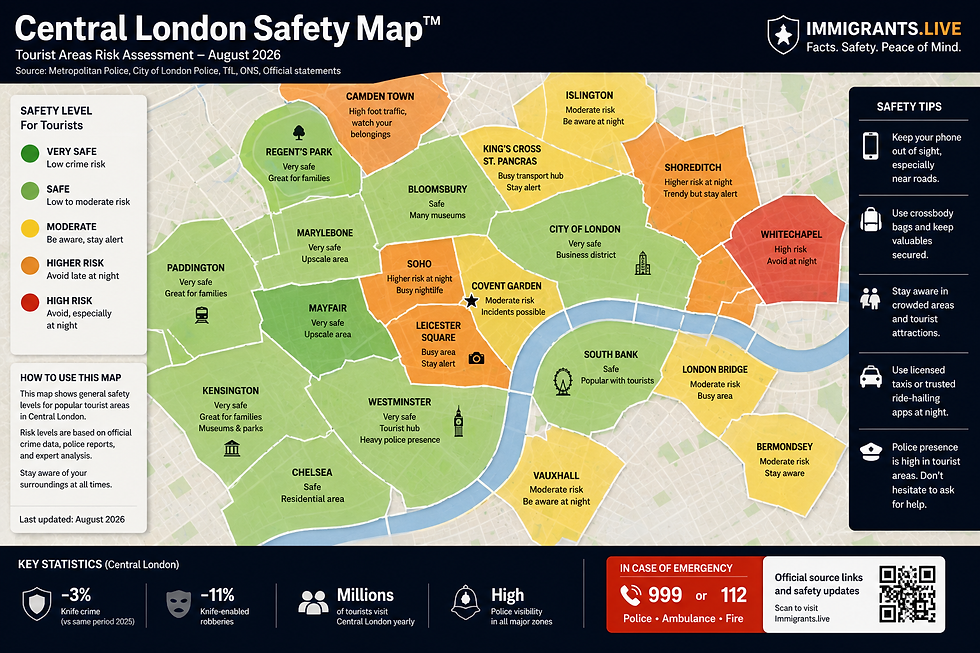
Reality vs Headlines
A single viral headline can create the impression that central London has become dangerous.
The evidence tells a more nuanced story.
Headlines create the impression that:
violent attacks are becoming routine;
tourists are frequent targets;
walking through central London has become unusually risky.
The available evidence shows:
serious violent incidents receive enormous media attention precisely because they remain relatively uncommon in tourist areas;
the overwhelming majority of visitors complete their trips without experiencing violent crime;
police continue to classify central tourist districts as areas requiring visible patrols because of high visitor numbers rather than because they are uniquely dangerous.
This distinction matters.
Fear spreads faster than context.
The Risks Tourists Actually Face
When experienced London police officers and travel safety experts discuss everyday risks, the conversation usually begins somewhere else.
Not knife attacks.
Not terrorism.
Not random assaults.
Instead, they repeatedly mention:
phone snatching;
pickpocketing;
distraction theft;
bag theft in cafés;
bicycle and e-bike thieves grabbing phones from pedestrians;
opportunistic street crime around crowded attractions.
These offences occur far more frequently than the type of attack seen in Covent Garden.
For visitors, they represent the most realistic safety concern.
Why Phone Theft Has Become London's Most Common Tourist Crime
Modern smartphones are valuable, easy to resell and often visible.
Criminals increasingly target distracted pedestrians who:
hold phones while navigating;
stand near roads taking photographs;
film videos for social media;
text while walking.
In many cases, thieves use bicycles, electric bikes or scooters to grab a device and disappear within seconds.
For international visitors, losing a phone can mean losing:
boarding passes;
banking access;
hotel reservations;
identity documents stored digitally;
emergency contacts.
The financial loss is often secondary.
The disruption to the entire trip can be far greater.
What Tourists Say
Across travel communities, one pattern appears repeatedly.
Visitors rarely describe feeling physically threatened.
Instead, they warn newcomers about becoming distracted in crowded places.
Common advice includes:
"Keep your phone in your pocket near busy roads."
"Don't leave your bag hanging on a café chair."
"Central London feels busy—not frightening—but stay aware."
These experiences align more closely with police prevention advice than with sensational social media posts.
So, Is Central London Safe?
After reviewing the available evidence, the answer is more balanced than either side of the online debate suggests.
No, central London is not crime-free.
No, violent incidents should not be dismissed.
But no, one highly publicized attack does not prove that central London has become broadly unsafe for tourists or migrants.
The more useful question is not:
"Can something happen?"
Because in any global city, the answer is always yes.
The better question is:
"What is most likely to happen—and how can I reduce that risk?"
That is the question the rest of this investigation answers.
Editor's Note
This investigation is based on information available as of August 2026, including statements from the Metropolitan Police, official UK crime statistics and reporting from Reuters and other established news organizations. Because investigations and crime data are updated over time, readers should treat this article as a snapshot of the situation at the time of publication rather than a definitive assessment of long-term trends.

The Numbers Behind the Headlines
Is knife crime actually increasing?
After the Covent Garden attack, one question dominated social media:
"Is London becoming more dangerous?"
The short answer is not in the way many people believe.
The latest official figures show a more complicated picture than the headlines.
The First Myth
"Knife crime is exploding."
Reality:
Official statistics show that knife crime remains one of London's biggest policing challenges, but recent trends are moving downward rather than upward.
According to the latest figures published by the UK Office for National Statistics:
offences involving knives or sharp instruments across England and Wales fell by 10% in the year ending December 2025;
homicides also declined by 6%;
firearm offences reached their lowest level since modern recording began.
That does not mean knife crime has disappeared.
It means the long-term problem remains, but recent data point to improvement rather than acceleration.
London Is Different
London still records the highest number of knife-enabled offences in England and Wales.
That sounds alarming.
But London is also:
Britain's largest city;
the country's biggest transport hub;
Europe's most visited urban destination;
home to more than nine million residents.
Because of its size, London naturally records more incidents than smaller police areas. The Metropolitan Police accounted for about 28% of all knife-enabled offences recorded in England and Wales, while also showing a 15% year-on-year decrease in those offences.
What Happened in 2026?
Immediately after the Covent Garden stabbing, the Metropolitan Police released updated operational figures.
Compared with the same period in 2025:
knife crime overall was down 3%;
knife-enabled robberies had fallen 11%;
knife crimes resulting in injury were down 1.5%.
These figures don't erase the seriousness of the attack.
But they do show that one shocking incident does not necessarily reflect the broader trend.
Reality vs Headlines
Headlines | Verified data |
"London is out of control." | Serious violence remains a challenge, but several key indicators have improved. |
"Knife crime keeps rising." | Recent official statistics show year-on-year declines nationally and across Metropolitan Police data. |
"Tourists are constantly attacked." | Most visitors never experience violent crime; theft remains the more common risk. |
Where Does Knife Crime Actually Happen?
This is one of the biggest misconceptions.
Many people assume tourist districts account for most violent crime.
Official policing patterns suggest otherwise.
Knife-enabled offences are concentrated mainly in:
gang-related disputes;
robberies;
neighbourhood conflicts;
domestic incidents;
areas with persistent organised criminal activity.
The majority are not random attacks on tourists.
Why Covent Garden Felt Different
The recent stabbing attracted global attention because several unusual factors occurred simultaneously.
It happened in daylight.
It occurred in one of London's busiest tourist areas.
Multiple victims were injured.
Videos spread within minutes.
The incident appeared random.
Events combining all of these elements are relatively uncommon, which is precisely why they receive extensive international coverage.
London Tourist Safety Score™ 2026
Immigrants.live Assessment
Category | Score |
Violent Crime Risk | ⭐⭐⭐⭐☆ |
Terrorism Risk | ⭐⭐⭐⭐☆ |
Public Transport Safety | ⭐⭐⭐⭐⭐ |
Tourist Areas During Daytime | ⭐⭐⭐⭐⭐ |
Tourist Areas After Midnight | ⭐⭐⭐☆☆ |
Pickpocket Risk | ⭐⭐☆☆☆ |
Phone Theft Risk | ⭐⭐☆☆☆ |
Emergency Response | ⭐⭐⭐⭐⭐ |
Safety for Families | ⭐⭐⭐⭐☆ |
Safety for New Migrants | ⭐⭐⭐⭐☆ |
Overall Score
8.4 / 10
Conclusion:
Central London remains one of Europe's safer major capitals for visitors, but awareness of opportunistic street crime is essential.
Which Risks Matter Most?
Based on police advice and crime patterns, the average visitor is far more likely to experience one of these incidents than a random knife attack.
Higher likelihood
🟠 Phone snatching
🟠 Pickpocketing
🟠 Bicycle or e-bike theft of mobile devices
🟠 Bag theft in cafés
🟠 Tourist scams
Lower likelihood
🟢 Serious assault
🟢 Random knife attack
🟢 Terrorism
This distinction is important because it helps travellers focus on realistic risks rather than the most dramatic ones.
The Safest Tourist Areas
These central districts remain among the most heavily patrolled parts of London because they attract millions of visitors each year.
Area | General Assessment |
Westminster | Very safe during daytime |
Covent Garden | High visitor density, strong police presence |
South Bank | Generally safe |
Kensington | Low violent crime exposure for tourists |
St James's | Very safe |
City of London | Strong police visibility |
Heavy foot traffic does not automatically mean high personal risk.
Areas Requiring More Awareness
Not because tourists should avoid them—
—but because visitors should stay alert, especially after dark.
Area | Advice |
Soho | Stay aware late at night |
Oxford Street | Watch your phone |
Camden | Busy nightlife requires normal precautions |
Brixton | Exercise greater caution after dark if unfamiliar with the area |
This is practical advice—not a recommendation to avoid these neighbourhoods altogether.
What Metropolitan Police Wants Visitors to Remember
Police messaging is remarkably consistent.
The most common recommendations are:
✔ Keep valuables out of sight.
✔ Avoid using your phone close to busy roads.
✔ Stay aware around transport hubs.
✔ Report suspicious behaviour immediately.
✔ Call 999 in an emergency.
✔ 112 also works from mobile phones.
The Bottom Line
The data lead to an important conclusion.
London does have a knife crime problem.
That problem is real.
However, it is also true that:
official statistics have recently improved;
most knife crime does not involve tourists;
most visitors never experience violent crime;
practical awareness reduces everyday risks far more than fear does.
The Covent Garden attack deserves attention.
It should not, by itself, redefine the reputation of an entire city visited safely by millions of people every year.
Practical Safety Guide for Tourists and New Migrants.
If something goes wrong, these first five minutes matter most.
Most visitors to London will never become victims of violent crime.
But if your phone is stolen, your bag disappears or you witness an assault, knowing what to do can save time, money and potentially your life.
Emergency Numbers Every Visitor Should Know
Service | Number |
Police | 999 |
Ambulance | 999 |
Fire Brigade | 999 |
European Emergency Number | 112 |
Both 999 and 112 connect callers to emergency services in the UK.
If you cannot speak English fluently, stay on the line. Operators will try to connect an interpreter when necessary.
If Your Phone Is Stolen
Phone theft is one of the most common crimes affecting visitors.
Step 1
Move to a safe location.
Do not chase the thief.
Many thieves work in groups.
Step 2
Use another device immediately.
Open:
Find My iPhone
Find My Device
Lock the phone remotely.
Step 3
Contact your bank.
Block:
Apple Pay
Google Wallet
banking apps
Step 4
Report the theft to police.
Request a crime reference number.
This is often required for:
insurance
travel claims
replacement documents
Step 5
Call your mobile provider.
Block the SIM card immediately.
If You Witness Violence
Never assume somebody else has already called emergency services.
Call 999.
Provide:
location
number of injured people
whether the attacker is still present
description of clothing
direction of travel
Stay at a safe distance.
Tourist Safety Checklist
Before leaving your hotel each morning:
✔ Passport copied digitally
✔ Emergency contacts saved
✔ Phone tracking enabled
✔ Portable charger
✔ Small amount of cash
✔ Main payment card
✔ Travel insurance details
✔ Offline Google Maps
✔ Hotel address saved
Safety Apps Worth Installing
Citymapper
The easiest way to navigate London.
TfL Go
Official Transport for London app.
Provides live Underground information.
what3words
Extremely useful during emergencies.
Allows emergency services to locate you within three metres.
Google Maps Offline
Download London before travelling.
Useful if your mobile connection disappears.
Find My / Find My Device
Essential if your phone is lost or stolen.
Five Mistakes Visitors Make
Walking while staring at the phone.
The easiest target for phone snatchers.
Leaving bags hanging behind café chairs.
Professional thieves look for exactly this.
Carrying passports all day.
Better left in the hotel safe when not required.
Using expensive cameras carelessly.
Crowded tourist areas attract opportunistic thieves.
Assuming "it won't happen here."
Large cities reward awareness.
Myth vs Reality
Myth
London has become too dangerous to visit.
Reality
Millions of tourists continue to visit safely every year.
Myth
Knife attacks are common for tourists.
Reality
Most knife crime does not involve international visitors.
Myth
The Underground is dangerous.
Reality
London Underground remains one of the safest major metro systems in Europe.
Myth
Police rarely respond.
Reality
Central London has one of the highest visible police presences in the country.
What New Migrants Should Know
Moving to London is different from visiting.
New residents quickly adapt to simple habits:
avoid displaying phones near roads;
stay aware around busy transport hubs;
use licensed taxis or trusted ride-hailing services late at night;
learn the nearest police station and hospital to your home;
register with a local GP after arrival.
These habits become routine and significantly reduce everyday risks.
Frequently Asked Questions
Should I cancel my trip because of the Covent Garden attack?
There is no evidence suggesting visitors should cancel travel solely because of this incident.
Is central London safe at night?
Busy tourist districts remain active late into the evening, but awareness is advisable, especially after midnight.
Is London safer than many people think?
Public perception is often influenced by viral videos and breaking news. Official data provide a more nuanced picture.
Is terrorism the main concern?
No.
For most visitors, theft is a much more realistic everyday risk.
Immigrants.live Verdict
The Covent Garden stabbing was a serious criminal incident that understandably attracted international attention. It also reminded millions of people how quickly a single event can shape perceptions of an entire city.
Our review of the latest official statistics, policing information and public safety guidance suggests a more balanced conclusion.
London remains a global city with the opportunities and challenges that come with its size. Serious violence has not disappeared, and authorities continue to invest significant resources in tackling knife crime. At the same time, recent official figures point to improvements in several key indicators, and the overwhelming majority of visitors complete their trips without experiencing violent crime.
For tourists and new migrants, the most likely risks are still opportunistic offences such as phone theft, pickpocketing and scams—not random attacks.
The lesson from Covent Garden is not that London has become unsafe.
It is that awareness, preparation and reliable information remain the best forms of protection.
Sources & Methodology
This analysis is based on publicly available information current as of August 2026, including:
Metropolitan Police statements and crime dashboards.
UK Office for National Statistics crime releases.
Home Office publications.
Transport for London safety guidance.
Reuters reporting on the Covent Garden incident.
Statements from senior Metropolitan Police officials.
Where possible, multiple official or established news sources were compared before drawing conclusions. The article distinguishes between verified facts, statistical trends and editorial analysis to avoid overstating the implications of a single incident.


Komentarze