Is Dubai Still Safe in 2026? We Checked Crime, Scams, Strict Laws, Metro Safety and What Tourists and Expats Need to Know
- 23 sie
- 9 minut(y) czytania
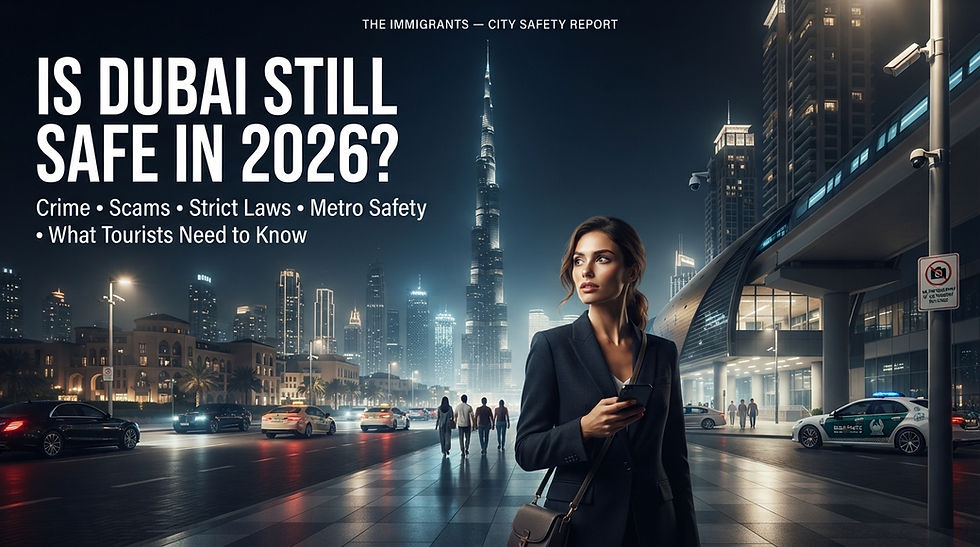
Dubai is one of the safest major cities in the world — but in 2026, the biggest mistake a visitor can make is confusing low crime with zero risk.
In many global cities, the first safety question is simple:
“Which areas should I avoid?”
Dubai is different.
For most tourists, the more important questions are:
What laws apply to me? What can get me into trouble? Which scams still exist? What happens if I have an emergency? And can extreme heat become a real safety risk?
Dubai Police reported a 99.9% daytime safety-perception score for 2025, while 98.7% of respondents said they felt safe walking at night, according to the Security Quality of Life Survey cited by Dubai's government media office. Those numbers reinforce Dubai's reputation as an exceptionally safe global city.
But that reputation can also create a false sense of security.
A tourist can feel perfectly comfortable walking through Downtown Dubai at midnight and still make a decision that creates a serious problem.
The risk may not be a mugger on the street.
It may be:
an unfamiliar local law;
a scam or fraudulent transaction;
an online post or photograph;
alcohol consumed in the wrong context;
drugs;
a public argument that escalates;
a rental-car dispute;
extreme heat;
or simply not knowing who to call when something goes wrong.
Dubai is safe. But understanding Dubai is part of staying safe.
Dubai Safety Scorecard 2026
Risk | Level | What visitors should know |
Violent street crime | 🟢 Low | Not the main concern for most visitors |
Theft | 🟢 Low | Normal precautions still apply |
Tourist scams | 🟡 Moderate | Watch transactions, unofficial offers and unfamiliar services |
Taxi risk | 🟢 Low | Use official taxis and recognised booking services |
Rental-car disputes | 🟡 Moderate | Document the vehicle and understand the contract |
Dubai Metro | 🟢 Very Low | Generally one of the easiest ways to move around |
Nightlife | 🟢 Generally safe | Know the rules around alcohol and behaviour |
Strict laws | 🟠 Important | Some behaviour tolerated elsewhere can create legal problems |
Social media/privacy | 🟠 Important | UAE cyber and privacy rules can have consequences |
Drugs | 🔴 Zero-tolerance environment | Do not take risks |
Extreme heat | 🟠 Serious | A genuine health and safety issue |
Solo travel | 🟢 Generally safe | Standard precautions still matter |
Women travelling alone | 🟢 Generally safe | Normal situational awareness recommended |
Natural disasters | 🟢 Low, but not zero | Severe weather and flooding can disrupt the city |
The Dubai Safety Reality
Dubai's reputation for security is not accidental.
The city has extensive surveillance, a visible police presence, modern emergency services and a legal environment that strongly emphasises public order.
For an ordinary visitor, this creates a very different experience from cities where concerns about violent street crime dominate daily travel decisions.
That does not mean every neighbourhood or every situation carries identical risk.
But Dubai's practical safety question is usually less:
“Will I be robbed walking home?”
And more:
“Do I understand the rules of the environment I'm in?”
The Biggest Risk Tourists Misunderstand: The Law
Dubai is an international city.
Millions of tourists visit every year.
English is widely spoken.
Alcohol is available in licensed venues.
People from almost every country live and work here.
That can make Dubai feel familiar.
But it remains part of the United Arab Emirates, and local laws and cultural rules apply to residents and visitors alike.
The UAE government's official guidance tells visitors that public displays of affection should be minimal, and warns that disruptive behaviour, obscene gestures and disrespectful conduct can create legal problems. It also advises modest dress in public places and restrictions on photography.
The practical rule:
Don't assume that something being normal in London, New York, Berlin or Paris automatically means it is legally or socially acceptable in Dubai.
Public Behaviour: What Tourists Should Know
The UAE's official visitor guidance specifically highlights several areas where visitors should exercise care.
These include:
public displays of affection;
offensive or disruptive behaviour;
obscene gestures;
disrespectful conduct;
inappropriate clothing in certain public settings.
Holding hands is generally treated differently from more overt displays of affection, while the official guidance says public kissing and hugging should be avoided.
This is not about creating fear.
It is about avoiding the classic tourist mistake:
“I didn't know.”
Photography Can Also Create Problems
Dubai is one of the most photographed cities on Earth.
But there is an important distinction between taking a skyline photo and photographing people or restricted locations.
Official UAE guidance warns visitors not to photograph certain government buildings or military installations, and advises against photographing people without permission. It also states that photographing aircraft and plane spotting are illegal.
The safest rule:
Before taking a close photograph of someone:
Ask.
And if you see a restricted area or a clear no-photography sign:
Don't test the rule.
What About Social Media?
The same principle applies online.
The UAE has cybercrime and media laws covering issues including privacy, defamation, insults, false or misleading information and other prohibited online conduct.
For tourists and expats, the practical lesson is straightforward:
Don't assume that an argument, accusation, insult or private recording can safely be posted online just because you would do it at home.
If you have a serious dispute with a business, landlord, employer or another person, deal with it carefully and, where necessary, through the appropriate official or legal channels.
Drugs: This Is Not a Grey Area
Dubai and the UAE maintain strict policies toward illegal drugs.
Official UAE visitor information explicitly warns of strict penalties for drug use and dealing.
The safest advice is also the simplest:
Do not experiment. Do not carry illegal drugs. Do not accept substances from strangers. Do not assume that rules from another country apply in Dubai.
For prescription medication, travellers should check current official UAE requirements before travelling rather than relying on old social-media advice.
Is Alcohol Legal in Dubai?
Yes, alcohol is available in licensed venues.
But that does not mean the rules are identical to those in countries where public drinking is widely accepted.
Official UAE visitor guidance warns against drinking alcohol in public places and while driving.
The practical approach is simple:
Drink only in authorised places, know how you are getting home, and avoid behaviour that can turn a normal night out into a public-order problem.
Dubai at Night: Is It Actually Safe?
For most tourists, Dubai remains highly comfortable after dark.
Areas such as:
Downtown Dubai;
Dubai Marina;
JBR;
Business Bay;
major hotel districts;
established shopping areas;
remain heavily populated and active into the evening.
The latest government-reported safety-perception data found 98.7% of respondents felt safe walking at night.
But nightlife safety still requires common sense.
Watch your:
drinks;
cards;
personal belongings;
transportation arrangements;
level of intoxication.
And do not allow an argument with another person to escalate simply because you are on holiday.
The Scams Tourists Should Actually Watch For
Dubai is not defined by aggressive street scams.
But that does not mean fraud disappears.
The most realistic risks include:
Unclear or unexpected charges
Always confirm:
prices;
deposits;
cancellation rules;
service charges;
rental terms.
Card and online fraud
Use official websites and recognised payment channels.
Be suspicious of unexpected messages asking you to:
verify a bank account;
pay a fine immediately;
provide passwords;
click an unfamiliar link.
Unofficial offers
If a deal sounds unusually cheap, verify the business independently.
Rental-car disputes
Before driving away:
photograph the vehicle;
document existing damage;
read the insurance conditions;
understand the fuel and mileage rules;
keep copies of the contract.
The safest option for getting around is to use recognised providers and official transport. Dubai's official tourism guidance describes licensed taxi services as a reliable way to move around the city.
Dubai Metro: One of the Safest Ways to Move Around
Dubai's public transport system is modern, heavily used and generally straightforward for tourists.
For most visitors, the Metro is one of the safest ways to travel between major parts of the city.
The bigger challenges are practical:
understanding station locations;
avoiding peak-hour crowds;
planning around the city's large distances;
knowing that some attractions require a taxi connection after leaving the Metro.
As in any major transport system:
keep your belongings with you;
avoid leaving bags unattended;
pay attention during busy periods.
Which Areas Should Tourists Know?
Dubai is not best understood through a simple list of "safe" and "unsafe" neighbourhoods.
Instead, think about what each area is designed for.
Area | Profile | Main practical issue |
Downtown Dubai | 🟢 Tourist-friendly | Crowds, cost, heat |
Dubai Marina | 🟢 Very popular | Nightlife and tourist spending |
JBR | 🟢 Beach/tourist zone | Heat, crowds, water safety |
Business Bay | 🟢 Modern central district | Traffic and large-scale development |
Deira | 🟡 Older commercial Dubai | Busy streets, bargaining and tourist awareness |
Bur Dubai | 🟢 Historic/commercial | Crowds and traffic |
Al Barsha | 🟢 Tourist/residential | Normal urban precautions |
Palm Jumeirah | 🟢 Resort-oriented | Transport costs and beach safety |
The most important distinction is usually not:
“Is this area dangerous?”
It is:
“What type of risk is most likely here?”
Deira and Bur Dubai: Different Dubai, Different Experience
Tourists staying in modern Downtown Dubai or Dubai Marina sometimes forget how geographically and culturally diverse the city is.
Deira and Bur Dubai offer a more traditional commercial environment.
They can be busy, crowded and more intense than luxury resort districts.
That does not automatically make them unsafe.
But visitors should use normal urban precautions:
watch personal belongings;
agree on prices where appropriate;
use recognised transportation;
avoid carrying unnecessary valuables.
Dubai for Solo Travellers
Dubai is generally a strong destination for solo travel.
The city's infrastructure, transport, hotels and public spaces are designed around an enormous international population.
Still, travelling alone means:
avoid becoming heavily intoxicated;
tell someone where you are going if meeting strangers;
use recognised transport;
verify unfamiliar venues;
keep emergency numbers saved.
The city being safe does not remove the need for situational awareness.
Dubai for Women
Dubai is widely regarded as a comfortable destination for many female travellers, including those travelling alone.
But normal precautions remain important.
The best approach is the same one that applies in any major international city:
be aware of your surroundings;
use established transport;
keep valuables secure;
be cautious when meeting strangers;
understand local expectations around behaviour and dress.
The Risk Many Tourists Underestimate: Extreme Heat
This is one of the most important sections of the entire guide.
A tourist may spend days researching crime and scams — and then underestimate Dubai's climate.
Extreme heat can become a genuine safety issue.
The biggest risks include:
dehydration;
heat exhaustion;
heatstroke;
sun exposure;
becoming stranded outdoors;
underestimating walking distances.
The Dubai heat rule:
Do not judge distance by what looks close on a map.
A 20-minute walk can feel completely different in extreme heat.
Carry water.
Use sun protection.
Plan outdoor activities around the weather.
And don't wait until you feel seriously unwell before finding air conditioning and assistance.
What Happens if You Have an Emergency?
Save these numbers before you arrive.
🚔 Police Emergency
999
🚑 Ambulance
998
🔥 Fire / Civil Defence
997
The UAE government's official emergency guidance confirms these nationwide emergency numbers.
🚓 Dubai Police — Non-Emergency
901
Dubai Police specifically directs non-urgent inquiries to 901, including access to Tourist Police information.
🧳 Tourist Police
The UAE government provides Dubai Tourism Police contact channels for tourists. Because official pages have shown more than one published contact format over time, the safest first choice in an urgent situation is 999, while non-urgent police assistance can go through 901.
What If Your Passport Is Lost or Stolen?
Do not panic.
Step 1: Report the incident
For an emergency or active crime, call 999.
For non-emergency assistance, contact Dubai Police through 901.
Step 2: Get the required documentation
Follow police instructions and ask what documentation is needed for your embassy or consulate.
Step 3: Contact your embassy or consulate
Use official government or embassy contact details.
Step 4: Protect your accounts
Cancel or freeze compromised cards.
Change important passwords if your phone or devices were also stolen.
What If You Are Sick or Injured?
For a serious medical emergency:
Call 998.
The UAE government states that emergency medical services can be accessed through 998, and that hospitals can provide initial emergency treatment and stabilisation before transfer if needed.
Dubai also provides an emergency ambulance app with SOS functionality that can help communicate the patient's location.
What Tourists Should Never Do
Let's make this simple.
Don't:
carry or use illegal drugs;
drink alcohol in public;
drive after drinking;
photograph restricted facilities;
photograph people without permission;
assume social-media rules are identical to your home country;
let public arguments escalate;
make obscene gestures;
ignore local rules because "you're only a tourist";
underestimate extreme heat;
sign rental or service contracts without reading them.
Official UAE guidance specifically covers many of these cultural, behavioural, privacy and safety expectations.
Dubai vs Tokyo vs London vs New York
City | Main safety risk |
Dubai | Laws, scams, extreme heat, public behaviour |
Tokyo | Scams, theft, nightlife, earthquakes |
London | Theft, phone snatching, nightlife |
New York | Theft, scams, neighbourhood variation |
Paris | Pickpocketing, scams, tourist hotspots |
Dubai's difference is obvious.
In other cities, the question is often:
“What could someone do to me?”
In Dubai, another question becomes equally important:
“What could I accidentally do that creates a problem?”
The 10 Rules We Would Give Any First-Time Dubai Visitor
1. Save 999, 998 and 997 before you arrive.
2. Use 901 for non-emergency Dubai Police assistance.
3. Don't assume low crime means zero risk.
4. Understand local laws and social expectations.
5. Don't photograph restricted locations or people without permission.
6. Never take risks with illegal drugs.
7. Keep alcohol consumption within authorised settings.
8. Read contracts and confirm charges before paying.
9. Use recognised transportation and service providers.
10. Take extreme heat seriously.
Editor's Verdict
Dubai remains one of the safest major cities in the world in 2026.
The latest official safety-perception figures reinforce that reputation: Dubai Police reported a 99.9% daytime safety-perception score and 98.7% feeling safe walking at night, based on 2025 survey data published in 2026.
But the city's safety story is more complicated than simply saying:
“There is almost no crime, so don't worry.”
Dubai's real safety advantage is a combination of security, infrastructure and strong public order.
Its main risks for visitors are different:
misunderstanding local laws;
ignoring cultural expectations;
fraud and unexpected charges;
online scams;
privacy and social-media mistakes;
unsafe behaviour involving alcohol;
illegal drugs;
and extreme heat.
Our verdict: VERY SAFE — if you understand the environment you're entering.
Emergency Cheat Sheet
Police emergency: 999
Ambulance: 998
Fire / Civil Defence: 997
Dubai Police non-emergency: 901
Tourist police assistance: via Dubai Police / official tourist channels
Official emergency guidance: UAE Emergency Help for Tourists
Official emergency services guidance: UAE Emergency Numbers and Services
Official Dubai Police services: Dubai Police
Updated: August 2026


Komentarze