Is Minsk Still Safe in 2026?
- 30 sie
- 8 minut(y) czytania
We Checked Crime, Police Checks, Political Repression, Surveillance, Phone Searches, Detention Risks, Public Transport and What Foreigners Really Need to Know

The uncomfortable answer
If you judge Minsk only by street crime, the city can look surprisingly safe.
The streets are generally orderly. Violent street crime is not what most visitors are likely to encounter. Public transport is extensive, the centre is heavily maintained, and walking through central Minsk can feel considerably calmer than in many large European cities.
But that is only one definition of safety.
In Minsk in 2026, the bigger question is not necessarily whether someone will rob you.
It is whether you can attract the attention of the state.
That distinction changes everything.
Foreign governments currently warn travellers about arbitrary enforcement of Belarusian law, detention and restrictions on consular assistance. The UK specifically warns that security forces may stop people, search them, demand identification and require them to unlock their phones. Canada advises against all travel because of arbitrary enforcement and the regional security situation.
So our conclusion is deliberately uncomfortable:
Minsk can be physically calm while remaining legally and politically high-risk.
Is Minsk dangerous because of ordinary crime?
Not in the way many people might expect.
Minsk does not have the profile of a city where tourists routinely face armed robbery or violent street crime.
The Belarusian statistical system continues to publish crime data, including annual 2025 crime statistics.
For an ordinary visitor, the more familiar risks remain:
pickpocketing;
phone and wallet theft;
scams;
alcohol-related incidents;
taxi problems;
nightlife disputes;
occasional assault;
fraudulent accommodation or payments.
Those risks exist.
But they are not the defining security problem of Minsk in 2026.
The bigger issue is that conventional crime statistics tell you almost nothing about what can happen when the state itself becomes the source of risk.
The safety paradox of Minsk
This is perhaps the most important thing to understand before visiting.
You can have:
Low street crime + high political risk.
These aren't contradictory.
A visitor can spend three days in Minsk without seeing a single violent incident.
They can use the Metro, visit museums, eat at restaurants, walk around Independence Avenue and return to their hotel without any problem.
And yet another person can experience a completely different Belarus after a document check, a border inspection, a phone search or questions about political activity.
That's why saying simply:
“Minsk is safe.”
is misleading.
So is saying:
“Minsk is dangerous.”
The reality depends enormously on who you are, what is on your phone, what you've posted online, where you've travelled previously and what attracts official attention.
Political repression is part of the safety equation
This is the section that is almost impossible to understand from conventional tourism websites.
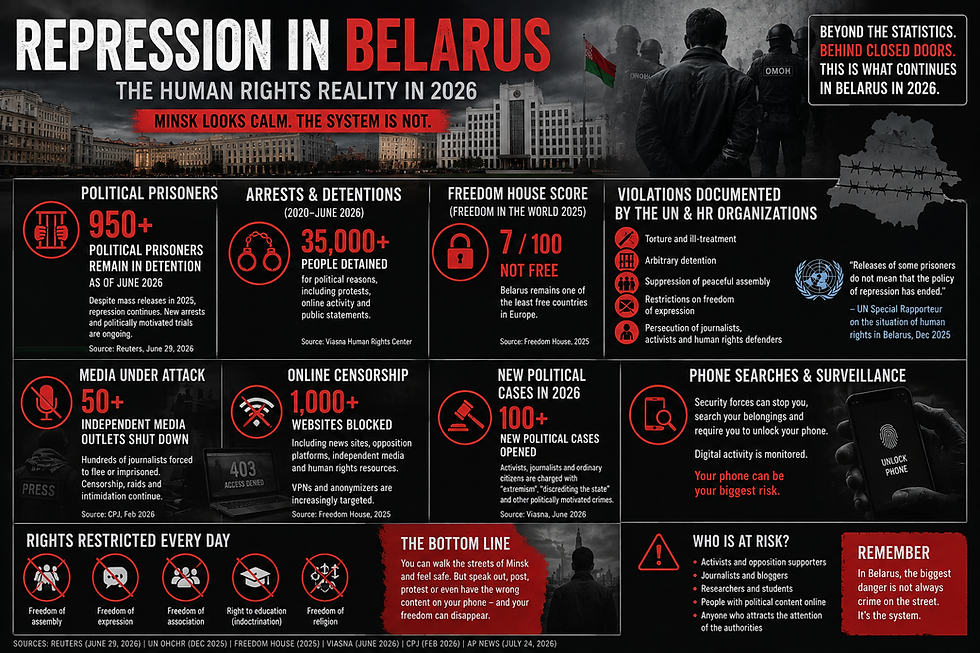
Belarus continues to face international condemnation over systematic repression.
The UN Special Rapporteur has warned that releasing political prisoners does not mean the policy of repression has ended.
Freedom House has documented suppression of online voices, blocking of independent media and prosecution of people over online material authorities classify as extremist.
Amnesty International's latest country assessment describes severe restrictions on expression, assembly and association and reports the abuse of the justice system to suppress dissent.
And this isn't merely historical.
In June 2026, former political prisoner and journalist Katsiaryna Andreyeva publicly warned that arrests were continuing despite major prisoner releases. Reuters reported that more than 950 political prisoners remained detained at that time.
In July, journalist Kiryl Pazniak received a 3.5-year prison sentence on charges including “discrediting Belarus” and forming an “extremist organization.”
This is the reality that a normal “Minsk travel guide” doesn't capture.
What does this mean for an ordinary tourist?
This is where we need to be precise.
It does not mean that every foreign tourist arriving in Minsk is going to be arrested.
That would be sensationalism.
Most visitors will not experience political persecution.
But it does mean that the margin for error is smaller than in a typical European capital.
A person who:
attends a demonstration;
photographs a sensitive location;
posts political material;
interacts publicly with opposition activists;
carries politically sensitive material;
has suspicious or controversial content on their phone;
has previous involvement in Belarusian political activity;
may face risks that have little relationship to ordinary tourist safety.
And authorities have used detention and questioning against people who were not necessarily the central participants in demonstrations. The US government specifically warns that bystanders, including foreign nationals, can face arbitrary arrest or detention.
Your phone can become part of the border crossing
This is one of the most important practical realities.
The UK travel guidance explicitly warns that Belarusian security forces can require people to unlock their phones during searches.
And this is not simply theoretical.
Recent reporting by Viasna describes continuing phone searches, questioning and detentions at Belarusian border checkpoints in 2026.
That changes how a traveller should think about digital security.
Your phone isn't just:
camera + maps + WhatsApp + banking.
It may also become something authorities want to inspect.
Before travelling, think carefully about:
unnecessary political conversations;
sensitive photographs;
old social-media posts;
politically sensitive channels;
documents;
contacts;
photographs from demonstrations;
material involving opposition organisations;
information that could be interpreted as extremist under Belarusian law.
This is particularly important for journalists, activists, researchers and people who have previously participated in Belarusian political activity.
Journalism is a completely different risk category
Belarus has one of the harshest environments for independent journalism in Europe.
Reporters Without Borders describes censorship, arrests, raids and prosecution of journalists as part of the state's campaign against independent media.
The Committee to Protect Journalists told a US congressional human-rights body in February 2026 that the authorities continue raiding journalists' homes and imprisoning them under anti-state charges.
So if you are travelling to Minsk as:
tourist → one risk profile
business visitor → another
researcher → higher
journalist → significantly higher
political activist → potentially extreme
That distinction needs to be made explicit.
Photography: think before you press the shutter
This is one of the simplest practical rules for Minsk:
Don't photograph everything simply because it looks interesting.
A tourist might naturally photograph:
government buildings;
police;
security infrastructure;
military facilities;
checkpoints;
demonstrations;
security personnel;
infrastructure connected to the military;
airports and sensitive transport facilities.
But in Belarus, the consequences of being questioned about photographs can be much more serious than in an ordinary European city.
If you aren't sure, don't take the photograph.
And if security personnel tell you to stop, don't turn the encounter into an argument.
Police checks
Visitors should carry appropriate identification.
The UK government specifically advises travellers to carry their passport or a copy of the identification page and visa if applicable because security forces can conduct stop-and-search operations.
Security personnel may not always appear in conventional uniforms.
That means the safest approach is simple:
Stay calm.
Don't make sudden movements.
Don't physically resist a search.
Don't argue about politics.
Ask what is required of you.
And if detained, contact your embassy or consular service as soon as realistically possible.
What about foreigners?
This is where the situation becomes particularly complicated.
Belarus does not recognise dual nationality in the same way many Western travellers might expect.
The UK warns that dual British-Belarusian nationals can be treated as Belarusian citizens and that dual nationality does not protect someone from arrest, questioning or detention related to political activity.
Australia gives a similar warning concerning dual nationals.
The US has also warned that Belarusian authorities have prevented some dual US-Belarusian citizens from leaving the country.
A second passport is therefore not necessarily a shield.
Minsk Metro and public transport
Ironically, this is one of the areas where Minsk can feel extremely safe.
The Metro is widely used and central areas are heavily policed and monitored.
For normal commuting and sightseeing, public transport is generally a much smaller concern than the political/legal environment.
Still:
keep valuables secure;
avoid confrontations;
don't photograph security personnel;
be careful with alcohol late at night;
don't participate in demonstrations or political gatherings.
The Metro isn't necessarily where the biggest risk lies.
The risk can begin when your identity or behaviour attracts attention.
Nightlife
Minsk nightlife requires normal big-city precautions.
Avoid:
accepting drinks from strangers;
unlicensed taxis;
isolated areas after heavy drinking;
confrontations;
arguments with security staff;
carrying large amounts of cash.
The most important difference is that a drunken confrontation that might result in a warning or fine elsewhere can potentially become much more complicated when police involvement occurs in a tightly controlled environment.
Demonstrations: don't “just watch”
This deserves its own warning.
If you see a political demonstration, do not assume that standing nearby is harmless.
US travel guidance warns that even bystanders and foreign nationals may face arbitrary arrest or detention around demonstrations.
Don't:
join;
chant;
film;
photograph police operations;
hold signs;
argue with officers;
livestream the event.
The safest option for a tourist is to leave the area.
Border crossings may be a different experience
One of the least discussed risks concerns leaving Belarus.
Recent reporting has described phone searches, questioning and detentions at border checkpoints.
For some travellers, the most stressful part of the trip may therefore happen not when entering Minsk, but when trying to leave.
This is especially relevant to people with:
Belarusian citizenship;
dual nationality;
previous political activity;
links to opposition organisations;
sensitive online activity;
journalism backgrounds.
Don't assume:
“I entered without a problem, therefore leaving will be equally simple.”
Is Minsk safe for families?
From a conventional crime perspective, Minsk can be a relatively calm city for families.
There are parks, museums, restaurants and extensive public transport.
But parents should also consider a second layer of safety:
What digital material is stored on family members' phones?
What has been posted online?
Does anyone in the family have Belarusian citizenship?
Has anyone previously participated in political activity?
These questions can matter far more than whether someone might pickpocket you in a shopping centre.
Who should be particularly cautious?
🟢 Lower-risk profile
A foreign tourist with:
no Belarusian political history;
no activism;
no journalism;
no sensitive online activity;
clean travel documents;
ordinary tourist itinerary.
🟠 Higher-risk profile
Someone with:
Belarusian citizenship;
dual nationality;
political connections;
journalism/research activities;
extensive public political posts;
previous participation in demonstrations.
🔴 Very high-risk profile
People travelling specifically for:
political activism;
investigative journalism;
opposition activity;
sensitive research;
attempts to meet political organisations;
documentation of repression.
For these groups, this is not simply a tourism question anymore.
Emergency numbers
If something happens, know the basics before you arrive.
Situation | Number |
🚓 Police | 102 |
🚑 Ambulance | 103 |
🚒 Fire | 101 |
🆘 General emergency | 112 |
These numbers are listed by Belarusian official tourism/emergency information and Minsk city authorities.
If you're a foreign national, keep your embassy/consulate contact details available offline, not only inside your phone.
The real Minsk Safety Score — 2026
Category | Our assessment |
Violent street crime | 🟢 Relatively low |
Pickpocketing/scams | 🟡 Moderate |
Public transport | 🟢 Generally calm |
Nightlife | 🟡 Normal precautions |
Walking in central Minsk | 🟢 Generally calm |
Police presence | 🟠 High |
Surveillance | 🔴 High concern |
Political activity | 🔴 Very high risk |
Journalism | 🔴 Very high risk |
Phone inspection | 🔴 Significant concern |
Border questioning | 🔴 Significant concern |
Arbitrary detention | 🔴 Significant concern for some travellers |
Dual nationals | 🔴 Special risk |
Overall tourist safety | 🟠 Conditional |
Overall political/legal safety | 🔴 High risk |
So, is Minsk safe in 2026?
Our verdict:
Minsk is not a city where ordinary street crime is necessarily the biggest danger.
And that's exactly what makes the question complicated.
You can walk around the centre and feel perfectly comfortable.
You can take the Metro late in the evening.
You can visit restaurants and museums.
You can see very little visible disorder.
But physical calm should not be confused with freedom from state-related risk.
In 2026, Belarus remains an environment where political repression, censorship, surveillance and arbitrary enforcement of laws are serious concerns.
And the repression hasn't simply disappeared because some political prisoners were released.
The evidence from 2026 shows the opposite: large-scale releases have occurred, but new politically motivated arrests and prosecutions have continued.
That's the uncomfortable reality.
EDITOR'S VERDICT
Would we call Minsk dangerous?
Not in the conventional sense.
Would we call Minsk safe?
Not without a major qualification.
For an ordinary foreign tourist with no political involvement, Minsk can be calm, orderly and relatively uneventful.
But the consequences of attracting unwanted official attention can be far more serious than in most European capitals.
That's why our assessment is:
Minsk: physically calm, politically high-risk.
And for anyone with Belarusian citizenship, dual nationality, political activity, journalism or sensitive online history:
The question isn't “Will I get robbed?”
It's “Could I attract the attention of the state — and what happens if I do?”
That is the part of Minsk's safety story that conventional tourism statistics simply cannot tell you.


Komentarze