Nobody Told Me This About Moving to Germany: The Reality Check Every Immigrant Needs Before Arriving
Every year, hundreds of thousands of people move to Germany searching for something better.
A better salary.
A stronger economy.
More stability.
More opportunity.
Many arrive with a clear picture already forming in their minds. Germany is often portrayed as Europe's economic engine, a country where hard work is rewarded, public systems function flawlessly, and life simply works better.
Some of those assumptions are true.
Others are not.
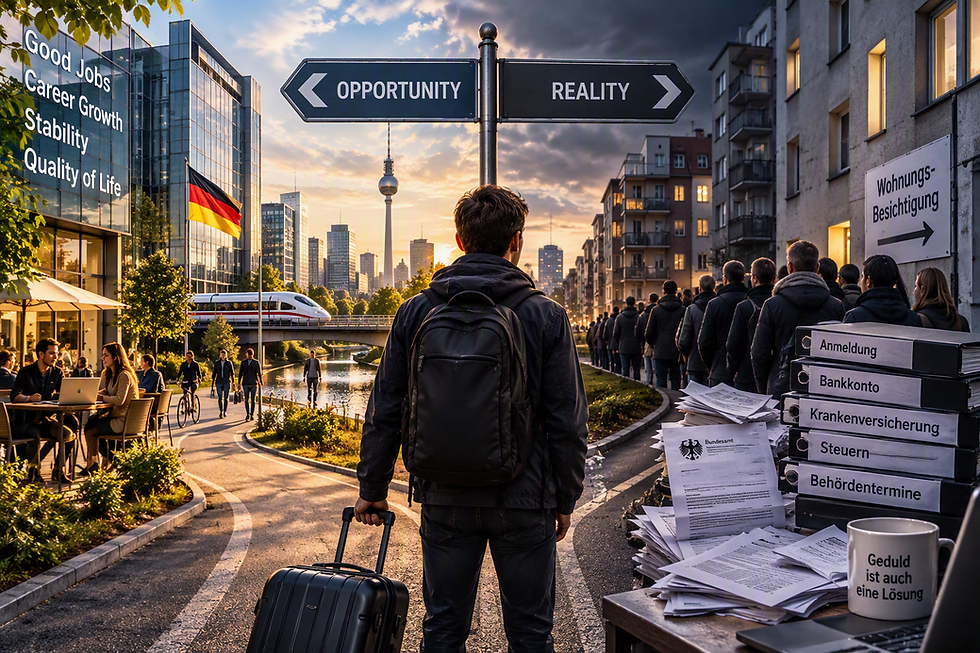
The Germany newcomers imagine before arrival often looks very different from the Germany they experience six months later.
This does not make Germany a bad destination.
In fact, Germany remains one of the best countries in Europe for skilled migrants.
But success in Germany depends less on expectations and more on understanding reality.
Before booking a one-way ticket, there are things many immigrants wish someone had told them.
This is that conversation.
The Biggest Myth About Germany
The biggest myth is not that Germany is rich.
Germany is rich.
The biggest myth is that life automatically becomes easier the moment you arrive.
For many newcomers, some parts of life become more difficult before they become better.
The first months can feel surprisingly stressful.
You may have a job offer.
You may have savings.
You may have all the right documents.
Yet suddenly the simplest tasks feel complicated:
Finding accommodation
Registering your address
Opening accounts
Understanding paperwork
Building a social circle
Germany often tests newcomers before it rewards them.
That reality catches many people off guard.
The €75,000 Surprise
Imagine arriving in Munich with a salary of €75,000 per year.
In much of the world, that would be considered an excellent income.
You expect comfort.
You expect security.
You expect the hardest part of relocation to already be behind you.
Instead, you spend weeks searching for housing.
You attend apartment viewings alongside dozens of other applicants.
You send applications and hear nothing back.
You discover that a strong salary does not automatically guarantee an easy life in a competitive housing market.
For many immigrants, the salary itself is never the shock.
The housing market is.
This is often the first reality check Germany delivers.
Getting an Apartment Can Feel Like a Full-Time Job
Many newcomers underestimate how competitive Germany's housing market can be.
Particularly in:
Munich
Berlin
Frankfurt
Hamburg
Stuttgart
Finding accommodation is frequently described as one of the most stressful parts of relocation.
People often arrive believing that once they have employment, housing will naturally follow.
The reality can look very different.
Even highly qualified professionals may spend weeks or months searching.
Some accept temporary accommodation.
Others move farther from city centers than originally planned.
Many discover that Germany's housing challenge affects everyone, not just migrants.
Germany Loves Rules More Than Speed
One of the most surprising discoveries for newcomers is that efficiency and speed are not the same thing.
Germany is highly organized.
Highly structured.
Highly procedural.
But that does not always mean fast.
Many people arrive expecting an ultra-digital society and instead encounter:
Paper forms
Letters by post
Appointments
Registration requirements
Administrative waiting periods
The system usually functions.
It simply functions according to clearly defined processes.
Patience is often part of the experience.
Germany vs Expectations
One of the best ways to understand Germany is to compare expectations with reality.
Expectation | Reality |
Everything is digital | Paperwork is still common |
Finding housing is straightforward | Competition can be intense |
Everyone speaks English | Depends heavily on region and profession |
A high salary guarantees comfort | Housing costs matter enormously |
Germany is one consistent experience | Every region feels different |
This doesn't mean expectations are wrong.
It means Germany is more complex than many relocation guides suggest.
Germany Is Several Different Countries Pretending to Be One
Many immigrants talk about Germany as though it were a single experience.
It isn't.
Munich is not Berlin.
Berlin is not Hamburg.
Hamburg is not Leipzig.
Leipzig is not rural Bavaria.
Germany is a federal country with strong regional identities, different job markets, different housing costs, and different cultural expectations.
A person who struggles in Berlin may thrive in Hamburg.
Someone who dislikes Munich may love Cologne.
The city you choose can have just as much impact on your experience as the country itself.
The Language Changes Everything
Contrary to popular belief, many people can survive in Germany using English.
Especially in:
Technology
International companies
Startups
Major cities
But surviving and thriving are not the same thing.
Again and again, long-term migrants describe the same turning point:
Learning German changed everything.
Career opportunities improve.
Bureaucracy becomes easier.
Friendships become deeper.
Everyday life becomes more comfortable.
German may not be required for every job.
But it remains one of the strongest investments a newcomer can make.
Loneliness Is Rarely Discussed
Immigration guides talk about salaries.
They discuss visas.
They explain taxes.
Few talk honestly about loneliness.
For many newcomers, the first year in Germany is emotionally more difficult than financially difficult.
You leave behind:
Family
Friends
Cultural familiarity
Support networks
Building a new life takes time.
Building trust takes time.
Building friendships takes time.
Many immigrants later say this emotional transition was harder than any paperwork.
Your First Year in Germany
Not everyone follows the same path.
But many newcomers recognize some version of this journey.
Month 1
Everything feels exciting.
The opportunity feels real.
The future looks promising.
Month 3
Administrative tasks begin to pile up.
Housing challenges become apparent.
Daily routines are still missing.
Month 6
Frustration appears.
The honeymoon phase starts fading.
You begin comparing Germany with home.
Month 12
Things slowly start making sense.
Systems feel familiar.
The city feels less foreign.
Life becomes more predictable.
This is often the point where Germany finally starts feeling like home.
What Germans Rarely Mention
Many of Germany's greatest advantages are almost invisible.
You do not notice functioning infrastructure every day.
You simply depend on it.
You do not constantly think about worker protections until a problem occurs.
You do not appreciate legal stability until you experience instability elsewhere.
Many immigrants arrive focused on Germany's flaws.
Over time, they often discover that some of the country's greatest strengths are the things they stopped worrying about.
Germany Is Safer Than Many People Expect
One area where Germany often exceeds expectations is everyday stability.
Many newcomers value:
Reliable infrastructure
Strong labor protections
Consumer rights
Healthcare access
Public transportation
Long-term predictability
These advantages rarely generate headlines.
Yet they are among the reasons why millions of immigrants decide to stay.
So Why Do Millions Stay?
This is perhaps the most important question.
If Germany can be frustrating, bureaucratic, and difficult to navigate, why do so many people remain?
Because Germany still offers something increasingly rare.
Predictability.
Life may not become easier overnight.
You may not become wealthy overnight.
But many immigrants discover that Germany allows them to build something more valuable:
A stable future.
A future built on:
Employment opportunities
Social protections
Safety
Infrastructure
Long-term planning
In an increasingly uncertain world, those things matter.
A lot.
The Real Cost of a Better Life
Germany offers tremendous opportunities.
But opportunity is never free.
It comes with trade-offs.
Higher taxes.
Housing pressure.
Language barriers.
Cultural adjustment.
Patience.
Adaptation.
The real question is not whether Germany has problems.
Every country does.
The real question is whether the opportunities outweigh those problems.
For millions of people, they still do.
What Nobody Tells You About Germany
Nobody tells you that Germany may frustrate you and impress you in the same week.
Nobody tells you that some systems feel twenty years ahead while others feel twenty years behind.
Nobody tells you that life can become more secure while simultaneously becoming more complicated.
And nobody tells you that Germany does not reveal itself quickly.
Most people do not truly understand Germany after one month.
Or six months.
Sometimes not even after a year.
Germany reveals itself slowly.
And often, its greatest strengths appear long after the initial excitement disappears.
From the Editorial Desk
At Immigrants.Live, we believe many relocation disappointments come from unrealistic expectations rather than poor decisions.
Germany remains one of the strongest destinations in the world for skilled migrants, professionals, students, and families.
But the people who succeed most often are not those who arrive expecting perfection.
They are the people who arrive prepared for reality.
Migration is not about finding a perfect country.
It is about finding the imperfections you can live with and the opportunities that make those compromises worthwhile.
Germany is not perfect.
No country is.
But for millions of people, it continues to offer something that remains worth pursuing.
Final Verdict
Germany is neither the paradise some people imagine nor the bureaucratic nightmare others describe.
The truth lies somewhere between those extremes.
Germany rewards patience.
Germany rewards preparation.
Germany rewards persistence.
Many newcomers arrive expecting Germany to change their lives immediately.
In reality, Germany often disappoints your expectations before it exceeds them.
And that may be the most important lesson of all.
Because the Germany that eventually changes your life is rarely the Germany you expected to find.


Komentarze