Portugal Closes the Door. Spain Opens the Gate.
Southern Europe Is Splitting Over Immigration
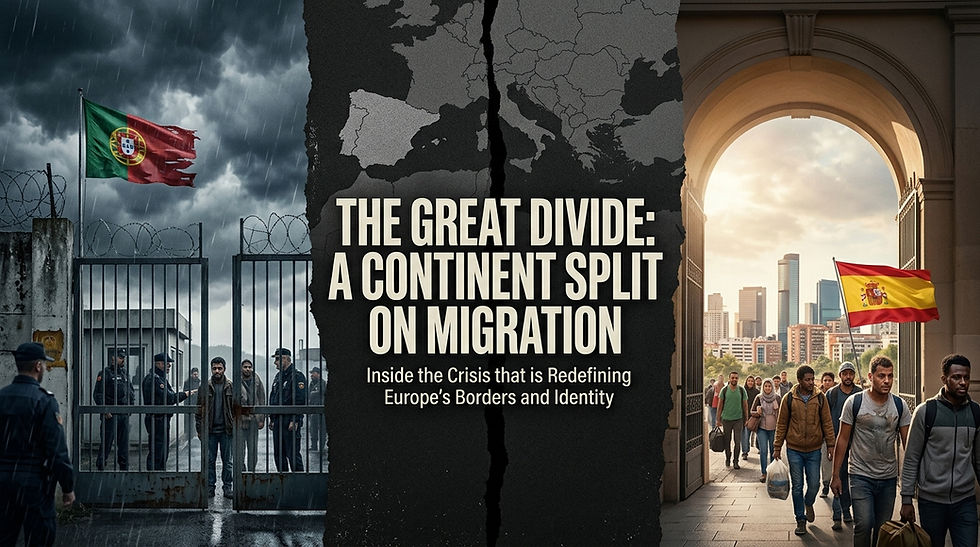
For years, Southern Europe was seen as the continent's most welcoming region for migrants. Portugal built a reputation as one of the easiest places in Europe to relocate, while Spain increasingly relied on immigration to support its labor market and population growth.
In 2026, that shared trajectory began to break apart.
Portugal is tightening immigration rules, extending pathways to citizenship, and imposing stricter conditions on newcomers. Spain, meanwhile, has just completed one of the largest migrant regularization programs Europe has ever seen, attracting more than 1.17 million applications.
What is emerging is not just a policy difference.
It is a growing divide over how Europe should respond to one of its most defining challenges: immigration.
Portugal's Great Immigration U-Turn
Portugal spent much of the last decade positioning itself as a destination for global talent, entrepreneurs, remote workers, and migrants seeking a future in Europe.
That image is now changing.
The Portuguese government says its new migration strategy has dramatically slowed the pace of migration growth while resolving most long-pending immigration cases. Officials argue that immigration remains important for the economy, but insist that future arrivals must be aligned with the country's capacity to integrate them successfully.
Recent reforms have moved the country toward a more restrictive model:
tougher entry requirements;
tighter family reunification rules;
longer paths toward citizenship;
stronger border and immigration controls;
an end to policies that previously allowed large-scale regularization.
The message from Lisbon is increasingly clear:
Portugal is not closing itself to immigration, but it is ending the era of open-ended expansion.
For many prospective migrants, that represents a profound shift.
Only a few years ago, Portugal was often viewed as Europe's easiest immigration success story.
Now it is becoming an example of how quickly public policy can change when migration reaches the center of national politics.
Spain Is Betting on the Opposite Strategy
While Portugal seeks greater control, Spain is attempting something very different.
Earlier this year, Spain completed a massive migrant regularization process that generated more than 1.17 million applications, far exceeding initial expectations.
If approved, many of these applicants could move from the informal economy into legal employment.
For businesses, that means access to workers.
For the government, it means more taxpayers.
For migrants, it means stability and legal status.
For critics, however, it raises concerns about long-term capacity, housing pressure, and future migration incentives.
Whatever the outcome, the scale alone makes Spain's approach one of the most significant immigration experiments currently underway in Europe.
Spain Has Passed a Symbolic Threshold
At the same time, Spain is confronting another reality.
Recent reports indicate that the country's immigrant population has surpassed 10 million people, a figure that would have seemed extraordinary just a generation ago.
Supporters see this as evidence of economic dynamism and demographic renewal.
Others point to growing pressure on housing, healthcare systems, schools, and public infrastructure.
As a result, immigration has become one of the most politically sensitive issues in the country.
Debates increasingly focus on:
points-based immigration systems;
migration quotas;
targeted selection criteria;
integration capacity.
These discussions were once associated primarily with Northern Europe.
Today, they are rapidly moving south.
A Question Facing All of Europe
The most important story is not whether Portugal or Spain is right.
It is why two neighboring countries facing many of the same demographic and economic challenges have reached such different conclusions.
Portugal's approach reflects a growing belief that migration must be more tightly managed to remain politically sustainable.
Spain's approach reflects the reality that many sectors of the economy depend heavily on migrant labor and demographic growth.
Both arguments resonate across Europe.
The continent is aging rapidly.
Millions of workers are approaching retirement.
Labor shortages continue to affect sectors ranging from tourism and agriculture to construction, logistics, healthcare, and elder care.
At the same time, public concern about immigration remains one of the strongest political forces shaping elections across the continent.
Two Countries. Two Futures.
Portugal and Spain are no longer simply neighbors pursuing different immigration policies.
They have become test cases for competing visions of Europe's future.
One model favors control, slower growth, and stricter integration requirements.
The other seeks economic expansion through large-scale incorporation of newcomers into society and the workforce.
The outcome of this experiment will not only shape the Iberian Peninsula.
It may influence how the rest of Europe responds to immigration in the years ahead.
Because the central question facing the continent is no longer whether immigration is necessary.
The question now is:
How much immigration is Europe willing to accept, and under what conditions?
Suggested Headline
Portugal Closes the Door While Spain Opens the Gate: Southern Europe Is Splitting Over Immigration
Alternative Viral Headline
One Country Says “Enough.” The Other Welcomes Millions. Europe’s Immigration Divide Is Here.


Komentarze