Spain's Housing Revolt: The Crisis That Could Reshape Europe
As rents soar, evictions rise and frustration boils over, Spain may be becoming the first country to openly revolt against Europe's housing model
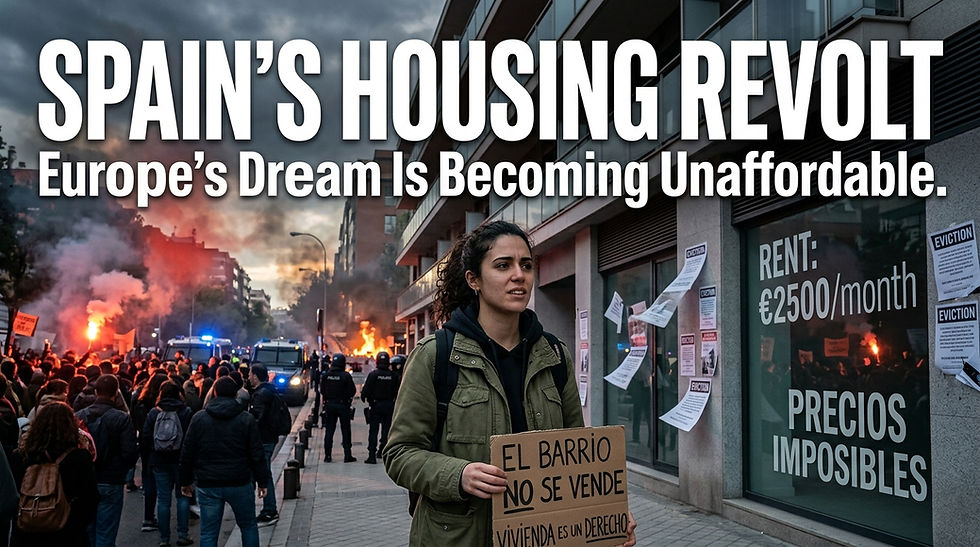
For years, European politicians warned about inflation, migration, demographic decline and economic stagnation. Yet the issue now pushing people into the streets is far simpler and more personal: housing.
Across Spain, tens of thousands of people have spent recent days protesting what many describe as a system that no longer allows ordinary citizens to live in their own cities. Demonstrations have spread across dozens of locations, with Madrid becoming the symbolic center of a growing movement that is challenging not just property prices, but the economic direction of modern Europe.
What is happening in Spain is not an isolated political dispute.
It is the visible eruption of a crisis that has been building for more than a decade.
And if Spain is the first country where the pressure has exploded into nationwide unrest, it is unlikely to be the last.
The Event That Ignited a Nation
The latest wave of protests was triggered by a case that quickly became a national symbol.
An 87-year-old woman in Madrid was evicted from the apartment where she had lived for decades after the property was acquired by an investment fund seeking higher rents. Public outrage spread rapidly across social media and national news outlets. Protesters established encampments in central Madrid and began organizing demonstrations demanding stronger tenant protections.
The government's attempt to pass emergency housing measures then failed in parliament, adding even more fuel to public anger. The proposed legislation included protections against evictions and additional housing measures, but lawmakers rejected it after a deeply divisive debate.
Within days, streets filled with demonstrators carrying banners accusing politicians of protecting profits while ordinary citizens faced rising rents and shrinking living standards.
A Crisis Measured in Rent, Not Headlines
The Spanish housing crisis did not begin this week.
For years, house prices and rental costs have risen faster than incomes in many parts of the country.
Young professionals increasingly remain with parents longer than previous generations. Families spend larger portions of their income on rent. Workers are pushed further from city centers while investors accumulate property portfolios.
The result is a growing feeling among many Spaniards that home ownership has become a distant dream and even renting has become financially exhausting.
This dissatisfaction is increasingly visible in public opinion, political discourse and now on the streets.
The Growing Backlash Against Tourism
Housing protests in Spain are no longer focused solely on landlords or developers.
Increasingly, they are targeting mass tourism.
Many protesters argue that short-term rental platforms and record levels of tourism have transformed housing from a place to live into a financial asset. In some cities, local residents blame tourist demand for accelerating rent increases and reducing long-term housing supply.
The conflict is particularly visible in tourism hotspots where local workers often struggle to afford accommodation near their jobs.
This creates a striking contradiction:
The tourism industry generates billions of euros and supports large portions of the economy.
Yet many residents increasingly believe they are being priced out by the very success of that industry.
From Housing Protest to Political Movement
What began as frustration over rent levels is evolving into something much broader.
Protest organizers are discussing larger actions, including pressure campaigns and wider mobilization efforts. Some activists argue that housing should be treated as a fundamental right rather than a market commodity.
The political consequences could be significant.
Housing affordability has become one of the few issues capable of uniting students, working families, pensioners and even parts of the middle class.
That combination makes it particularly dangerous for governments.
Unlike many political debates, nearly everyone either rents, owns, or hopes to buy a home.
Housing affects everybody.
Why This Matters Beyond Spain
Perhaps the most important question is not what happens next in Madrid.
It is whether Madrid is simply getting there first.
Look across Europe:
Country | Main Housing Pressure |
Spain | Rent inflation, evictions, tourism pressure |
Portugal | Rising rents and growing protests over affordability |
France | Cost-of-living pressures increasingly linked with broader social unrest |
Netherlands | Severe housing shortages |
Germany | Rising housing costs in major urban centers |
Different countries.
The same story.
A growing number of Europeans feel that economic growth has continued while access to housing has deteriorated.
For younger generations especially, the promise that hard work eventually leads to home ownership appears increasingly uncertain.
The New European Divide
For decades, politics was often described as a clash between left and right.
The next great divide may be something different:
People who own assets versus people trying to buy them.
Those who purchased homes years ago have frequently benefited from rising values.
Those entering the market today face much higher prices, increased competition and fewer affordable options.
In many cities, the gap is becoming generational.
And increasingly political.
What Happens Next?
The immediate question is whether Spain's protests continue to grow.
The larger question is whether policymakers across Europe are prepared to confront the roots of the housing crisis rather than merely its symptoms.
Because once people begin to feel that they cannot afford a future in their own country, frustration eventually finds an outlet.
Sometimes that outlet is political.
Sometimes it is economic.
And sometimes it fills the streets.
Conclusion
Spain's housing revolt is about far more than rent.
It is about a generation questioning whether Europe still works for ordinary people.
It is about pensioners facing eviction, young adults delaying their futures, families struggling to remain in the communities where they were born, and workers increasingly unable to live near the jobs that keep cities running.
The images coming from Madrid may look like another round of demonstrations.
But they may ultimately be remembered as something larger:
The moment Europe's housing crisis stopped being an economic problem and became a political one.


Komentarze