The End of "Duration of Status": What DHS's New F-1 Rule Actually Means Before September 15, 2026
Three decades of student visa policy just ended, quietly, on a Friday in July
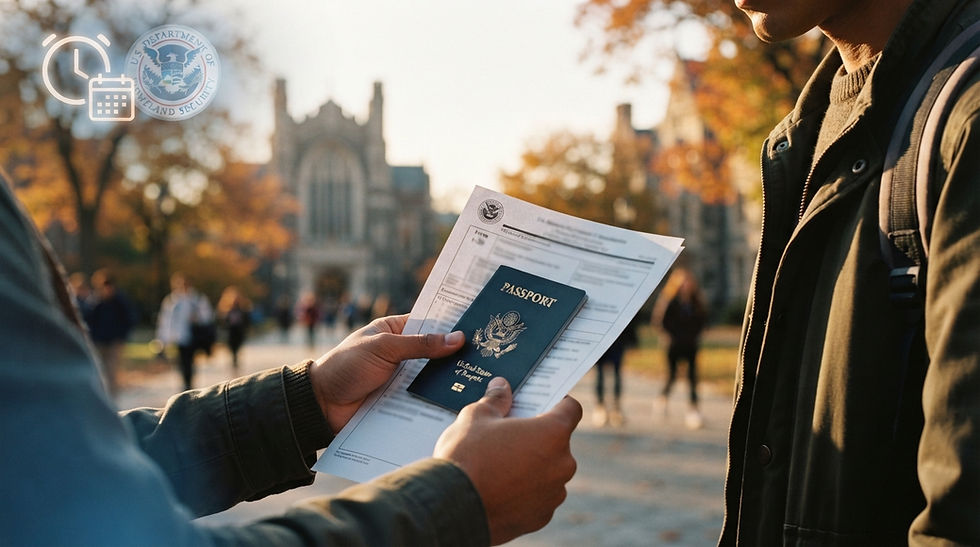
For more than 30 years, the deal for international students in the United States was simple: as long as you stayed enrolled and followed the rules, you didn't need to watch a clock. Your F-1 status lasted for the duration of your studies — that's literally what "Duration of Status," or D/S, means. No fixed expiration date. No countdown.
On Friday, 17 July 2026, the Department of Homeland Security ended that. A new final rule — described by one immigration law firm as the biggest shift to the student visa in decades — replaces D/S with a fixed admission period, capped at four years, for F-1 students, J-1 exchange visitors, and I-visa foreign media representatives. It takes effect 15 September 2026, and it reaches back to touch people already inside the United States right now.
Most coverage of this so far has come from university international-student offices, writing cautiously for their own populations. This is the complete, independent breakdown — what changed, who's affected, the exact dates that matter, and what almost nobody is saying plainly: this rule closes a well-known graduate-school loophole and cuts your safety margin for leaving the country in half.
The core change, in one table
Element | Before (Duration of Status) | After 15 September 2026 (Fixed Period) |
How long you're admitted for | Indefinite — tied to maintaining valid status | Fixed date on Form I-94, based on your I-20/DS-2019 program end date |
Maximum admission period | No cap | 4 years, plus a 30-day arrival buffer and 30-day departure window |
How you extend your stay | Automatic, as long as status was maintained | Must file a formal Extension of Stay (EOS) application with USCIS before your Admit Until Date |
F-1 post-completion grace period | 60 days | 30 days — cut in half, now matching the J-1 standard |
Re-enrolling after finishing a degree | Generally unrestricted | Barred from a new F-1 program at the same or a lower degree level after finishing one |
F-2 / J-2 dependents | Tied to principal's D/S | Fixed date that cannot exceed the principal's new admission date |
Why "up to four years" matters more than it sounds
The fixed period is capped at your program's listed length on the I-20 or DS-2019 — but never more than four years total, including the 30-day arrival and departure buffers. For most bachelor's and master's programs, that's not a practical problem. It becomes one for:
PhD students, whose programs frequently run past four years and will now require at least one formal extension application mid-program
Students who change majors, add a second degree, or take a leave of absence, since any of these can push completion past the original window
Students combining OPT or STEM OPT with their program timeline, where the math can get tight fast
The loophole this rule was clearly built to close
Here's the detail buried in law-firm analysis that deserves far more attention than it's getting: F-1 students who complete a degree program after 15 September 2026 are barred from enrolling in another F-1 program at the same or a lower degree level. For example, a student who already completed a US master's degree would no longer be able to pursue a new bachelor's or master's program under F-1 status.
This directly targets what's known in international education circles as "day-one CPT" — a practice where students who already hold a US master's degree enroll in a second master's program specifically to access Curricular Practical Training work authorization from day one, effectively using a second degree as a legal workaround to extend US work eligibility. DHS didn't announce this as its target explicitly. But the mechanics of the new restriction map almost exactly onto that practice, and its removal is likely to be one of the most consequential — and least discussed — effects of this entire rule.
If you're already in the US on D/S: the transition rules
This is the part every current F-1 and J-1 student needs to actually calculate for themselves, not skim.
Your situation on 15 September 2026 | What happens |
Currently on D/S, program still in progress | Continue without filing anything, up to your I-20/DS-2019 end date, OPT end date, or STEM OPT end date — but never beyond 14 November 2030 (four years plus a 60-day departure period from the rule's effective date) |
Need to stay in the US beyond that outer date | Must file an Extension of Stay (EOS) application with USCIS before reaching it |
Timely filed for post-completion OPT or STEM OPT by 18 March 2027 | No separate EOS filing required — the OPT/STEM OPT approval itself carries you forward |
Beneficiary of a timely filed, cap-subject H-1B petition (cap-gap) | No separate EOS needed — you may remain until the H-1B petition is decided, or 1 April of the relevant fiscal year, whichever comes first |
You travel internationally and re-enter on or after 15 September 2026 | You will be issued a new, fixed-period I-94 at the port of entry, regardless of your prior D/S status |
You were on D/S with the 60-day grace period | You keep the 60-day grace period until you either travel and re-enter, or obtain an extension — at that point you shift to the new 30-day grace period |
That travel detail is easy to miss and important: re-entering the US after 15 September 2026 converts you to the new fixed-period system on the spot, even if you were living comfortably under open-ended D/S beforehand. Multiple university international offices are explicitly advising students to plan return travel carefully around this date, with some recommending arrival before the start of fall classes to avoid any ambiguity at the port of entry.
Why this is happening: DHS's stated rationale
DHS frames the change as a matter of oversight and accountability — a way to allow the agency to more consistently evaluate whether F, J, and I nonimmigrants are actually maintaining their status while in the country, rather than relying on a system with no built-in checkpoint. Losing an open-ended admission period in exchange for a system with hard, verifiable dates does give the government a much cleaner enforcement mechanism: a status either has an active fixed period or it doesn't, with far less room for the ambiguity that made student-visa status notoriously hard to police under D/S.
The rule remains classified as a "major rule" under the Congressional Review Act, meaning Congress has a formal window to review — and potentially disapprove — it before implementation. DHS has stated it will publish updated guidance if that review changes the effective date or blocks the rule outright. Legal challenges are also considered likely by immigration attorneys tracking the rule, meaning 15 September 2026 should be treated as the current target date, not an absolute certainty.
Editorial opinion — Immigrants.live
There's a real, defensible policy argument buried underneath the headline panic here, and it deserves to be stated plainly rather than dismissed: an admissions system built entirely on trust and self-reporting, with no fixed checkpoint, genuinely is harder to enforce than one with clear dates. Most developed countries that host large international student populations already use fixed-period admissions rather than an open-ended "as long as you're enrolled" model. In that narrow sense, this rule brings the US closer to global norms.
But two specific design choices in this rule go well beyond an enforcement fix, and both deserve more scrutiny than they've gotten. First, halving the F-1 grace period from 60 to 30 days doesn't improve enforcement — it simply shrinks the practical window international graduates have to wrap up their affairs, ship belongings, or transition to a new visa status, at exactly the moment their lives are most logistically complicated. Second, quietly closing the door on a second same-level F-1 program does target a real practice that critics have long called a workaround — but it does so through a blanket restriction rather than a targeted rule aimed at the specific behavior DHS says concerns it, which means it will also catch students with entirely legitimate reasons for pursuing a second degree at the same level.
Our take: if you're currently in the US on F-1 or J-1 status, don't wait for your university's official guidance to fully catch up before doing your own math. Calculate your personal "outer date" — program end date, OPT end date, or STEM OPT end date, capped at 14 November 2030 — today, and mark your calendar for when an Extension of Stay filing needs to go in. USCIS processing queues are not built for a sudden wave of first-time EOS applications from a population that never had to file them before.
Frequently asked questions
Does this rule apply to me right now, today, in July 2026? Not yet. Until 15 September 2026, F-1 and J-1 students continue to be admitted under Duration of Status as before. The fixed-period system applies to new admissions on or after that date, and to current D/S holders once they travel and re-enter or need an extension.
Will I be forced to leave the country if my program runs past four years? No — but you will need to file a formal Extension of Stay application with USCIS before your admission period expires, something D/S holders never had to do. Build in extra time for USCIS processing.
Does this affect OPT or STEM OPT directly? Not directly, provided you filed for post-completion OPT or STEM OPT in a timely manner by 18 March 2027 under the transition rules — in that case, no separate EOS filing is required.
I already have a US master's degree. Can I still start a new master's program in F-1 status after September 2026? Based on the final rule, F-1 students who complete a degree program after the effective date cannot enroll in a new F-1 program at the same or a lower degree level. If you're weighing this option, timing your enrollment relative to 15 September 2026 matters significantly — speak with your Designated School Official.
Is this rule guaranteed to take effect on September 15, 2026? It's the current effective date, but the rule is classified as "major" under the Congressional Review Act, giving Congress a formal window to review it, and legal challenges are considered likely. Treat the date as the current target, and watch for updated DHS guidance.
What should I do right now if I'm on F-1 or J-1 status in the US? Calculate your personal outer date under the transition rules, confirm it with your school's international student office, and if you're planning international travel near or after mid-September, build in extra time to understand how re-entry will affect your admission period.
Sources and further reading
U.S. Department of Homeland Security — Final Rule, "Establishing a Fixed Time Period of Admission and an Extension of Stay Procedure for Nonimmigrant Academic Students, Exchange Visitors, and Representatives of Foreign Information Media," Federal Register, 17 July 2026
Study in the States (DHS/SEVP) — Final Rule Quick Facts and FAQ
NAFSA: Association of International Educators — regulatory analysis of the final rule
University international student and scholar offices (Yale OISS, Columbia ISSO, NYU OGS, University of Pittsburgh OIS) — transition guidance for currently enrolled students
Immigration law firm client alerts analyzing the rule's academic mobility restrictions
This article is provided for general informational purposes and reflects publicly available government and legal sources as of July 2026. It is not a substitute for personalized immigration advice from a Designated School Official, Responsible Officer, or licensed immigration attorney. This is a newly finalized, complex rule still subject to Congressional review and potential litigation — always confirm your specific situation with your school's international office before making travel or enrollment decisions.



Komentarze