The Europe Nobody Told You About: 10 Legal Ways to Build a Life in the EU That Most People Never Consider
When people think about moving to Europe, they usually focus on work visas, asylum, marriage, or study programs. Yet every year, thousands of people obtain the right to live in the European Union through legal pathways that rarely make headlines and are often overlooked by migration agencies.
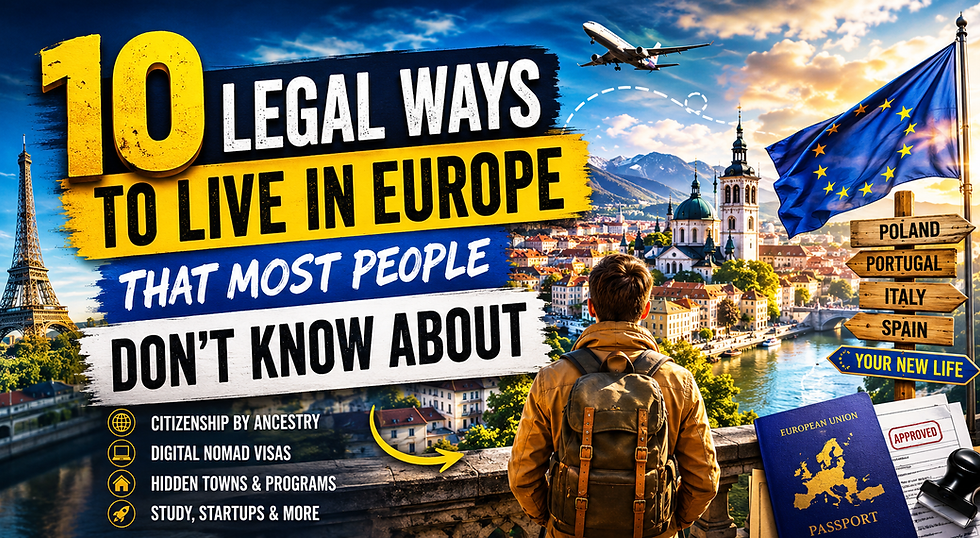
As Europe faces demographic decline, labor shortages, and an aging population, many countries are quietly expanding opportunities for specific groups of newcomers.
The challenge is not always finding a way into Europe.
The challenge is knowing which pathway already fits your personal circumstances.
Why Most People Look in the Wrong Direction
Every year, hundreds of thousands of people begin their immigration journey with the same questions:
How can I get a work visa?
How do I find an employer in Europe?
Can I apply for asylum?
Is marriage the easiest option?
In reality, European immigration systems are far more complex.
Migration specialists often point out that applicants spend years pursuing difficult routes while completely overlooking options that may already be available to them.
“Many people focus exclusively on employment-based migration while ignoring ancestry claims, regional programs, research opportunities, or specialized residence permits that may offer a more realistic path,” says a European migration consultant.
The most successful immigration strategies often begin with a careful assessment of a person's background, skills, family history, and long-term goals.
Citizenship by Ancestry: Your European Connection May Already Exist
For millions of people around the world, citizenship eligibility may already be hidden in their family history.
Many European countries recognize citizenship rights based on ancestry.
Among the most well-known examples are:
Poland
Italy
Ireland
Hungary
Romania
Portugal
Germany (in specific historical cases)
Insider Insight
One of the most common discoveries occurs when applicants investigate family records and uncover connections that previous generations never fully documented.
Sometimes a century-old birth certificate, military record, or immigration document can become the key to an entirely different immigration pathway.
Case Example
A professional from Eastern Europe spent years exploring employment visas before discovering that his grandfather had been born in a territory that later qualified him for an ancestry-based citizenship process. What began as a routine document search eventually opened a completely new route to Europe.
Expert Commentary
“In some cases, locating the documents takes longer than the actual application process. Many families simply don't realize that their own history may contain a legal pathway to European citizenship.”
What Most People Don't Know
Misspelled names do not automatically disqualify an application.
Historical records can often be reconstructed.
Missing originals do not always prevent a successful claim.
Digital Nomad and Remote Worker Residence Permits
A decade ago, this category barely existed.
Today, several European countries offer residence programs specifically designed for remote workers and online entrepreneurs.
Insider Insight
Governments increasingly recognize that remote professionals bring income into local economies without directly competing for domestic jobs.
These programs often attract:
Software developers
Designers
Consultants
Marketing professionals
Content creators
Online business owners
Case Example
A software engineer working remotely for a U.S.-based company relocated to Southern Europe while keeping the same employer, income level, and professional responsibilities.
Expert Commentary
“One of the biggest misconceptions is that you must have a European employer. In many modern residence programs, that is no longer the case.”
Key Requirements
Most programs require evidence of:
Stable income
Health insurance
Accommodation
Legitimate source of funds
Research and Academic Mobility: One of Europe's Best-Kept Secrets

Many people assume research-based immigration is reserved for world-famous academics.
That is often not true.
Insider Insight
European universities and research institutions regularly welcome:
Researchers
Doctoral candidates
Academic staff
Specialists participating in international projects
Case Example
A young researcher from Central Asia received an invitation to join an international research project and obtained legal residence through academic cooperation rather than traditional employment channels.
Hidden Advantage
Research-based permits can sometimes provide smoother transitions toward long-term residence than standard work permits.
Shortage Occupations: Demand Doesn't Always Follow Prestige
When people think of in-demand professions, they often imagine technology or finance.
Yet Europe's labor shortages frequently appear elsewhere.
Insider Insight
Some of the most sought-after workers include:
Nurses
Caregivers
Electricians
Welders
Drivers
Technical specialists
Skilled trades professionals
Case Example
An experienced electrician received multiple employment offers while several university graduates struggled to find sponsorship opportunities.
Recruitment Expert Comment
“Practical skills often create more immigration opportunities than prestigious degrees when labor shortages become severe.”
European Towns That Are Looking for New Residents
When people dream of Europe, they often imagine Berlin, Paris, Amsterdam, or Barcelona.
But another Europe exists beyond the major capitals.
Across several countries, smaller towns face population decline and are actively searching for new residents, entrepreneurs, and skilled workers.
Spain: Communities Fighting Population Loss
Particular attention has focused on regions such as:
Galicia
Asturias
Aragón
Castilla-La Mancha
Extremadura
Many communities face aging populations and declining birth rates.
Case Example
A family relocated from Eastern Europe to a small town in Galicia after one spouse secured remote work. Lower housing costs and a stronger sense of community helped make the transition easier than expected.
Italy: The Famous €1 Homes
Some of the most widely known initiatives include:
Sambuca di Sicilia
Mussomeli
Troina
Biccari
Pratola Peligna
Important Reality Check
The famous €1 homes are not truly free.
Buyers are generally required to renovate the properties within a specific timeframe and invest significant funds into restoration.
Case Example
A North American family purchased a historic property in Sicily, renovated it, and later converted it into a successful tourist accommodation business.
Portugal: Beyond Lisbon and Porto
Growing interest can be seen in cities such as:
Viseu
Bragança
Évora
Beja
Castelo Branco
These areas often provide lower living costs while maintaining a high quality of life.
Case Example
A remote technology professional left a major metropolitan area and relocated to Viseu, reducing housing expenses while maintaining the same international career.
Croatia: An Emerging Destination for Remote Professionals
Popular locations increasingly include:
Zadar
Pula
Osijek
Varaždin
Šibenik
Case Example
A multinational team of software developers chose Zadar as a remote-work base because of its infrastructure, affordability, and coastal lifestyle.
Greece: Regions Seeking a Future
Several islands and rural communities continue to experience population decline.
Case Example
A couple initially moved to a Greek island for a temporary remote-working experiment but eventually decided to settle permanently.
Demographic Expert Comment
“For some European regions, attracting new residents is no longer about growth. It is about survival.”
Where Opportunities Exist
Country | Regions and Cities | Main Advantages |
Spain | Galicia, Asturias, Aragón | Affordable housing, population renewal |
Italy | Sambuca di Sicilia, Biccari, Mussomeli | Revitalization programs |
Portugal | Viseu, Évora, Bragança | Lower cost of living |
Croatia | Zadar, Pula, Osijek | Remote-work infrastructure |
Greece | Smaller islands and rural regions | Demographic initiatives |
Education as a Long-Term Immigration Strategy
Many people view education only as a degree.
In reality, it often serves as the first step toward permanent settlement.
Insider Insight
Several European countries allow graduates additional time to search for employment after completing their studies.
Case Example
An international student completed a master's degree and successfully transitioned into a work-based residence permit without leaving the country.
Common Mistake
Choosing a study program based solely on tuition costs rather than employment prospects.
Startup Visas: Entrepreneurship Instead of Employment
One of the fastest-growing immigration categories in Europe.
Insider Insight
Many applicants assume entrepreneurship requires millions in investment.
In reality, innovation and business potential often matter more than the size of the initial capital.
Case Example
A technology founder obtained residence through a startup program after presenting a viable business plan and scalable concept.
Expert Commentary
“Governments increasingly evaluate future economic contribution rather than simply measuring available capital.”
Time Itself Can Become Your Greatest Immigration Asset
There is one resource that cannot be purchased.
Time.
Every year of legal residence may bring an individual closer to long-term status and greater stability.
Insider Insight
Many immigrants underestimate the importance of maintaining continuous lawful residence.
Case Example
A temporary resident eventually secured long-term status after several years of uninterrupted legal stay.
Humanitarian Pathways Beyond Traditional Asylum
Between standard immigration routes and refugee protection lies a complex middle ground.
Insider Insight
Some countries provide humanitarian residence options for exceptional circumstances that do not fit traditional asylum definitions.
Legal Expert Comment
“There is no universal formula. Humanitarian cases are highly individual and depend heavily on national legislation.”
Your Personal Story May Be Your Greatest Opportunity
After reviewing hundreds of immigration cases, specialists often reach the same conclusion:
The solution is frequently hidden within a person's own life story.
Family history.
Professional experience.
Education.
Research achievements.
Business activity.
Personal circumstances.
What appears insignificant today may become the foundation of a completely different immigration strategy tomorrow.
Case Example
One applicant spent years researching employment-based immigration before discovering that a forgotten family document opened a far more direct pathway.
Schema: 10 legal pathways to residence in Europe
A simplified map of the main legal routes discussed in this article:
1. Citizenship by ancestry
Based on family origin, historical citizenship, or descent rights.
2. Digital nomad residence permits
For remote workers with foreign income and stable earnings.
3. Research and academic mobility
University programs, research institutes, international cooperation projects.
4. Shortage occupation pathways
Work permits in sectors with structural labor shortages.
5. Regional and local settlement programs
Small towns and regions actively attracting new residents.
6. Study-to-residence transition
Legal stay after education with access to job-seeking periods.
7. Startup and entrepreneurship visas
Residence based on business innovation and economic contribution.
8. Long-term residence accumulation
Status gained through continuous legal stay over time.
9. Humanitarian residence pathways
Non-asylum humanitarian grounds under national law.
10. Personal profile-based opportunities
Combined assessment of skills, history, education, and life circumstances.
Key insight from migration specialists
Most successful cases do not follow a single straight path.
They are often a combination of:
eligibility discovery
timing
documentation readiness
and correct legal classification of the applicant’s profile
Five mistakes that prevent people from discovering their real immigration options
1. Focusing only on work visas
Many applicants limit their entire strategy to employment-based migration, ignoring other legal categories they may already qualify for.
2. Ignoring family and historical background
Ancestry-based rights are one of the most overlooked legal pathways, especially for people with complex Eastern European or mixed family histories.
3. Looking only at major cities and popular countries
Migration opportunities are often more accessible in smaller regions and less saturated labor markets.
4. Assuming all visas require high income or savings
Several legal routes are based on skills, documents, or institutional invitations rather than financial thresholds.
5. Treating immigration as a single application instead of a system
Most failures happen because people apply once, rather than exploring multiple parallel legal options.
Closing expert note
“The biggest barrier in European migration is rarely the law itself — it is the inability of applicants to correctly identify which part of the system actually applies to them.”
Five Mistakes That Prevent People From Discovering Their Best Immigration Options
Focusing only on work visas.
Ignoring family history.
Overlooking regional opportunities.
Chasing only the most popular destinations.
Never conducting a full immigration assessment.
Common Myths About Moving to Europe
Myth: You need a university degree.
Myth: You must have tens of thousands of euros in savings.
Myth: Immigration becomes impossible after 40.
Myth: All opportunities have already disappeared.
Myth: Success depends mostly on luck.
Which Professions Could Be Most Valuable by 2030?
Experts increasingly point to:
Healthcare
Elderly care
Engineering
Construction
Energy
Technology
Logistics
Infrastructure maintenance
Europe's demographic trends suggest these sectors may remain critically important for years to come.
Final Thoughts
Europe is gradually moving away from one-size-fits-all immigration models.
The future increasingly favors individuals whose skills, experience, education, and personal circumstances align with specific economic and demographic needs.
The question is no longer:
"How do I get to Europe?"
The more important question may be:
"Which opportunity already exists for me — and I simply haven't discovered it yet?"
Disclaimer
This article is intended for informational and educational purposes only. It does not constitute legal advice, immigration consulting, or official guidance from any government authority.
Immigration laws and eligibility criteria vary significantly by country and are subject to change. Individual outcomes depend on personal circumstances, documentation, and applicable national regulations.
Readers are encouraged to consult qualified legal professionals or official government sources before making any immigration-related decisions or applications.


Komentarze