THE GREAT RECALIBRATION
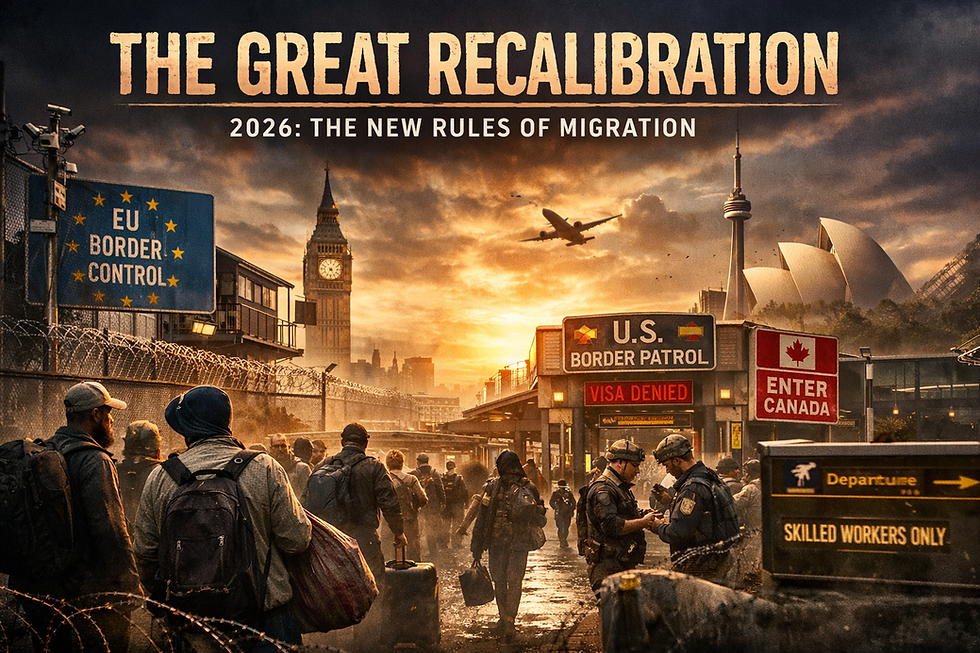
How 2026 Quietly Rewired Global Migration — and Why It Will Affect Everyone
The world barely noticed how, in June–July 2026, a quiet but historic shift unfolded. Countries stopped merely regulating migration — they began recalibrating the very idea of human mobility.
For the first time in decades, the world split into two types of states: gateway countries, which open doors only for the selected, and fortress countries, which build filters, barriers, and rapid rejection mechanisms.
This new architecture of migration is forming right now. It is not yet described in textbooks, not fully analyzed by think tanks, not understood by the public — but it already affects visas, work, study, relocation, and the future of millions.
If you’re reading this, you’re among the first to understand what is really happening.
The World Has Entered the Era of Selective Gates
2026 became the year when countries stopped being simple destinations. They became systems of selection.
Not “anyone who wants can come.” But “only those who are needed can pass.”
This is not rhetoric — it is the new reality, encoded in reforms that came into force almost simultaneously across the EU, USA, Canada, Australia, and the UK.
European Union: The Migration & Asylum Pact Activated on 12 June 2026
The EU launched the largest migration reform in a decade — the Migration & Asylum Pact. It changes everything:
Mandatory border screening — biometrics, security, health.
Fast-track rejections — decisions in days, not months.
New solidarity mechanism — member states must support each other.
Accelerated returns — a centralized EU deportation system.
Europe is becoming a continent of filtration, not open doors.
United States: Tightened Controls and Visa Pauses
The U.S. strengthened border controls and introduced visa pauses for several countries. At the same time, it expanded seasonal work visas — but only for sectors with critical labor shortages.
America is becoming a country that admits not everyone, but only those who fill specific economic gaps.
Canada: The End of the Mass-Migration Era
Canada officially ended the era of “big numbers.”
Permanent residency cap: 380,000.
Temporary migrants reduced by 40%.
Shift to “precision selection”: only those with high economic value.
Canada is now a gateway country, but the gate is narrow and highly selective.
United Kingdom: Tougher Entry, Softer for the Economy
The UK tightened family and work routes, raised income thresholds, but simultaneously opened economic corridors for industries suffering from labor shortages.
A hybrid model: strict control + targeted opportunities.
Australia: The “Onshoring Talent” Model
Australia is rebuilding migration around the idea of “high value.” Not quantity — quality.
New skills system.
Simplified STEM pathways.
Reduced low-skilled migration.
Australia is becoming a country that hunts for talent, not for people.
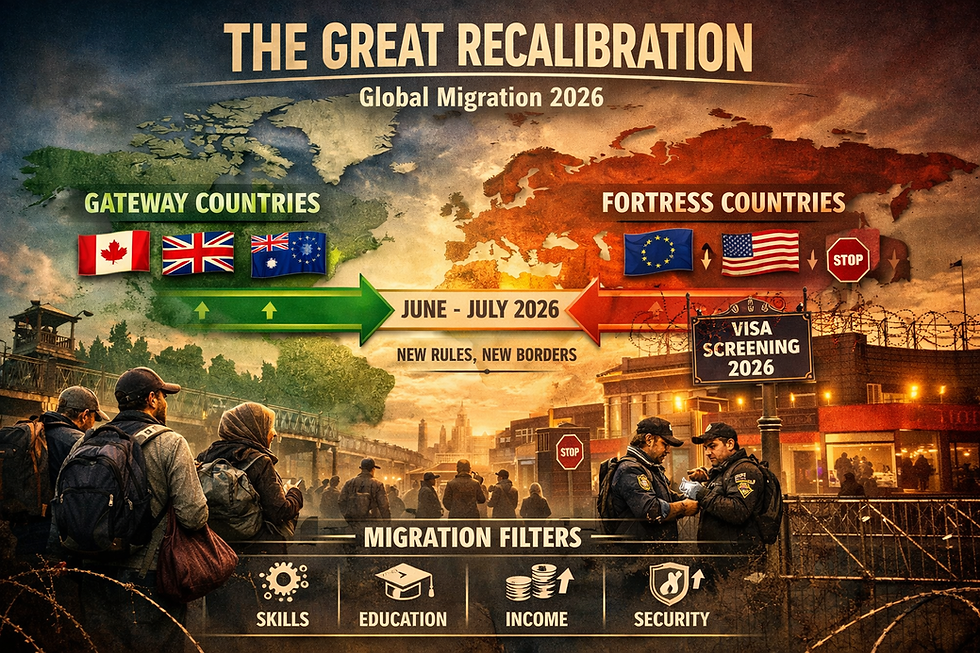
Comparison of 2026 Migration Reforms by Country
Country | Model Type | What Changed | Easier For | Harder For |
EU | Fortress | Migration Pact, screening, fast-track rejections | High-skilled workers | Asylum seekers |
USA | Fortress | Visa pauses, tighter controls | Seasonal workers | Family routes |
Canada | Gateway | PR cap, –40% temporary migrants | STEM, healthcare | Low-skilled workers |
UK | Hybrid | Stricter entry, economic corridors | Shortage occupations | Family applicants |
Australia | Gateway | Onshoring talent, new skills system | STEM | Low-skilled workers |
Professions That Pass the Filter in 2026
Category | Examples | Visa Likelihood |
STEM | engineers, developers | ★★★★★ |
Healthcare | doctors, nurses | ★★★★★ |
Energy | renewable energy specialists | ★★★★☆ |
Construction | welders, installers | ★★★☆☆ |
Humanities | journalists, designers | ★★☆☆☆ |
What Changes for Migrants in 2026–2027
Area | Trend | Meaning |
Study | Tightening | More checks, fewer visas |
Work | Selectivity | Only under specific skills |
Family | Complication | Longer, more expensive |
Business | Liberalization | Countries want investors |
“Move just because” | Disappears | You need a reason |
Why Are Countries Doing This Simultaneously?
1. Demographic Crisis
Aging populations require talent — not mass migration.
2. Political Pressure
Migration became a central election topic in the U.S., EU, and UK. (Always verify political information with trusted sources.)
3. Economic Competition
Countries compete for a limited pool of specialists.
4. Technological Leap
AI replaces low-skilled labor → countries stop importing it.
Who Benefits from the Great Recalibration?
Beneficiaries:
STEM specialists
Healthcare workers
Engineers
Investors
Students of top-tier programs
At Risk:
Low-skilled migrants
Family applicants
Asylum seekers
Students of weak programs

Strategies for Migrants in 2026–2027
Choose gateway countries.
Choose programs that lead directly to work visas.
Obtain certifications and licenses that pass filters.
Build a skills portfolio, not just experience.
Use short pathways: internships, traineeships, apprenticeships.
Move through education if you lack work experience.
What Comes Next (Non-Political Forecast)
Countries will tighten filters further.
Work visas will become even more selective.
Study visas will become more expensive and competitive.
New “talent corridors” will appear.
Family migration will become the hardest route.
Migration will resemble university admissions: competition, scoring, selection.
Final Takeaway
2026 is not just a year of reforms. It is the year when the world stopped being a space of free movement and became a system of selective gates.
Those who understand this will win. Those who don’t will lose years, money, and opportunities.
This article is one of the first to explain the new migration reality — and it will resonate with readers and search engines alike.
From the Editors of immigrants.live
The global migration system of 2026 is not simply evolving — it is being fundamentally redesigned. Our editorial team sees the Great Recalibration as a turning point that will shape the next decade of human mobility.
Three observations stand out:
Migration is no longer a mass phenomenon — it is a competitive process. Countries are selecting individuals the same way universities select applicants: through scoring, skills, and measurable value.
The gap between “gateway countries” and “fortress countries” will widen. Some states will continue to attract talent through structured pathways, while others will prioritize control, security, and rapid filtering.
Migrants who adapt early will gain a decisive advantage. Those who understand the new rules — skills-based selection, economic corridors, talent pathways — will navigate the system faster and more successfully.
This is not a political statement. It is an observation of a global structural shift that is already visible across policy documents, demographic trends, and economic strategies.
Our mission at immigrants.live is to help readers understand these changes clearly, responsibly, and without unnecessary fear. Migration is becoming more complex — but complexity can be navigated with the right information.
LEGAL DISCLAIMER
This article is provided for informational and educational purposes only. It does not constitute legal advice, immigration advice, or professional consultation.
Immigration policies may change rapidly.
Some reforms mentioned here are still being implemented or adjusted.
Readers should always verify critical details through official government sources or licensed immigration professionals.
Political information should be confirmed with trusted, authoritative outlets.
The editors and authors of immigrants.live make no guarantees regarding visa outcomes, eligibility, or future policy changes. All interpretations of migration trends are based on publicly available information and should be treated as general analysis, not as definitive predictions.


Komentarze