The Great Return Machine: Europe's Toughest Migration Crackdown Has Begun
How the European Union Is Quietly Rebuilding Its Migration System and Why Millions of Migrants, Asylum Seekers, and Future Applicants Should Pay Attention
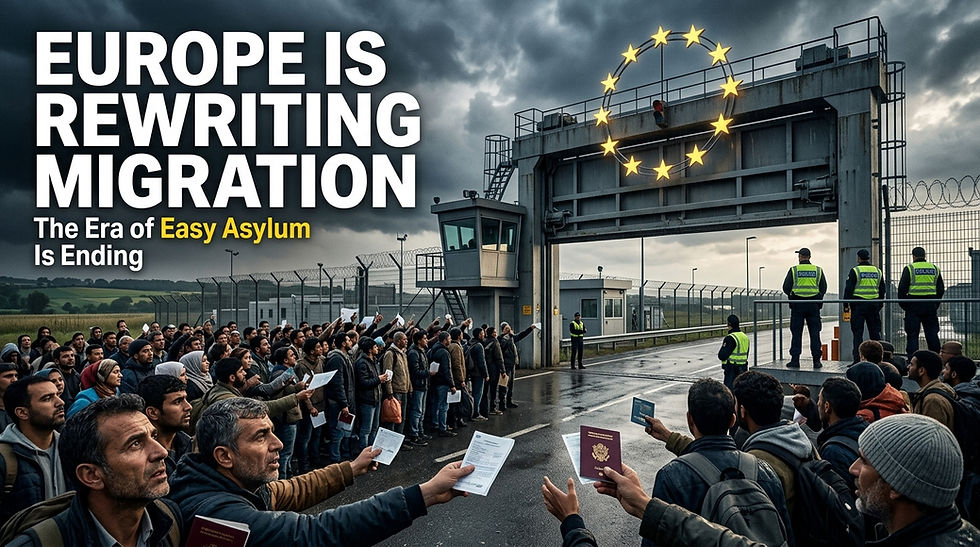
For years, Europe's migration debate seemed trapped in a cycle.
Every major migration surge triggered the same arguments.
Governments promised action.
Opposition parties demanded tougher controls.
European leaders announced reforms.
And yet, the underlying criticism remained remarkably consistent:
Too many people who received orders to leave Europe never actually left.
Now, the European Union believes it has found a solution.
In a move that received far less public attention than previous migration battles, EU governments have formally approved a new system designed to make returns and deportations significantly more effective across the bloc. According to EU officials, roughly two out of every three people ordered to leave the European Union do not actually depart.
The new rules are intended to change that.
And they may represent the most significant transformation of European migration policy in years.
A Quiet Revolution in European Migration Policy
Most migration reforms arrive with dramatic headlines.
This one did not.
Yet its impact could be enormous.
The EU's newly adopted return framework forms part of the wider migration and asylum reforms that began entering into force in 2026. The objective is straightforward:
Create a system that makes migration rules easier to enforce.
European leaders increasingly argue that public confidence in legal migration and asylum systems depends on one basic principle:
People who have a legal right to stay should be protected.
People who do not have a legal right to stay should actually leave.
For years, that second part proved difficult to achieve.
Now Brussels is attempting to redesign the system from the ground up.
Why Europe Is Changing Course
The political pressure has been building for years.
Migration remains one of the most divisive issues across the continent.
From Italy and Germany to the Netherlands, Austria, Denmark, and France, governments have faced increasing demands to demonstrate greater control over borders and migration systems.
At the same time, migration crises repeatedly exposed weaknesses in the existing framework.
Many governments argued that asylum procedures could take years.
Return decisions were often difficult to enforce.
Cooperation between EU member states remained inconsistent.
As a result, policymakers increasingly concluded that the system was no longer sustainable in its current form.
The new return regulation is Europe's answer to that challenge.
The New European Return Order
One of the most important changes is the creation of a European Return Order.
Under the new framework, member states will use a standardized EU-wide document containing the essential elements of a return decision. This allows other member states to recognize and understand decisions issued elsewhere in the Union.
That may sound technical.
In practice, it could dramatically change enforcement.
Critics of the previous system argued that migrants who received return orders in one EU country could move elsewhere within the bloc, creating administrative complications.
European officials believe the new framework will make it easier for governments to coordinate and share information.
Tougher Rules for Those Ordered to Leave
The new rules also increase obligations for people who have no legal right to remain in the European Union.
According to the legislation, individuals will be expected to cooperate with authorities throughout the return process. Failure to cooperate may result in sanctions, including reduced benefits, financial penalties, or other measures permitted under national law.
The EU is effectively moving toward a system where refusing to engage with the return process becomes increasingly difficult.
Supporters say this is necessary to restore credibility to migration policies.
Critics argue it risks creating new legal and humanitarian challenges.
The debate is only beginning.
The Most Controversial Idea: Return Hubs
If there is one aspect of the new system likely to dominate future headlines, it is the concept of "return hubs."
The new rules create a legal basis for EU countries to establish return facilities in non-EU countries under specific agreements. These arrangements would apply to people who have no legal right to remain in the Union and are subject to return procedures.
Supporters view the idea as a practical solution to one of Europe's biggest migration problems.
Critics see it as a potential outsourcing of responsibilities beyond EU borders.
Either way, return hubs represent a major departure from how Europe traditionally approached migration management.
And they could become one of the defining migration debates of the next decade.
Security Risks and Stronger Enforcement
The regulation introduces special provisions for individuals considered security risks.
According to the adopted rules, member states may issue longer entry bans and apply extended detention measures in certain cases involving security concerns.
European governments argue these measures are necessary to address situations where national security considerations play a role.
Human rights organizations are expected to scrutinize how these provisions are implemented in practice.
What Does This Mean for Asylum Seekers?
The EU insists that all return measures must be implemented with full respect for fundamental rights and international obligations.
However, migration lawyers and advocacy groups will undoubtedly watch closely to see how these commitments translate into real-world enforcement.
For future asylum applicants, the broader message is clear:
Europe is moving toward faster decisions, stricter procedures, and stronger enforcement mechanisms.
The Bigger Political Shift
The most important part of this story may not be the regulation itself.
It is what the regulation reveals about Europe's political direction.
For decades, debates focused largely on how Europe should receive migrants.
Today, increasing attention is being paid to how Europe removes people whose claims have been rejected.
That shift reflects a wider transformation occurring across the continent.
Migration policy is increasingly moving away from emergency responses and toward long-term systems designed around enforcement, returns, and external cooperation.
Whether one views that trend positively or negatively, it is becoming difficult to ignore.
Europe's New Migration Era
Europe is not closing its borders.
Nor is it abandoning asylum.
But it is clearly redefining how migration management works.
The adoption of the new return regulation signals that the European Union wants a system where migration decisions lead to tangible outcomes, whether that means protection, residence, integration, or return.
The era of migration policy built primarily around arrivals may be ending.
A new era focused on enforcement has begun.
Conclusion
The migration debate has shaped European politics for more than a decade.
Now the European Union is attempting something different.
Instead of focusing only on who enters Europe, it is investing significant political and legal effort into determining who leaves.
The newly approved return rules, the European Return Order, stronger enforcement mechanisms, and the possibility of return hubs outside the EU are all pieces of the same puzzle.
For supporters, these reforms represent overdue modernization.
For critics, they raise serious questions about rights, accountability, and the future of asylum.
For everyone else, they signal something larger:
Europe's migration system is entering a new chapter, and its consequences will be felt far beyond Brussels.



Komentarze