The Migration Singularity
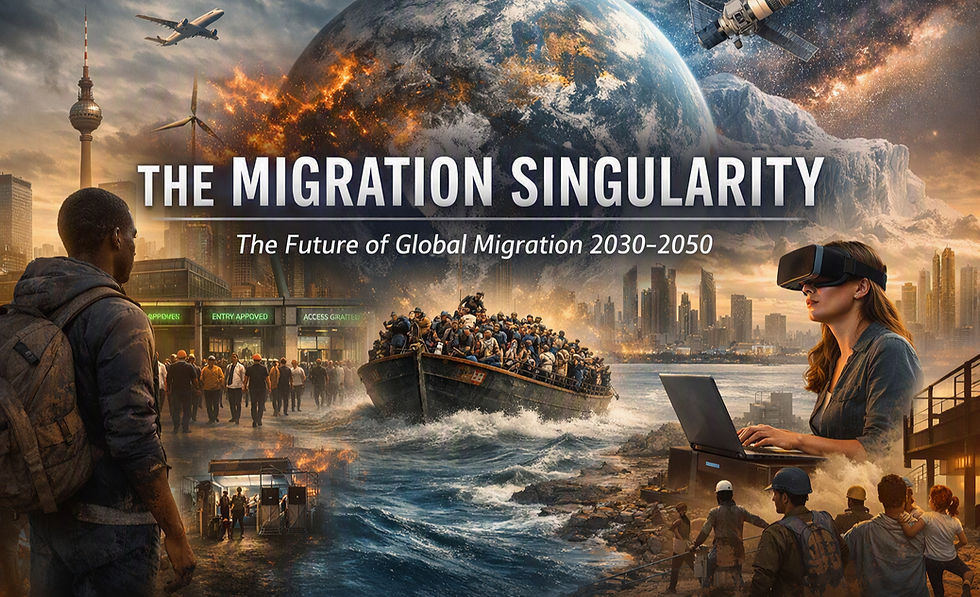
How Migration Is Becoming the World’s Most Powerful Force
Key Takeaways
Global migration trends show a shift from movement to power.
Countries compete for migrants to solve demographic crises.
Climate migration will reshape global population maps by 2050.
Digital nomads and AI workers redefine borders and citizenship.
A new type of nation emerges: the Migration‑Driven State.
Global Migration Trends (2030–2050)
The Demographic Crisis Driving the Future of Migration.
Europe’s Aging Population
Europe faces the fastest demographic decline in modern history. Germany, Poland, Spain, and Portugal are entering a labor shortage era, making labor migration essential for economic survival.
Asia’s Population Paradox
China’s population decline threatens its long‑term economic stability. Japan and South Korea are becoming the world’s oldest societies, accelerating demand for foreign workers.
Africa’s Youth Boom
By 2050, one in three young people globally will be African. African migration will become the defining force of global labor markets.
Related deep dive:
global migration trends
demographic crisis analysis
Migration Geopolitics: Why Countries Compete for People
Human Capital Wars and the New Global Power Map.
Migration as Currency
Countries now treat migration as a strategic resource, competing for skilled workers, healthcare professionals, and tech talent.
Key Migration Corridors
Germany–Kenya labor pact
Poland–Philippines healthcare corridor
USA–India tech migration pipeline
Portugal–Brazil Lusophone mobility zone
These agreements form the backbone of migration geopolitics.
Explore more:
migration geopolitics
labor migration systems
Climate Migration: The Largest Human Movement in History
Migration Statistics 2050 and Climate‑Driven Displacement.
Climate Migration Will Reshape the Planet
Up to 1.2 billion people may be displaced by climate change by 2050. Entire regions will become uninhabitable due to heat, drought, and rising sea levels.
Future Migration Flows
South Asia → Gulf States, Europe
Central Africa → North Africa, Europe
South America → USA, Canada
Climate migration becomes not a choice — but survival.
Related:
climate migration
migration statistics 2050
Digital Nomads and AI Migrants: The Future of Borders
How Technology Redefines Citizenship and Mobility
Digital Nomads
Millions of workers now choose countries based on lifestyle, cost, and visa flexibility. Lisbon, Barcelona, Mexico City, and Tbilisi are emerging migration hubs.
AI Migrants
Workers contribute to global companies without crossing borders. This creates a new category of digital migration.
Cloud Citizenship
Countries like Estonia, UAE, and Portugal experiment with digital citizenship, allowing global participation without physical presence.
Explore:
digital nomads
cloud citizenship
Migration‑Driven States Explained
Countries Built on Migration as Their Core Strategy.
What Is a Migration‑Driven State?
A nation that builds its economy, culture, and political identity around migration.
Leading Examples
Canada — precision immigration system
Portugal — flexible visas, digital nomads
UAE — migration‑powered hyper‑economy
Germany — transitioning into a migration‑dependent industrial state
Poland — on the threshold of transformation
Learn more:
migration-driven states
Migration Predictions 2030–2050
What Will Change in the Next Two Decades.
Key Predictions
Borders become fully algorithmic.
Citizenship becomes digital and subscription‑based.
Migration becomes the world’s most valuable currency.
Climate reshapes human geography.
Nations compete for migrants to survive economically.
Explore:
migration predictions
FAQ: Future of Migration
Answers to the Most Searched Questions About Global Migration.
What is the Migration Singularity?
A point where migration becomes the primary force shaping global politics, economics, and demographics.
Which countries will need migrants the most?
Germany, Poland, Spain, Portugal, Japan, South Korea, Canada, and the UAE.
How will climate change affect migration?
It will trigger the largest human movement in history, with over 1 billion displaced.
Will digital nomads replace traditional migrants?
They will complement traditional migration, not replace it.
What is a migration-driven state?
A country that builds its future around attracting and integrating migrants.
Conclusion: Migration Is Power
Migration is no longer the movement of people — it is the movement of power. The world is entering a Migration Singularity, where human mobility becomes the defining force of civilization.
Editorial Opinion
Why the Migration Singularity Is the Defining Global Shift of Our Century.
The editorial board of immigrants.live believes the world is entering a historic moment where migration becomes the central axis of global transformation. This is not a temporary trend, nor a cyclical fluctuation. It is a structural shift — one that will define the next fifty years of geopolitics, economics, and human geography.
The evidence is overwhelming. Demographic decline is accelerating across Europe and East Asia. Climate migration is no longer a distant scenario but an active force reshaping entire regions. Digital nomads and AI‑enabled workers are dissolving traditional borders. Nations are rewriting immigration systems at unprecedented speed, not out of ideological preference, but out of necessity.
From our perspective, the Migration Singularity marks the moment when migration stops being a reaction to global change and becomes the engine driving it. Countries that understand this — and build policy around it — will thrive. Those that resist it will face economic stagnation, political instability, and demographic collapse.
We see three truths emerging:
Migration is now a form of power. Nations compete for people the way they once competed for territory or resources.
Migration is becoming the world’s most valuable currency. Talent, youth, and mobility determine which economies grow and which decline.
Migration will define the global order more than ideology or military strength. The countries that adapt fastest will shape the future.
The editorial board believes that societies must shift from fear‑based narratives to strategic thinking. Migration is not a threat — it is a solution. It is the mechanism through which economies renew themselves, cultures evolve, and nations survive demographic and climate shocks.
The world is not simply experiencing more migration. The world is reorganizing around migration.
This is the Migration Singularity. And it is already here.



Komentarze