The World's Hardest Citizenships to Earn in 2026
- 9 lip
- 3 minut(y) czytania
Some countries welcome new citizens. Others make citizenship so difficult that even decades of legal residence may not be enough.

For millions of immigrants, citizenship represents the end of a long journey. It brings security, political rights, and a permanent place to call home. Yet around the world, not all passports are equally attainable.
While some countries offer clear and predictable paths to naturalization, others maintain some of the strictest citizenship systems on Earth. In these places, applicants may face decades of residency requirements, demanding language exams, restrictions on dual nationality, or discretionary approval that leaves no guarantee of success.
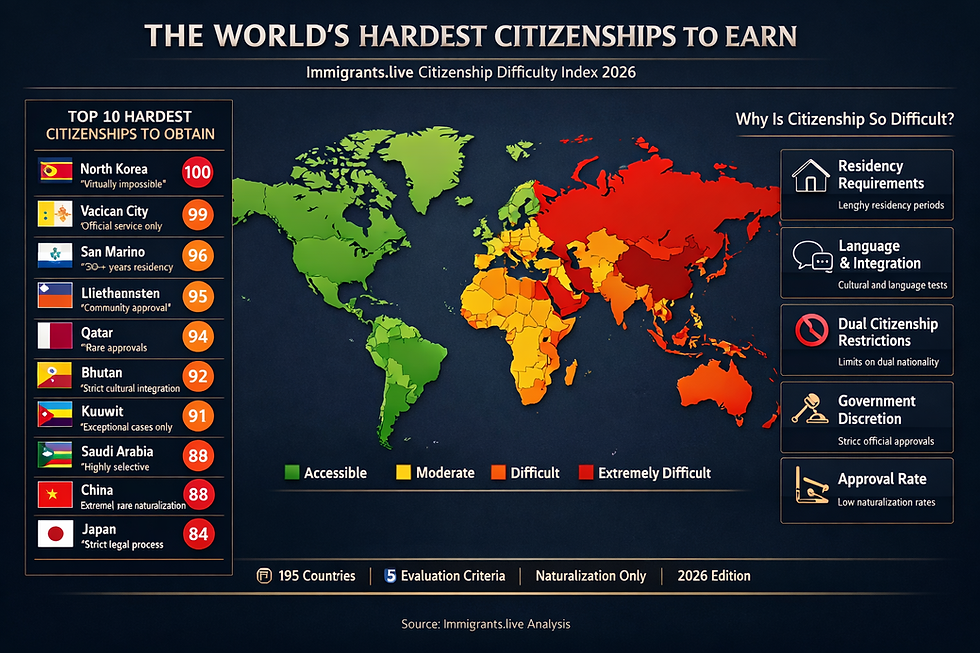
To better understand these differences, Immigrants.live created the 2026 Citizenship Difficulty Index, comparing countries across five measurable factors:
Minimum legal residency required
Language and civic integration requirements
Acceptance of dual citizenship
Transparency of the naturalization process
Practical likelihood of approval
The result is not a ranking of the "best" passports, but of the most difficult citizenships to obtain through naturalization.
The 10 Hardest Citizenships to Obtain in 2026
Rank | Country | Why it's difficult | Difficulty Score |
1 | North Korea | No practical naturalization pathway for foreigners | 100 |
2 | Vatican City | Citizenship linked to official service, not standard immigration | 99 |
3 | San Marino | Extremely long residency requirement | 96 |
4 | Liechtenstein | Up to 30 years of residence and strict local approval | 95 |
5 | Qatar | Long residency, Arabic proficiency, very rare approvals | 94 |
6 | Bhutan | Strong cultural integration requirements | 92 |
7 | Kuwait | Citizenship granted only in exceptional circumstances | 91 |
8 | Saudi Arabia | Highly selective, points-based and discretionary decisions | 89 |
9 | China | Naturalization available only in exceptional cases | 88 |
10 | Japan | Strict review process and limits around dual nationality | 84 |
Why These Countries Rank So Highly
🇰🇵 North Korea
Foreign nationals have virtually no realistic pathway to acquire North Korean citizenship. Publicly available information on naturalization is extremely limited, and there are no known regular immigration channels leading to citizenship.
🇻🇦 Vatican City
Unlike other states, Vatican citizenship is generally tied to employment or official service within the Holy See. It is not something immigrants can ordinarily apply for after living in the country.
🇸🇲 San Marino
One of Europe's smallest countries also has one of its longest naturalization timelines. Foreign residents generally face decades of lawful residence before becoming eligible to apply.
🇱🇮 Liechtenstein
Liechtenstein combines a very long residence requirement with a highly selective process. In many cases, local community support plays an important role before citizenship can be granted.
🇶🇦 Qatar
Although long-term residents contribute significantly to the country's economy, citizenship remains exceptionally rare. Even after meeting formal residency requirements, approval is entirely discretionary.
What Makes Citizenship So Difficult?
Our analysis identified five factors that consistently increase the difficulty of naturalization:
Long Residence Requirements
Many countries require between 20 and 30 years of uninterrupted legal residence before an application can even be submitted.
Language and Integration
Applicants may need to demonstrate advanced language skills, civic knowledge, and cultural integration through examinations or interviews.
Restrictions on Dual Citizenship
Some countries require applicants to renounce their previous nationality, making the decision far more consequential.
Limited Government Discretion
Even applicants who satisfy every published requirement may still be denied citizenship if authorities retain broad discretionary powers.
Exceptionally Low Approval Rates
In several countries, only a handful of foreign nationals become citizens each year despite large expatriate populations.
Not Impossible—Just Extremely Rare
It is important to distinguish between legal difficulty and practical rarity.
Countries such as Japan have clearly defined legal pathways, but applicants face extensive scrutiny and strict compliance requirements. Others, such as Qatar or Kuwait, legally allow naturalization yet grant citizenship only in exceptional circumstances.
Meanwhile, places like Vatican City operate under entirely different legal principles, where citizenship depends on institutional service rather than a traditional immigration process.
Methodology
The Immigrants.live Citizenship Difficulty Index 2026 evaluates naturalization systems using publicly available legislation, official government guidance, and comparative legal analysis. Each country was assessed using five criteria:
Minimum residency requirement
Language and civic integration obligations
Dual citizenship policy
Transparency of the legal framework
Practical accessibility of citizenship through naturalization
This ranking focuses exclusively on naturalization for foreign residents and does not assess citizenship by birth, descent, marriage, or investment.


Komentarze