A Judge Stopped USCIS's New Fee Rules the Night Before They Took Effect. Here's What Actually Changed.
Picture this: you have Temporary Protected Status. You've already renewed your work permit once under the current rules. You're expecting it to stay valid until the date printed on it. Then, one evening in July, you find out that starting tomorrow, that date might not count anymore — the government wants to shorten it, retroactively, based on a law that didn't even exist when you first applied.
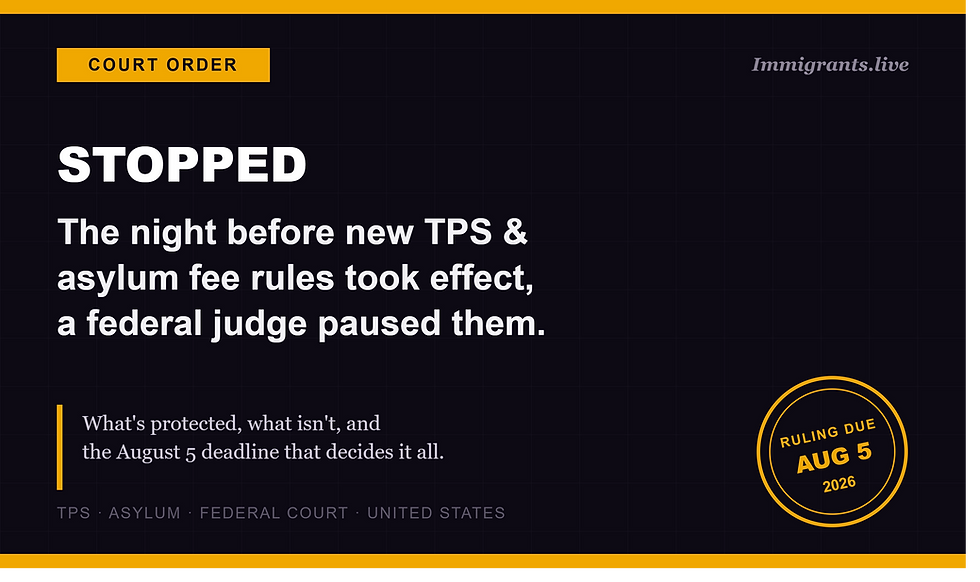
That was the reality facing hundreds of thousands of TPS holders and people with pending asylum cases on July 21, 2026. The new rule was set to kick in on July 22. Instead, a federal judge in Massachusetts stepped in the night before and pressed pause.
This didn't cancel the new fees or reverse the underlying law. It's narrower and more specific than that — but it matters a lot if you're one of the people affected. Here's the plain version of what happened, what it means for you right now, and what's still uncertain.
First, some background: where these fees came from
In July 2025, Congress passed a large tax and spending bill — officially H.R. 1, nicknamed the "One Big Beautiful Bill Act" — that quietly rewrote a lot of the financial rules around asylum and Temporary Protected Status. Before this law, applying for asylum was free, and there was no yearly fee just to keep a case pending. That changed.
Here's what got more expensive, in plain terms:
What you're doing | What it used to cost | What it costs now |
Filing for asylum | Free | $100 |
Keeping an asylum case pending, per year | Free | $100 every year it's still pending |
Getting your first work permit (asylum, parole, or TPS) | Lower cost | $550 |
Renewing that work permit | Lower cost | $275 |
Getting a fee waived if you can't afford it | Usually possible | No longer allowed for these specific fees |
On top of the money, there was a second change that turned out to matter even more: TPS work permits would now only be valid for one year, or however long is left on your TPS status — whichever is shorter. For a lot of people, that's a real cut from what they had before.
USCIS spent the following months turning this into actual policy — through a public notice in 2025, an update to their website in March 2026, and a formal rule that took effect on May 29, 2026. Under that rule, if you didn't pay the new yearly asylum fee, USCIS would reject your work permit application. If you already had a work permit tied to your case, you'd lose it immediately.
The part that ended up in court wasn't the fee itself — it was the decision to apply the new, shorter work permit rule backward, to people whose permits had already been extended under the old rules before this law even existed.
What the judge actually did
On July 21, 2026, Judge Nathaniel Gorton issued what's called an emergency stay — think of it as hitting pause on a policy while a court decides if it's fair to let it start at all. This wasn't the final word on the case. It was a "wait, not so fast" order, granted because the new rules were about to take effect the very next day and the harm would already be done by the time a normal court schedule played out.
The pause specifically covers four things:
USCIS can't shorten a work permit that was already extended. If your TPS work permit had a later expiration date under the old rules, that date stands — for now.
USCIS can't reject an asylum application just because the yearly fee wasn't paid.
USCIS can't take away someone's work authorization just because that fee wasn't paid.
USCIS can't start deportation proceedings based on the same nonpayment.
Everything else about the new law is still in force. New applicants are still paying the $100 asylum fee and the $550/$275 work permit fees. The one-year cap on TPS work permits still applies going forward. This ruling only protects people from having the rules applied backward onto situations that already existed.
Who brought this case? A group that included the National TPS Alliance, the Venezuelan Association of Massachusetts, two SEIU labor unions, and the Asylum Seeker Advocacy Project. They sued USCIS and its leadership — Director Joseph Edlow and DHS Secretary Markwayne Mullin — arguing this specific piece of the rollout was both unfair and rushed.
USCIS said it would follow the order while the case continues. DHS's public response was blunter — the agency said it "vehemently disagrees" and is figuring out its next move, which almost certainly means an appeal or an attempt to rewrite the rule in a way that avoids this exact objection.
What this actually means for you, right now
Your situation | Where things stand today |
Your TPS work permit was already extended under the old rules | It keeps its original expiration date — the government can't shorten it while this stay is active |
You have a pending asylum case and haven't paid the new yearly fee | Your case can't be rejected for that, and your work permit can't be pulled, at least for now |
You're a TPS holder from Haiti | USCIS put out specific instructions on July 24 for how employers should fill out your paperwork during this pause — see the note below |
You're applying for a brand-new work permit under asylum, parole, or TPS | You're still paying the new $550 (or $275 for renewal) fee — that part wasn't touched |
You're filing a new asylum application | The $100 filing fee still applies |
If you're a Haitian TPS holder and your employer needs to update your paperwork: USCIS said employers should write "as per court order" in Section 1 of Form I-9, and "July 27, 2026" in Section 2, with a note pointing to the official TPS Haiti page.
There's also a second, separate lawsuit worth knowing about. The Asylum Seeker Advocacy Project is challenging the $100 yearly asylum fee directly, in its own case — and while that plays out, payment of that specific fee has effectively been put on hold too. It's a related fight, running on its own timeline, not the same case as the one above.
Why this matters more than "a rule got delayed"
Here's the part worth sitting with for a second, because it's easy to miss in the legal back-and-forth: courts generally aren't in the business of second-guessing whether Congress can create a new fee. It can, and it did. What courts do take seriously — pretty consistently, across administrations and across issues that have nothing to do with immigration — is when an agency tries to apply a brand-new burden backward, onto people who already had something settled under the old rules. That's the actual legal question here, and it's a narrower, more technical one than the headlines suggest.
That also tells you something about what happens next. DHS pushing back hard doesn't mean this fight is over — it probably means the agency tries again, either through an appeal or a rewritten version of the rule that sidesteps the retroactivity problem specifically, while keeping everything else in place.
So if this affects you, don't treat this as solved. Treat it as a pause with an expiration date: the court says it will rule on the bigger question — whether to make this protection last through the full legal process — by August 5, 2026. Whatever you were planning to do about your status or your paperwork, do it with that date in mind, not after it.
A few practical things worth doing now if you're affected: keep a copy of your original work permit and its original expiration date somewhere safe, in case this protection changes after August 5. Don't assume the fees themselves have gone away — most of them haven't. And if you're not sure how any of this applies to your specific case, this is exactly the kind of situation where twenty minutes with an immigration attorney or a reputable nonprofit legal service is worth far more than reading any article, including this one.
Common questions
Does this mean the new fees are cancelled? No. The $100 asylum fee, the yearly $100 fee, and the $550/$275 work permit fees are all still in effect for anything not specifically covered by this pause. What got paused was applying the shorter work-permit rule backward, and penalizing people for not paying fees while that fight plays out.
Is my TPS work permit safe? If it was already extended under the old rules, its original date holds for now. That could change depending on what the court decides by August 5, so keep checking your status and don't assume this is permanent.
What happens on August 5, 2026? The court rules on whether to extend this protection while the full case is argued, or let it expire. That decision will directly affect anyone this stay is currently protecting.
Do I still need to pay the yearly asylum fee? A separate lawsuit has paused that specific payment requirement while it's being challenged in court — but this is moving fast, so confirm your current status with USCIS or a lawyer rather than relying on what you read here today.
I'm an employer with a Haitian TPS employee — what do I put on the I-9? Write "as per court order" in Section 1 and "July 27, 2026" in Section 2, and attach a note referencing USCIS's TPS Haiti page. Check that page directly for any updates.
Where this comes from
U.S. District Court for the District of Massachusetts — Venezuelan Association of Massachusetts, et al. v. USCIS, et al., No. 1:26-cv-13038-NMG, order issued July 21, 2026
USCIS — official alert on the court's administrative stay
USCIS — Temporary Protected Status page, including the Haiti-specific Form I-9 guidance from July 24, 2026
USCIS — official notice on new H.R. 1 fees
National TPS Alliance — guidance letter for employers
National Immigration Forum — summary of the immigration provisions in H.R. 1
Asylum Seeker Advocacy Project — tracker on the separate Annual Asylum Fee lawsuit
This is general information based on public court records and government sources as of July 2026, not legal advice. This case is still moving, with a court decision expected by August 5, 2026. If this affects you personally, talk to USCIS directly or a licensed immigration attorney before making decisions based on this or any other article.


Komentarze