“A Targeted Enforcement That Ended in Death”: The Fatal ICE Shooting in Houston Raises Alarming Questions
- 8 lip
- 5 minut(y) czytania
immigrants.live — July 8, 2026
A Routine Operation That Turned Deadly
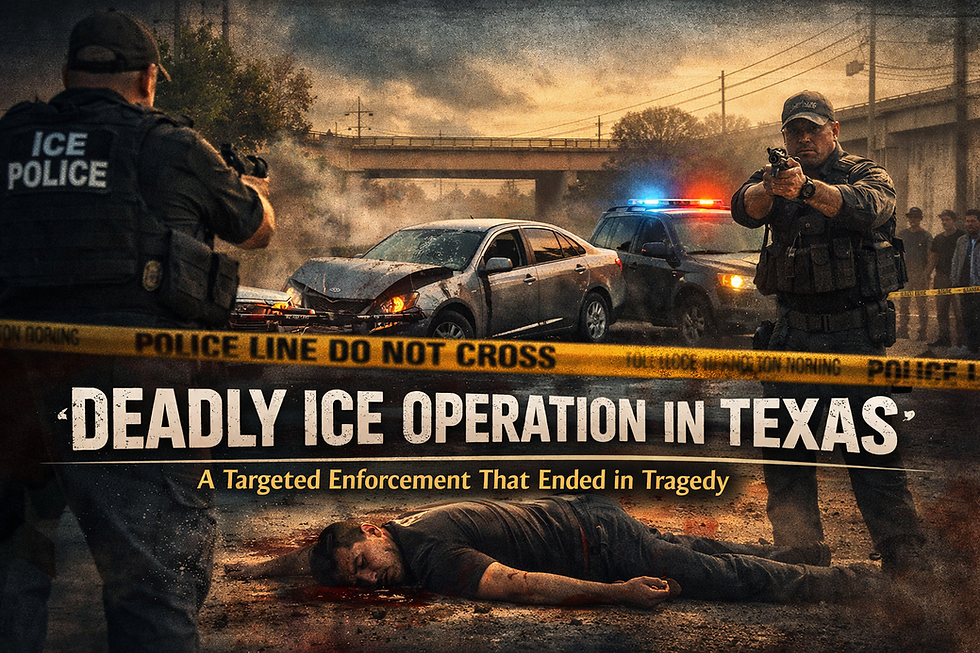
At 6:50 a.m. on July 7, a U.S. Immigration and Customs Enforcement (ICE) operation in Houston’s East End escalated into a fatal encounter. The man behind the wheel — Lorenzo Salgado Araujo, a Mexican national — was shot by an ICE officer during what the agency described as a “targeted enforcement operation.” He later died at the hospital.
ICE officials say Araujo ignored commands, attempted to flee, and used his vehicle as a weapon, allegedly trying to run over an officer. The agent fired in what ICE calls self‑defense.
But by evening, a competing narrative had already taken shape.
“My father did not deserve this” — A Family Rejects the Official Story
Araujo’s family publicly disputed ICE’s account within hours.
“My father did not deserve this.”
His son’s statement spread quickly across Houston’s Latino community. Relatives insist the agency’s description is false, accusing ICE of excessive force and racial profiling.
Their version directly contradicts ICE’s claims — and adds emotional weight to a case already inflaming tensions in a city where immigration enforcement is a daily reality.
A Death That Fits a Troubling Pattern
Araujo is not the first person killed during an ICE operation in 2026. Fatal encounters have risen since President Trump returned to office, according to multiple reports.
Advocacy groups argue that ICE’s tactics — especially vehicle‑based stops — have become more aggressive, less transparent, and far more dangerous.
The Houston shooting is now part of a growing national debate: How far can immigration enforcement go before it becomes a public safety threat?
Houston Demands Answers
Local leaders and civil rights organizations reacted swiftly.
LULAC called the incident “deeply troubling.”
The group offered a $5,000 reward for information — a rare step that signals profound distrust of ICE’s narrative.
Community organizers demanded an independent investigation.
The FBI has already opened an inquiry.
Houston has seen immigration raids before. But this one felt different — more chaotic, more violent, more final.
The Scene on Canal Street
Witnesses described a tense, disorienting moment:
A vehicle stop. Shouts. A collision. A single gunshot. A man bleeding on Canal Street in Magnolia Park — a neighborhood built by immigrants.
By nightfall, candles and flowers appeared at the site. Two women knelt beside them, praying.
The city was quiet, but not calm.
The Legal Question: When Is Deadly Force Justified?
ICE officers may use deadly force only when facing an imminent threat to life.
ICE insists that threshold was met: Araujo allegedly rammed an ICE vehicle and weaponized his car.
Civil rights groups counter that ICE’s vehicle‑stop tactics have become reckless, creating situations where escalation is almost inevitable.
The contradiction is stark:
ICE: The officer acted to save a life.
Family: The officer took a life without justification.
Only an independent investigation can determine which version is true.
Why This Case Matters Beyond Houston
This shooting is more than a local tragedy. It is a national test case for the future of immigration enforcement.
Three reasons:
It exposes the risks of ICE’s increasingly aggressive vehicle stops.
It highlights racial profiling concerns in Latino communities.
It raises accountability questions at a moment when federal agencies wield expanded authority.
This is not just about one man. This is about the system that killed him.
The Line People Will Quote
“A targeted enforcement operation is supposed to end with an arrest — not a funeral.”
This sentence captures the core of the tragedy: a routine ICE stop that became a fatal encounter, leaving a family grieving and a city demanding answers.
What Happens Next
The FBI investigation will determine whether the shooting was justified.
Houston leaders are pushing for full transparency.
Civil rights groups are preparing for legal action.
Community organizations are planning vigils and protests.
And immigrants across the country are watching — because what happened on Canal Street could happen anywhere.
Final Takeaway
The death of Lorenzo Salgado Araujo is a story about power, fear, and the thin line between enforcement and tragedy. It is a story that demands scrutiny. And it is a story that will not fade quietly.

Editorial Opinion
The death of Lorenzo Salgado Araujo is not merely a tragic footnote in America’s immigration debate — it is a warning signal. When a targeted enforcement operation ends with a fatal gunshot on a residential street, the question is no longer whether ICE followed protocol. The question is whether the protocol itself has drifted beyond the boundaries of what a democratic society should accept.
ICE insists the shooting was an act of self‑defense. The family insists it was an act of unjustified force. Both narratives deserve investigation. But one fact is undeniable: a man is dead after an operation designed to detain, not kill.
This incident reflects a deeper structural problem. Over the past year, ICE’s enforcement posture has grown more aggressive, more opaque, and more willing to escalate routine encounters into high‑risk confrontations. Vehicle‑based stops — already among the most dangerous forms of policing — have become a central tool of immigration enforcement. That shift carries consequences, and Houston is now living with one of them.
The United States cannot afford an immigration system where fatal outcomes become normalized. Enforcement must be firm, but it must also be accountable. It must be lawful, but it must also be humane. And above all, it must be designed to protect life — not end it.
The tragedy on Canal Street demands more than condolences. It demands transparency, independent oversight, and a national conversation about the limits of federal power. Because if a targeted enforcement operation can end with a funeral, then something fundamental has gone wrong.
A government’s authority is measured not by its ability to enforce the law, but by its ability to do so without sacrificing human life unnecessarily.
This case forces us to confront whether that standard is still being met.
Legal & Political Disclaimer
This article includes reporting on an ongoing law‑enforcement incident. Key details — including the precise sequence of events, the officer’s actions, and the circumstances leading to the shooting — remain under investigation by federal and local authorities.
The FBI inquiry is active.
No official determination has been made regarding the justification of the use of force.
All descriptions of the incident reflect publicly available statements from ICE, family members, and community organizations.
This editorial section represents the publication’s perspective, not established legal fact.
Readers should consult official releases and trusted news sources as new information becomes available.
This content does not constitute legal advice, political advocacy, or a definitive account of the incident. It is an editorial analysis intended to highlight systemic issues surrounding immigration enforcement and public accountability.



Komentarze