The Supreme Court Said No. Now They Want to Stop Pregnant Women at the Border
- 7 lip
- 11 minut(y) czytania
July 7, 2026 | United States | Birthright Citizenship | Birth Tourism | Immigration Policy
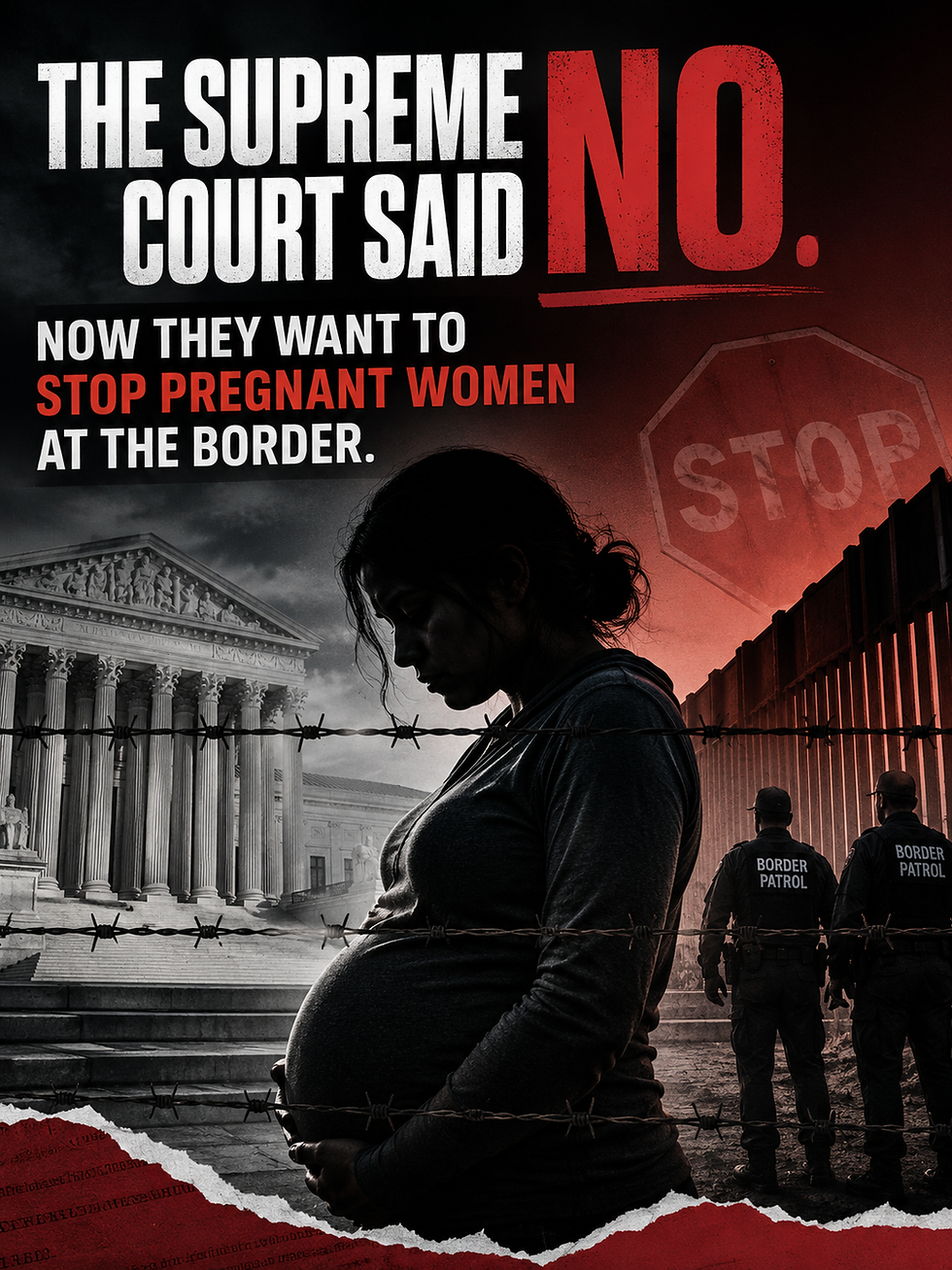
The Supreme Court ruled 6-3 on June 30. The Constitution holds. Children born in the United States are citizens. The case is closed.
The meeting at the White House started the same afternoon.
Stephen Miller, Tom Homan, and DHS Secretary Markwayne Mullin gathered with President Trump within hours of the ruling to discuss what comes next. According to Mullin, who described the session on Fox News the following morning, the conversation was long and the options on the table were broad. Within 24 hours, those options had leaked to reporters at Axios, Politico, and The 19th News — and the most striking one was this: if the courts won't let you strip citizenship from children born in America, consider stopping certain pregnant women from getting here in the first place.
The proposal is not yet policy. It may never become policy. But it is being discussed at the highest levels of the administration, it has been endorsed by name by three of the most powerful immigration figures in the federal government, and it has already produced at least two legislative proposals in Congress.
Here is everything you need to know about what is being considered, what is legally possible, what the numbers actually say about the problem being targeted, and what all of this means for pregnant women who travel to or live in the United States.
Within hours of losing Trump v. Barbara, the administration began discussing banning pregnant foreigners from entering the US. Miller, Mullin, Homan met at the White House. "Anchors Away" bill introduced. Here's what's proposed, what's legal, and what it means.
What Is Actually Being Proposed
The proposals being discussed fall into three distinct categories — each with different legal mechanisms, different scope, and different likelihood of implementation.
Proposal 1: Deny Tourist Visas to Pregnant Women
This is the most operationally straightforward option, and it is one the administration has already partially implemented.
In the early months of Trump's second term, the State Department instructed consular officers to deny B-1/B-2 tourist visa applications from anyone determined to be traveling to the United States for the primary purpose of giving birth. That guidance exists. It is already being applied at consulates around the world.
What is now being discussed is expanding and formalizing that approach — potentially requiring pregnant women in their third trimester to provide documentation ruling out imminent delivery as a purpose of travel, or creating a categorical presumption that late-stage pregnancy constitutes evidence of intent to give birth in the United States.
The legal mechanism: Section 214(b) of the Immigration and Nationality Act, which requires consular officers to presume that every visa applicant is an intending immigrant unless they can prove otherwise. Birth tourism — coming to the US specifically to deliver a child who will receive citizenship — has been a ground for visa denial for years. The change being considered is making that application more systematic and aggressive.
Proposal 2: Stop Pregnant Women at the Port of Entry
This is the option that DHS Secretary Mullin appeared to endorse on Fox News — expanding interdiction to the physical border itself, not just the consular stage.
"There are tourist visas that they get to come into the United States or into our territories just simply to give birth," Mullin said Wednesday morning. He did not offer evidence of the scale of the practice. He did not specify how border officers would identify pregnant women or what threshold of pregnancy would trigger additional scrutiny.
The legal mechanism being discussed: Section 212(f) of the Immigration and Nationality Act, which gives the President broad authority to suspend entry of any class of aliens whose entry "would be detrimental to the interests of the United States." This is the same provision used to implement the travel ban against 39 countries. A 212(f) proclamation targeted at pregnant foreign nationals in their third trimester is the option a second anonymous administration official described to Politico as under active consideration.
Proposal 3: The "Anchors Away" Bill and Congressional Action
Representative Andy Ogles (R-TN) announced within 48 hours of the ruling that he would introduce legislation called "Anchors Away" — a bill that would make pregnant women inadmissible to the United States if they are not citizens or lawful permanent residents.
Senator John Cornyn (R-TX) had already introduced the BACK OFF Act in May, which would make aliens involved in birth tourism inadmissible and deportable.
Senator Marco Rubio referenced legislation he had introduced targeting surrogacy schemes in US territories as part of the same broader push.
House Speaker Mike Johnson said on Tuesday that birthright citizenship had been "thwarted and overused and abused" and that Congress would "continue to look at that."
The legislative proposals face a significant obstacle: they would need 60 votes in the Senate to overcome a filibuster, which Republican leadership has shown no appetite to change.
The Numbers: How Big Is "Birth Tourism" Actually?
This is where the factual foundation of the proposed policies becomes important to examine.
The federal government, as Solicitor General Sauer acknowledged to Chief Justice Roberts during oral arguments in April, does not keep an official count of how many foreign tourists travel to the United States specifically to give birth.
Roberts asked directly: how prevalent is this practice? Sauer's response: "No one knows for sure."
The most careful independent estimate comes from the Migration Policy Institute, which analyzed US Census Bureau data and estimated that approximately 26,000 babies born annually in the United States could be attributed to women who traveled specifically for that purpose. That is MPI's upper-bound estimate based on indirect demographic inference — not a direct count.
To contextualize that number:
Metric | Number |
Total US births annually | ~3.5 million |
MPI estimated birth tourism babies (upper bound) | ~26,000 |
Birth tourism as % of total births | ~0.74% |
Children born to undocumented immigrants annually | ~250,000 |
Children born to visa holders (F-1, H-1B, B-2, etc.) annually | ~150,000 |
The 26,000 figure — already an estimate with significant uncertainty — represents less than 1% of annual US births. Children born to undocumented immigrants represent roughly 7%. Children born to legal visa holders represent roughly 4%.
The administration's focus on "birth tourism" specifically — as opposed to birthright citizenship more broadly — targets a phenomenon that accounts for a small fraction of the births it has been trying to restrict.
The Irony the Administration Cannot Avoid
Within hours of the proposals emerging, sports journalists pointed out a specific complication.
The United States men's national soccer team currently competing in the 2026 FIFA World Cup — which Trump had personally championed as a showcase for American greatness — includes several players who would not be eligible to represent the United States under any of the proposals being discussed.
Folarin Balogun, the team's leading scorer who had netted half the team's goals in the opening game, was born in New York to Nigerian parents who were not permanent residents at the time of his birth. Under the executive order the Supreme Court just struck down, Balogun would not have been a citizen. Under some of the proposed restrictions on pregnant women entering the US, his mother might not have been permitted to enter in the first place.
Axios noted the irony directly: "The push comes as the U.S. rallies around its World Cup team, which features several players who would not be eligible to represent America without birthright citizenship."
The Legal Landscape: What Can Actually Be Done
The administration's lawyers are working with three legal tools, each with distinct limitations.
Tool 1: Consular Discretion (Already Operational)
Denying tourist visas to people whose primary purpose is to give birth in the United States is already legally permissible and already being done. The State Department's guidance to consular officers already supports this. No new law is required. The expansion being discussed is operational — more aggressive training, clearer standards, more consistent application.
Limitation: It only reaches people who apply for visas. Citizens of the approximately 42 Visa Waiver Program countries — including most of Western Europe, Australia, Japan, South Korea, and Singapore — can enter the United States without any consular interaction. Any restriction implemented through the visa process does not touch them.
Tool 2: 212(f) Presidential Proclamation
Section 212(f) gives the President broad authority to suspend entry of any class of noncitizens. The Supreme Court has generally given this power significant deference. The Trump administration used 212(f) to implement the travel ban against 39 countries — a ban that survived Supreme Court review in Trump v. Hawaii (2018).
A 212(f) proclamation targeting pregnant women in their third trimester would face immediate constitutional challenge. The legal arguments against it include: sex discrimination (the restriction targets only women), vagueness (how would "pregnant" be determined at the border?), and the absence of the national security framing that helped the travel ban survive judicial review.
Limitation: The administration would need to define the class — "pregnant women in their third trimester"? "Pregnant women in their last 90 days of pregnancy"? — and explain how border officers would make that determination without invasive medical screening. Mullin himself acknowledged on Fox News that he did not know how they would figure out which women are pregnant.
Tool 3: Legislation
Congressional action could potentially create a statutory basis for broader restrictions. But it would require 60 Senate votes to overcome the filibuster unless Senate rules change, and it would face constitutional challenges under the Equal Protection Clause.
Approach | Legal basis | Limitation | Timeline |
Consular visa denial | INA 214(b) | Doesn't reach VWP countries | Already in use; expandable immediately |
212(f) proclamation | INA 212(f) | Sex discrimination challenge; implementation problems | Could be issued within days; would be litigated immediately |
"Anchors Away" legislation | Congressional authority | 60 vote Senate threshold; Equal Protection challenge | Months to years |
BACK OFF Act | Congressional authority | Same obstacles | Months to years |
What the Ruling Changed — And What It Didn't
It is important to be precise about what Trump v. Barbara actually decided and what remains open.
What is now settled: The Fourteenth Amendment guarantees citizenship to children born on US soil, regardless of their parents' immigration status. Executive orders cannot change this. Only a constitutional amendment — requiring two-thirds of Congress and 38 state ratifications — could alter the constitutional rule.
What remains open: The ruling explicitly addressed the constitutional question of birthright citizenship. It did not address:
Whether the government can restrict entry of pregnant women specifically
Whether birth tourism constitutes fraud justifying criminal prosecution
Whether Congress can legislate additional requirements for citizenship beyond those in the Constitution
Whether 212(f) can be used to target pregnant women at the border
The administration is working in the space that the ruling left open. Whether those efforts succeed legally is a question that will be decided in future litigation.
What This Means for Pregnant Women Traveling to the United States
For the vast majority of pregnant women traveling to or living in the United States, the current situation has not legally changed since last week. The proposals are proposals. The proclamation has not been issued. The legislation has not passed.
What has changed is the enforcement environment and the stated intentions of the administration.
If you are a pregnant foreign national planning to travel to the US as a tourist: The State Department's existing guidance — that consular officers can deny visas to travelers whose primary purpose is to give birth — is being applied more aggressively. If you are visibly pregnant and applying for a tourist visa, you may be asked about your purpose of travel and expected delivery date. Being honest about your plans is essential; misrepresentation is a permanent visa bar.
If you are pregnant and already in the United States on a valid visa: Nothing in the current proposals affects people already lawfully present. The discussion is about entry, not about people who are already here.
If you are a pregnant citizen of a Visa Waiver Program country: You do not need a visa to enter the United States for short stays. The current proposals, focused on the visa and border entry process, do not have clear mechanisms that would reach you without a 212(f) proclamation that has not been issued.
If you are pregnant and concerned about your status: Consult an immigration attorney, particularly if you are in a late stage of pregnancy and planning any international travel that involves US entry or re-entry. The policy environment is in flux and changes quickly.
FAQ
Is the ban on pregnant women entering the US already in effect? No. As of July 7, 2026, no executive order, proclamation, or legislation has been issued or passed implementing a ban on pregnant women entering the United States. The proposals are under active discussion but have not become policy.
Can border officers ask if I'm pregnant? Current law allows CBP officers to ask questions about the purpose of travel. There is no specific statutory authority for mandatory pregnancy testing. If a 212(f) proclamation is issued, the legal landscape could change — but its implementation mechanics have not been specified.
Does this affect pregnant green card holders? Lawful permanent residents have the right to return to the United States and are not subject to visa-based entry restrictions in the same way nonimmigrant visitors are.
What is "birth tourism" legally? There is no specific federal crime called "birth tourism." However, entering the United States on a tourist visa while intending to give birth — if misrepresented as tourism — can constitute visa fraud, which is a federal crime. The Justice Department memo issued after the Supreme Court ruling directed US attorneys to work with DHS to prioritize investigation of birth tourism schemes.
Could a 212(f) proclamation on pregnant women survive legal challenge? That question has not been decided by any court because no such proclamation has been issued. Immigration law scholars are divided on whether the President's broad 212(f) authority could support this application. The Equal Protection Clause challenges and the implementation difficulties (how to identify pregnant women at the border) would be central to any litigation.
Editorial Opinion — The Immigrants
The Supreme Court handed down one of the clearest immigration decisions of the Trump era on June 30. The vote was 6-3. The opinion was written by the Chief Justice. The constitutional text was unambiguous. Birthright citizenship is protected.
Within hours, the administration convened to discuss ways around it.
We want to be precise about what that means and what it doesn't. The proposals being discussed are not obviously illegal — 212(f) is a broad power, consular discretion is real, and Congress genuinely has authority to legislate on entry conditions. The question of whether any specific implementation would survive constitutional challenge is one for future courts.
But there is a more fundamental question worth naming: the administration's stated concern is with approximately 26,000 births per year — less than 1% of all US births — attributed to women who traveled specifically to give birth. To address that concern, it is considering policies that would subject every pregnant foreign national to additional scrutiny at the border or at consular offices worldwide.
The scope of the proposed solution is orders of magnitude larger than the problem it claims to address. Millions of pregnant women travel to and through the United States every year — for medical care, for work, for family visits, for tourism. The vast majority have no intention of giving birth here and no desire for their child to have US citizenship. All of them would be caught in the net of any categorical restriction on pregnant women at the border.
DHS Secretary Mullin said on Fox News that he did not know how officials would figure out which women are pregnant. That is not a minor detail. It is the central implementation question. And the answer — whatever it ends up being — will involve the government making determinations about women's bodies at the border that have no precedent in US immigration enforcement.
The Supreme Court told the administration that birthright citizenship cannot be ended by executive order. The administration's response is to explore whether it can be effectively curtailed by controlling who is allowed to be pregnant in the United States.
Those are the two positions. The courts will eventually decide what is legal. What is appropriate is a different question.
Disclaimer
This article is for informational and journalistic purposes only and does not constitute legal advice. No executive order, proclamation, or legislation banning pregnant women from entering the United States had been issued or passed as of July 7, 2026. All policy proposals described are under discussion and have not taken effect. Pregnant travelers with questions about their specific situations should consult a licensed immigration attorney. The Immigrants is not affiliated with any government agency, law firm, or advocacy organization.
July 7, 2026 | United States | Birthright Citizenship | Birth Tourism | Trump v. Barbara | 212(f) | Pregnant Women | Immigration Policy | Stephen Miller | Tom Homan | Markwayne Mullin | Anchors Away | BACK OFF Act


Komentarze