Migration Industry 2026: Inside the €42B System That Profits From Your Move
The hidden economy behind every visa, every queue, every relocation.

Migration Industry didn’t appear out of nowhere. It emerged precisely where governments became slow, opaque, and unpredictable. When official systems started moving slower than people’s lives, a vacuum opened — and the market rushed in to fill it.
Migrants don’t enter this industry because they want to pay. They enter it because time has become more valuable than money, and uncertainty more dangerous than mistakes.
A relocation is not a transaction — it’s a life gamble. It’s a moment when a person puts everything on the line: career, family, safety, future. And when the state says “wait”, the industry says “we can move now.” When the system stays silent, intermediaries whisper “we know the path.” When bureaucracy closes the door, the market opens a window.
Migrants choose this industry because it sells what governments no longer provide: speed, clarity, and the ability to keep life moving forward.
In a world where a delay can cost a year, and a mistake can cost a country, people pay for the only thing that matters — predictability.
“Migrants don’t buy services — they buy a chance. And a chance always costs more than fairness.”
Migration Is No Longer a Process — It’s an Industry
Migration in 2026 is not just a legal pathway. It is a marketplace. A €42‑billion ecosystem built around bureaucracy, uncertainty, and human mobility.
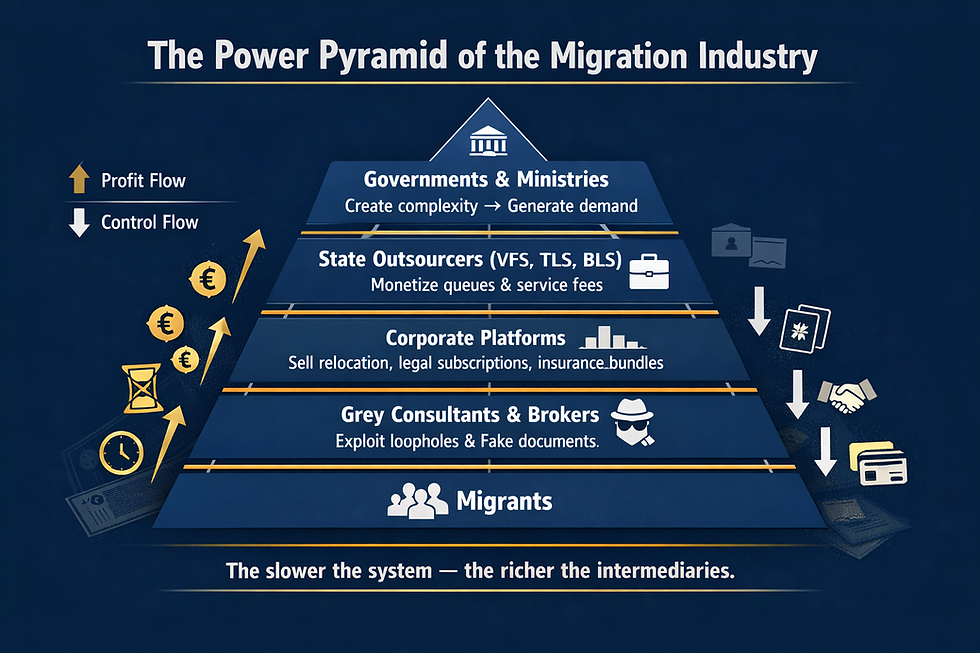
Governments create complexity. Corporations monetize uncertainty. Grey actors exploit gaps. Migrants pay for all of it.
This investigation reveals how the system works, who profits, and why the industry keeps growing — even when official migration channels shrink.

The Birth of the Migration Industry: When Bureaucracy Became a Market
Migration systems were never designed to be markets. But the moment governments introduced:
long queues,
unpredictable processing times,
fragmented requirements,
inconsistent regional rules,
a new economy emerged.
Core mechanism: uncertainty → monetization
Less information → more paid consultations
Longer queues → more slot resale
More documents → more “premium packages”
More checks → more paid accelerations
This is not a glitch. This is a structural dependency: bureaucracy generates profit.
The Players: Who Actually Makes Money on Migration
We mapped the ecosystem. It has five layers.
2.1. State Outsourcers
Official partners performing government functions:
VFS Global
TLScontact
BLS International
They profit from:
service fees,
premium submission,
paid notifications,
“priority slots”.
State Outsourcers are the legal face of the industry — but they monetize scarcity created by the state.
2.2. Corporate Platforms
relocation SaaS,
legal subscription services (€29–€99/month),
HR outsourcing,
insurance bundles.
They turn migration into a subscription model.
Corporate Platforms sell predictability in an unpredictable system.
2.3. Grey Consultants
The largest and most invisible segment:
slot brokers,
fake housing confirmations,
guaranteed invitations,
“priority processing”.
These actors operate where the official system fails.
Grey Consultants fill the gaps governments pretend don’t exist.
2.4. Shadow Insurance
Policies that cover nothing but are “required” by employers or agents.
Shadow Insurance is a €1.2B niche built on fear and misinformation.
2.5. Employer Kickback Networks
Employers who charge migrants for contracts or invitations.
Employer Kickbacks are the most politically sensitive part of the industry.
The Schemes: How the Industry Actually Works
3.1. Queue Acceleration
Slots for visa submission become a commodity.
Price: €50–€400 Mechanism: insiders reserve slots → resell.
Queue acceleration is the backbone of the grey market.
3.2. Employer Kickbacks
Paid contracts disguised as “administrative fees”.
Price: €300–€1500 Mechanism: HR networks + intermediaries.
3.3. Fake Housing Confirmations
Addresses sold to migrants who never live there.
Price: €100–€600/month Mechanism: landlords + agents.
3.4. Document Packaging
Free documents repackaged as “premium bundles”.
Price: €150–€900 Mechanism: consultants + translators.
3.5. Shadow Insurance
Mandatory-but-useless policies.
Price: €50–€120/month Mechanism: insurers + employers.
The Migrant as a Product: 17 Points of Monetization
We reconstructed the journey of a typical migrant. Each step is a profit point.
Paid consultations
Document packages
Overpriced translations
Mandatory insurance
Queue slot resale
Service fees
Paid notifications
Legal subscriptions
Relocation platforms
Housing commissions
Fake addresses
Bank package fees
Tax consultants
ID acceleration
Employer kickbacks
Renewal monetization
Premium PR processing
Geography of Profit: Where the Industry Is Strongest
Germany
Largest intermediary ecosystem. High demand → high monetization.
Poland
Most dense grey market. Fake addresses + slot brokers.
Spain
Fastest growth of corporate relocation platforms.
Portugal
Premium processing boom.
Netherlands
Highest penetration of legal subscriptions.
The Characters of the Industry (Investigative Profiles)
The Slot Broker
Controls access to time. Sells tomorrow.
The Legal Subscription Architect
Turns migration into monthly revenue.
The Shadow Insurer
Sells fear disguised as protection.
The Employer Gatekeeper
Monetizes access to the labor market.
Real Cases (Anonymized)
Ukrainian migrant in Poland pays €600/month for a fake address.
Indian engineer in Germany buys a queue slot for €250.
Brazilian designer in Portugal pays €900 for a “document package”.
Filipino worker in Italy pays €120/month for shadow insurance.
Why Governments Allow This Industry to Exist
8.1. It reduces pressure on the system
Grey actors do the work officials cannot handle.
8.2. It generates indirect revenue
Migrants who pay intermediaries still pay taxes.
8.3. It is politically convenient
Complexity = control. Industry = buffer.
Conclusion: Migration Is a Marketplace — and It’s Growing
Migration is no longer a public service. It is a multi‑layered industry with its own incentives, margins, and power structures.
And while governments debate quotas, the market debates profit.
The IMMIGRANTS — Migration Industry 2026
Why This Industry Exists — And Why Migrants Walk Into It
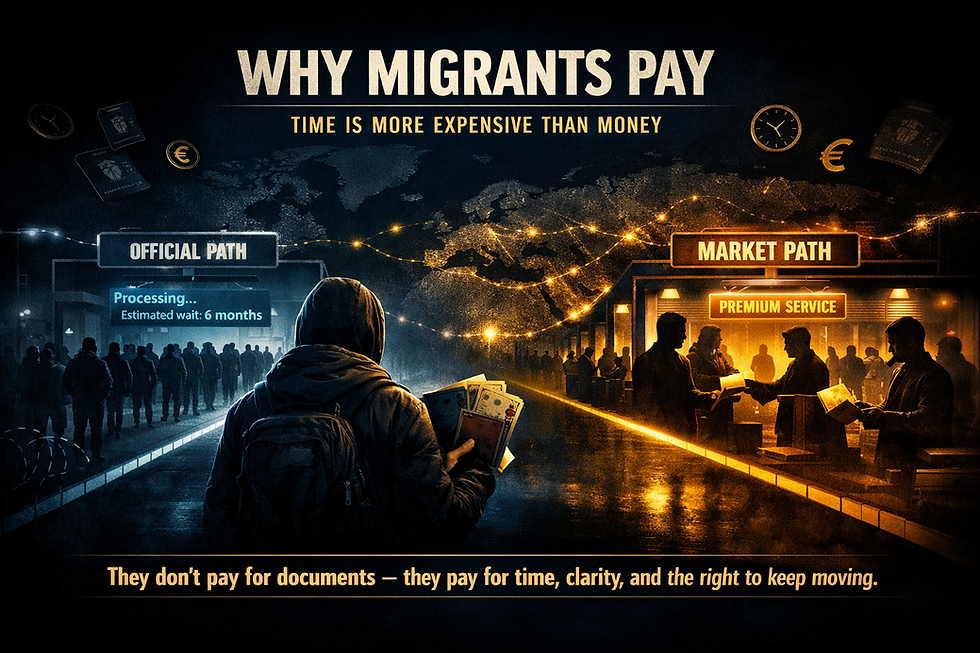
The Migration Industry didn’t appear because people suddenly wanted to pay more. It appeared because governments became slower than reality.
Modern migration systems are built on outdated assumptions: predictable labor markets, stable geopolitics, low mobility, minimal digitalization. None of that reflects the world of 2026. People move faster than institutions can process. Crises unfold quicker than ministries can respond. Opportunities expire before applications are even opened.
Into this gap — between human urgency and bureaucratic inertia — a new industry emerged.
Migrants step into it not out of naivety, but out of necessity. They know the system is slow. They know the queues are long. They know the rules are inconsistent. They know that waiting for “official clarity” can cost them a job offer, a visa window, a safe exit, or a future.
And so they pay.
Not for documents. Not for shortcuts. Not for “premium processing.”
They pay for time, because time is the only currency migration systems cannot provide.
They pay for certainty, because uncertainty is the most expensive risk a migrant faces.
They pay for continuity, because life cannot be paused until a government decides to move.
The Migration Industry thrives because it sells what states no longer guarantee: speed, clarity, predictability, and the ability to keep life moving forward.
This is not a moral judgment — it is a structural reality. As long as governments remain slow, opaque, and fragmented, the industry will grow. As long as migrants face life‑changing decisions with life‑breaking delays, they will continue to choose the market over the ministry.
And until migration systems are rebuilt for the world we actually live in, the industry will remain not an anomaly — but an inevitability.



Komentarze