Myanmar Job Scams 2026: Warning Signs Filipino Workers Must Know Before Accepting an Overseas Job
Updated: October 20, 2026
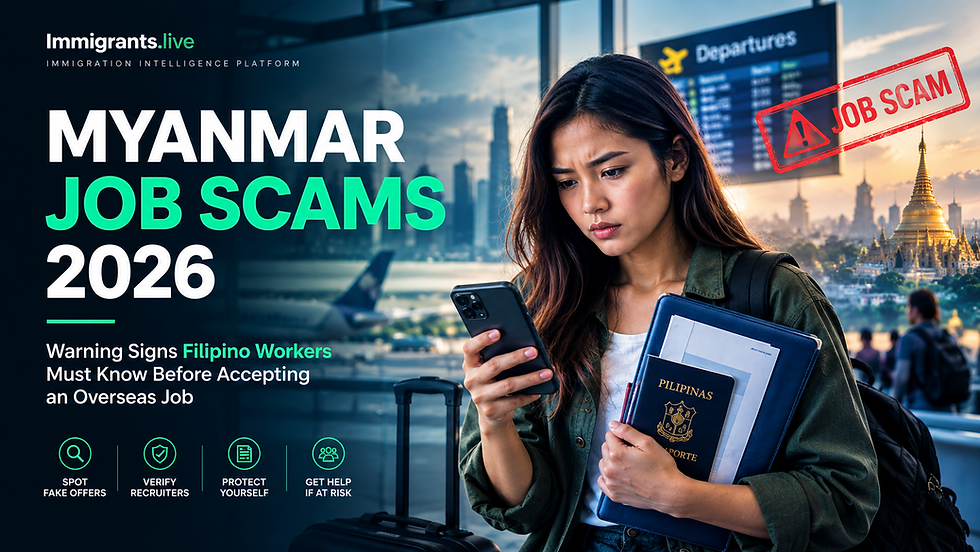
A job offer promising $1,000–$1,500 a month, free travel, and an easy hiring process may look like a life-changing opportunity. But for some Filipino job seekers, an overseas customer service job can become a route into human trafficking, forced labor, and online scam operations.
On October 14, 2026, the Philippine Bureau of Immigration (BI) reported that four Filipino women had been intercepted at Ninoy Aquino International Airport after officers found inconsistencies in their travel declarations and supporting documents. The women allegedly admitted that they were traveling to Myanmar for jobs they had been promised through online recruiters.
The case is a serious warning for Filipinos looking for work abroad, including people who find vacancies through Facebook, Telegram, WhatsApp, and other messaging platforms.
The most important rule: verify the actual employer, the recruitment agency, the approved job offer, and the legal authorization to work before traveling. A convincing recruiter, a written contract, or a promised salary is not enough.
This guide explains how overseas job scams operate, how to check whether an offer is legitimate, what to do before departure, and where to seek help if you or someone you know may be at risk.
What happened to the four Filipinos stopped at the airport?
According to the Philippine Bureau of Immigration, officers intercepted four women aged 22, 25, 27, and 41 at Ninoy Aquino International Airport on October 6, 2026.
The women initially said they were coworkers traveling to Thailand for a five-day, company-sponsored incentive trip. During a secondary inspection, they reportedly disclosed that they were not employed by the company they had named and that their actual destination was Myanmar.
They allegedly said they had been offered customer service jobs paying between US$1,000 and US$1,500 per month.
The BI reported that the women had been recruited through Facebook, Telegram, and other online platforms. Their recruiters allegedly provided travel and employment-related documents, while immigration officers identified questionable paperwork and inconsistencies involving return tickets.
The passengers were referred to the Inter-Agency Council Against Trafficking (IACAT) for further assessment and assistance.
These are allegations reported by the authorities, not a final judicial finding that every person involved committed a crime.
Why does this case matter?
Because the warning signs were not limited to an obviously fake advertisement. The reported arrangement included a plausible job title, a salary, travel plans, and supporting documents.
A recruitment scheme can appear organized and professional while concealing the real destination, employer, or work that a person will be expected to perform.
Why are Filipino workers being targeted by overseas job scams?
Filipinos have long sought employment abroad to support their families, repay debts, finance education, and build more secure futures. International employment can offer genuine opportunities, but the desire to earn more quickly can also make job seekers vulnerable to deceptive recruitment.
Fraudulent recruiters may advertise jobs such as:
Customer service representative
Chat support agent
Online sales representative
Virtual assistant
Data entry clerk
Digital marketing assistant
Cryptocurrency or investment support agent
English-speaking office employee
None of these job titles is inherently fraudulent. The danger arises when the advertised work, employer, destination, visa, or employment conditions do not match reality.
Some trafficking networks recruit workers for scam compounds in Myanmar and other parts of Southeast Asia. Victims may be promised ordinary office jobs but later be forced to participate in online fraud operations.
The Philippine National Bureau of Investigation reported in May 2026 that 25 repatriated Filipinos had described being recruited for work that turned out to involve online scam operations in Myanmar. According to the NBI, some victims had their passports confiscated, their movements restricted, and were subjected to intimidation and penalties.
The International Organization for Migration has also warned about trafficking into scam centers in the region, where people from many countries can be recruited through deceptive online job advertisements.
10 warning signs of a fake overseas job offer
One warning sign does not automatically prove that an employer is fraudulent. Several warning signs together, however, should prompt you to stop and independently verify the offer before sending money or traveling.
1. The recruiter contacts you through Facebook or Telegram and avoids formal verification
Social media is not proof of fraud. Legitimate employers sometimes use online platforms to find candidates.
The problem arises when the recruiter insists that all communication remain on a personal account, refuses to identify the actual employer, or tells you not to contact official agencies.
Be especially cautious if the recruiter changes accounts frequently, deletes messages, or pressures you to make a decision before you can check the offer.
2. The salary is unusually high for a simple job
An offer of US$1,000–US$1,500 per month for an entry-level customer service role may be attractive, particularly to someone who urgently needs work.
Do not judge the offer by salary alone. Ask for the exact job description, work location, employer's registered name, working hours, deductions, accommodation arrangements, and signed employment contract.
A high salary is not proof of a scam, but an unusually generous offer combined with secrecy and rushed travel is a reason to investigate.
3. You are told to travel as a tourist and start working after arrival
This is one of the most important red flags.
A tourist or visitor visa does not automatically authorize employment. The rules depend on the destination country's immigration system and the specific permission granted to the traveler.
If a recruiter says, "Enter as a tourist; we will arrange your work documents later," do not assume that this is a legitimate process.
Ask the relevant authorities to verify the appropriate visa or work authorization before departure. Filipino workers should also confirm the required overseas employment processing with the Department of Migrant Workers (DMW).
4. The recruiter tells you to lie at the airport
You may be told to say that you are visiting friends, attending a holiday, or traveling on a company incentive trip.
You might even be given a prepared story to repeat to immigration officers.
Do not follow instructions to conceal your real destination or employment plans. Providing false information or presenting misleading documents can create serious legal and immigration problems, in addition to leaving you more vulnerable to exploitation.
5. The company name cannot be independently verified
A recruiter may provide a logo, website, company registration certificate, or business card. These can be copied or fabricated.
Find the company's independently verifiable contact information. Contact the employer using details obtained from an official source rather than relying exclusively on the phone number or email provided by the recruiter.
Ask the employer to confirm the vacancy, your position, your supervisor, the work location, and the recruitment agency involved.
6. The recruiter asks for money before the offer is verified
Be cautious about demands for large advance payments for:
Job reservation
Guaranteed hiring
Visa approval
Airport clearance
Security deposits
Mandatory training
Last-minute document processing
Some legitimate recruitment-related costs may exist under applicable rules, but a demand for money does not become legitimate simply because the recruiter calls it a processing fee.
Verify the agency, job order, contract, and all permitted charges with the DMW before paying. Request official receipts and do not send money to a personal account without independently establishing the legal basis for the payment.
7. You are not allowed to contact the employer directly
A recruiter who insists that you communicate only through them may be hiding the identity of the real employer.
Ask for a direct company email, a verifiable office address, and an interview with a responsible hiring manager.
If the recruiter claims that direct contact would "cancel your application" or "break company rules," pause the process and verify the offer independently.
8. Your passport or phone will supposedly be kept by the employer
An employer may need to inspect documents for legitimate administrative reasons, but you should be extremely cautious about arrangements that require surrendering your passport indefinitely or restricting access to your phone.
Confiscation of identity documents and restrictions on movement can be signs of exploitation.
Ask in advance who will hold your documents, why they need them, and when they will be returned. Never accept a job on the assumption that you will be free to leave later if the arrangement turns out to be different from what was promised.
9. Your destination keeps changing
You apply for a job in one country, receive tickets to another, and are told that a third country is where the actual work will take place.
Some legitimate jobs involve transit or multiple locations. However, unexplained changes in the destination, employer, or visa arrangements must be resolved before departure.
Confirm every country involved in the itinerary and the legal reason for each stop. Do not board a flight simply because the recruiter says the paperwork will be explained later.
10. You are told to keep the job secret from your family
A recruiter may insist that you should not disclose the destination, employer, travel dates, or contact details to anyone.
That isolation can make it harder for family members to recognize danger or seek help if you disappear.
Before leaving, share your verified itinerary, employment contract, employer details, accommodation address, and expected arrival time with a trusted person.
Remember: a legitimate opportunity should withstand reasonable questions and independent verification.
How to verify an overseas job in the Philippines: step by step
Before accepting a job in Myanmar or any other foreign country, complete these checks.
Step 1: Verify the recruitment agency through the DMW
Use its official services to check whether the recruitment agency is licensed and whether the relevant job vacancy or job order is authorized.
Do not rely on screenshots sent by a recruiter. Search the official records independently and confirm that the agency's name and details match the information in your offer.
A legitimate company name does not establish that a particular intermediary is authorized to recruit workers on its behalf.
Step 2: Verify the specific vacancy, not just the agency
Even if an agency is licensed, that does not automatically prove that every vacancy advertised under its name is approved.
Check the particular job offer, employer, position, destination, and recruitment authorization.
If you cannot find the vacancy or the information does not match, contact the DMW and request clarification before proceeding.
Step 3: Contact the actual employer independently
Obtain the employer's full legal name and registered business address. Look for an official company website and contact details that you can verify independently.
Ask the employer to confirm in writing:
The exact position and duties
The salary and payment schedule
The actual work location
The identity of the recruitment agency
The employment contract
Who pays for transportation and accommodation
The required work visa or permit
What happens if the job ends or the contract is terminated
If the company says it has never heard of you or the recruiter, stop the process and report the suspected fraud.
Step 4: Confirm the correct visa or work authorization
Do not rely on the recruiter to determine whether your visa permits employment.
Check the destination country's official immigration website or contact the relevant embassy or consulate. Confirm the conditions of the exact visa or permit you will use.
A visa allowing entry is not necessarily permission to work.
Step 5: Check the contract before signing
Make sure the written contract matches the job you were offered. Read the sections on salary, deductions, working hours, leave, accommodation, termination, and dispute resolution.
Do not sign blank documents or accept a contract with missing employer details. Keep a copy of the signed contract and all supporting documents.
If the contract is written in a language you do not understand, obtain a reliable translation before signing.
Step 6: Confirm Philippine overseas employment requirements
Contact the DMW to determine which recruitment, contract verification, and departure-processing requirements apply to your circumstances.
The process can differ depending on whether you are being recruited directly, through a licensed agency, or while already working in another country.
Do not assume that an arrangement is lawful simply because you already hold a passport and a valid entry visa.
Step 7: Verify everything again shortly before departure
A genuine job offer can be changed or impersonated after an initial verification.
Before traveling, reconfirm the employer, destination, contract, visa, tickets, and contact details.
If the recruiter changes the itinerary or tells you to use a different explanation at immigration, pause the trip until the discrepancy is resolved.
What is third-country recruitment, and why can it be dangerous?
Third-country recruitment occurs when a worker who is living in one country is approached with an offer to work in another country, often through a recruiter or intermediary.
For example, a Filipino worker may already be employed in Singapore, Hong Kong, the United Arab Emirates, or another country. A recruiter then offers a higher-paying job in Myanmar or Cambodia.
The offer may appear to be a normal career move. But if the recruiter, employer, or deployment arrangement is unauthorized, the worker may be moved across borders without the protections normally associated with lawful overseas employment.
In July 2026, the DMW warned about third-country recruitment schemes targeting Filipinos already working abroad. The department described cases in which workers were offered better jobs elsewhere but ended up at scam hubs or in forced-labor situations.
If you are already an overseas Filipino worker (OFW), do not assume that a recruiter operating in your current country is authorized to arrange your transfer to another one.
Before accepting a transfer, ask the DMW or the appropriate Philippine Migrant Workers Office to explain the applicable requirements.
What if you have already accepted the job or bought the ticket?
You may still be able to prevent a dangerous situation from developing.
If you have not departed
Pause the trip if the destination, employer, visa, or contract cannot be verified.
Do not follow instructions to lie to immigration officers.
Do not pay additional fees simply because the recruiter claims that your departure will otherwise be canceled.
Save the job advertisement, messages, payment records, contract, tickets, and recruiter details.
Contact the DMW through its official channels to ask for verification and advice.
If a recruiter threatens you, pressures you to travel immediately, or tells you to conceal the real job, treat that as a serious warning.
If you are already abroad but have not started work
Contact the nearest Philippine embassy or consulate if the job or destination differs from what you were promised.
Stay in a safe, public location if possible, retain access to your passport and phone, and tell a trusted person where you are.
If you believe you are being monitored or threatened, prioritize your immediate safety over collecting evidence or confronting the recruiter.
If your passport has been taken or you are being forced to work
This may be a human-trafficking or forced-labor situation.
If you can do so safely:
Contact local emergency services if you face immediate danger.
Reach out to the nearest Philippine embassy or consulate.
Contact Philippine authorities responsible for migrant-worker protection.
Send your location and the employer's details to a trusted person.
Preserve messages and other evidence only when doing so will not increase the danger.
Do not assume that you must resolve the situation alone or that being deceived into a fraudulent job makes you responsible for the crimes you may be forced to commit.
People who have been trafficked may need urgent protection, legal assistance, medical care, and support returning home.
Where can Filipino workers report a suspicious overseas job offer?
Use official government channels rather than contact details supplied only by the recruiter.
Department of Migrant Workers (DMW)
Website: https://dmw.gov.ph/
The DMW provides information on licensed recruitment agencies, approved job orders, and migrant-worker services. Its official website lists the hotline 1348. Verify current contact options and operating hours through the official site.
Philippine Bureau of Immigration (BI)
Website: https://immigration.gov.ph/
The BI handles immigration controls at Philippine ports of departure and arrival. Its published notices explain how suspicious travel arrangements and possible trafficking cases are referred for assessment.
Philippine embassy or consulate
If you are already outside the Philippines, contact the nearest Philippine embassy or consulate. Use the Department of Foreign Affairs' official directory to identify the correct office:
If you are in immediate danger, contact local emergency services where available.
When reporting a suspicious offer, provide the recruiter’s name, phone number, social media profile, employer details, advertised salary, proposed destination, and copies of relevant messages if it is safe to do so.
Do not publish another person's passport details or sensitive personal information on social media.
Frequently asked questions
Are all customer service jobs in Myanmar scams?
No. A job title alone does not establish whether an offer is legitimate. The risk arises when recruiters conceal the real employer or destination, offer unverifiable employment, arrange travel without appropriate authorization, or use deception to move workers into exploitative conditions. Verify the specific vacancy before traveling.
Is a US$1,000–$1,500 monthly salary a sign of a job scam?
Not by itself. Salary depends on the employer, role, experience, and employment conditions. But an attractive salary combined with an unverified recruiter, rushed departure, a tourist visa, or instructions to mislead immigration officers should prompt serious concern.
Can I apply for an overseas job through Facebook or Telegram?
You can discover job advertisements through social media, but the platform does not verify the recruiter's legitimacy. Confirm the agency, vacancy, employer, contract, and work authorization independently through official channels before paying or traveling.
What if the recruiter says I should enter Myanmar as a tourist?
Do not assume that tourist entry allows you to work. Check the destination country's official visa requirements and confirm the proper employment process with the DMW. If the recruiter insists that you conceal your employment plans, do not proceed until the arrangement has been independently verified.
What if I have already paid the recruiter?
Save the payment records and all communications. Do not send additional money simply because the recruiter threatens to cancel the job or claims that another payment is needed to release your documents. Contact the DMW and, where appropriate, law-enforcement authorities to report suspected illegal recruitment or fraud.
What should my family do if I disappear after traveling for a job?
Preserve your messages, travel itinerary, employer details, recruiter profiles, and last known location. Contact Philippine authorities and the nearest Philippine embassy or consulate in the country where you are believed to be. If there is evidence of immediate danger or trafficking, tell authorities explicitly that you fear the person may be a victim of human trafficking.
Can someone who was trafficked be punished for crimes they were forced to commit?
The legal outcome depends on the country, the facts, and the applicable law. Victims may have been coerced into participating in online fraud or other criminal activity. They should seek qualified legal assistance and inform authorities about the coercion and exploitation they experienced. The DMW has identified stronger protection for trafficking victims, including the non-punishment principle, as an important area of government action.
Is this warning only for Filipino workers?
No. The reported case concerns Filipino women, and the DMW's guidance specifically addresses overseas Filipino workers. However, deceptive recruitment and trafficking into scam operations affect people from many countries. Anyone considering overseas employment should independently verify the employer, work authorization, and recruitment arrangements.
The bottom line: verify the job before you leave
The four Filipino women intercepted at Manila airport were reportedly promised customer service jobs in Myanmar paying up to US$1,500 a month. Their case demonstrates why a job advertisement, a salary promise, and travel documents cannot replace independent verification.
Before accepting an overseas job, confirm the recruiter, approved vacancy, employer, contract, destination, and work authorization. Never agree to lie to immigration officers or conceal the real purpose of your trip.
A genuine overseas job should be verifiable before you board the plane. If a recruiter will not let you verify it, that is a reason to stop—not a reason to hurry.
Editorial note: This article provides general information and safety guidance, not individualized legal advice. Recruitment rules and immigration requirements vary by country and employment arrangement. Confirm current requirements with the relevant government authorities before making travel or employment decisions.



Komentarze