October 2026 Visa Bulletin Still Not Out: Why It’s Late, What We Know and What to Do Now
Status: not yet published. As of September 28, 2026, we found no report that the October bulletin has been released. The last direct check of the State Department’s Visa Bulletin page we could verify was September 25, when it still listed September as the current bulletin and marked the next one "Coming Soon." This page is updated the moment the October bulletin appears.
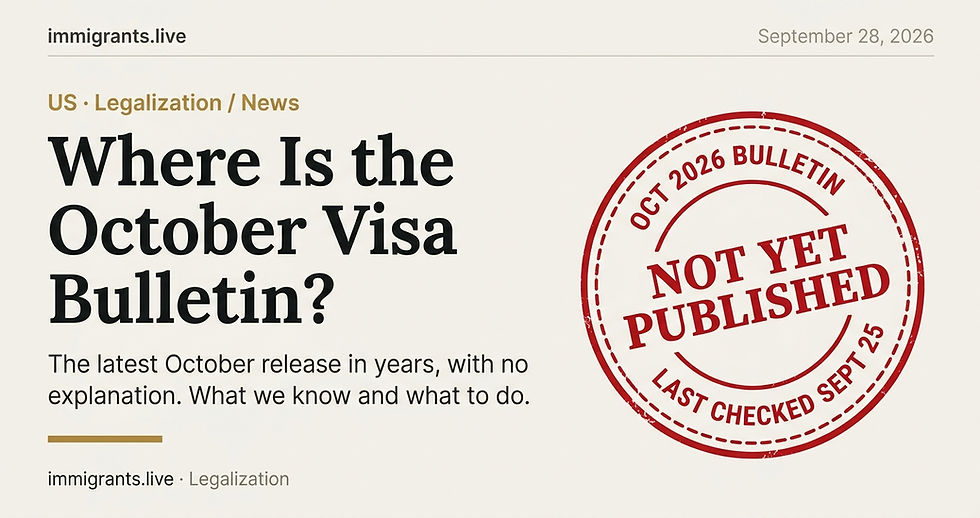
Every green card applicant in the United States and abroad knows the rhythm: the new bulletin arrives in the middle of the previous month, you check your priority date, you exhale or you don’t. October is the one that matters most, because it opens the new fiscal year on October 1 with a fresh supply of visa numbers. This year, the bulletin is late, the State Department has not said why, and the wait is already longer than in any recent October.
How late is it, really?
The September bulletin was released on August 22, which was already later than the mid-month timing of most recent years. October has now run past that. Analysts who track release dates note that every October bulletin from 2018 through 2025 was out by this point in September, and one immigration attorney’s review calls this the latest October release in at least several years. Even in 2020, with consulates shut down worldwide by COVID, the October bulletin appeared on September 24.
One caution worth keeping in mind: there is no legal deadline for publishing the Visa Bulletin. Neither the statute nor the regulations say when it must come out. The mid-month release is a long-standing practice, not a requirement. So a delay is unusual, but it is not a violation of anything.
What the State Department has already signaled
Even without the October charts, there are two official hints from the July 2026 bulletin, and both are conditional:
EB-2 India. The State Department announced on May 22, 2026 that all available FY2026 EB-2 numbers for India had been used, and the category has shown "Unavailable" since. The July bulletin said the October Final Action Date should advance to at least the date in the May 2026 bulletin, which was July 15, 2014, depending on demand and the FY2027 annual limit.
EB-5 India (unreserved). The July bulletin said the same for this category: unavailable for the rest of FY2026, with October expected to advance to at least its June 2026 position, again depending on demand.
Read those carefully. "At least" is a forecast floor, not a promise, and "July 15, 2014" should not be treated as the confirmed October date. The bulletin, when it arrives, is the only source that counts.
Why might it be late?
The State Department has not explained the delay, so anything below is analysis, not confirmed fact. To set October’s cutoffs, the department has to estimate supply and demand across every category for the whole year. Right now three separate restrictions are slowing immigrant visa processing at consulates:
The 39-country travel ban. Presidential Proclamation 10998, effective January 1, 2026, expanded an earlier 19-country ban to 39 countries. It has no expiration date, is reviewed every 180 days, and remains in effect.
The 75-country immigrant visa pause. Since January 21, 2026 the State Department had stopped issuing immigrant visas to nationals of 75 countries over public charge concerns. A federal court in New York struck the policy down on August 21 in Catholic Legal Immigration Network v. Rubio, holding that public charge must be assessed individually, not by nationality. The government acknowledged more than 43,000 applications fall into the affected group, and has appealed to the Second Circuit.
The worldwide interview freeze. On August 25, 2026, the State Department paused immigrant visa interview scheduling at every consulate so officers could be retrained on public charge screening. There is still no official restart date.
Two questions may be holding up the math: whether those 43,000 cases re-enter the pipeline or get frozen again by an appeals court, and when the interview freeze ends. A court decision could land any day, which makes the litigation a plausible reason to wait, though the department has not confirmed it.
Why the freeze could matter for employment-based applicants
This is the part most people miss. Family-sponsored and Diversity Visa numbers are used almost entirely at consulates. When consulates can’t issue visas, those numbers go unused, and family numbers left unused at the end of a fiscal year are added to the next year’s employment-based limit. That is why the FY2026 employment limit reached about 186,000 instead of the usual 140,000, after roughly 46,000 family numbers went unused in FY2025.
There is a precedent. In 2020, with consulates closed or operating at reduced capacity, large numbers of family visas went unused, the employment limit for FY2021 rose to about 261,500, and the October 2020 bulletin brought major forward movement in the employment categories. The situation today is not identical, and the freeze has only covered the final five weeks of FY2026, so the effect would likely be smaller. But the mechanics are the same, and they are the main reason employment-based applicants inside the US are watching this bulletin so closely.
How to read the October bulletin when it arrives
Don’t over-read it. October always brings fresh annual limits, so some forward movement happens almost every year regardless of policy.
Look at two tables, not one. The Final Action Dates chart shows when a green card can be approved. The Dates for Filing chart shows when you can submit your I-485. They are different, and they are not interchangeable.
Wait for USCIS. The State Department publishes the charts, but USCIS separately announces which chart adjustment-of-status applicants may use that month. In September, USCIS pointed employment-based applicants to Final Action Dates and family-sponsored applicants to Dates for Filing. Confirm October’s instruction before filing anything.
Watch the following months. If dates keep advancing for people filing inside the US, consular issuance abroad is probably still suppressed. If that movement slows or reverses, interviews have likely resumed.
What to do now
Your case goes through a consulate. Strengthen your affidavit of support file now: recent tax returns, current proof of income and, if the numbers are thin, a joint sponsor. Expect closer public charge scrutiny once interviews resume.
You are in the US with a priority date near the cutoff. Prepare your I-485 materials in advance so you can file quickly if October brings movement, and keep your status carefully maintained, since adjustment applications are also facing closer discretionary review.
You are an EB-2 or EB-5 India applicant. Treat the July 15, 2014 signal as a reference point only. Do not make filing or travel decisions on a date that has not been published.
Everyone. Ignore recycled charts and social media rumors of "leaked" October dates. Check travel.state.gov and USCIS’s adjustment-of-status filing charts page directly.
Frequently asked questions
Has the October 2026 Visa Bulletin been released?
Not according to anything we could find as of September 28, 2026. The last direct check of the State Department’s page we could verify was September 25. This page will be updated when it is published.
Why is the October Visa Bulletin late?
The State Department has not said. Analysts point to uncertainty caused by the immigrant visa restrictions and pending litigation, but that is analysis, not an official explanation.
Will my priority date become current in October?
No one can say until the bulletin is published. A new fiscal year resets annual limits, but that does not make every category current.
Is there a deadline for the State Department to publish it?
No. Neither the statute nor the regulations set one. The mid-month release is a long-standing practice.
What will EB-2 India look like in October?
The State Department has forecast that it should advance to at least the May 2026 date of July 15, 2014, depending on demand and annual limits. That is a forecast, not the issued cutoff.
This article is for information only and is not legal advice. Dates and rules change quickly; confirm your specific situation with a qualified immigration attorney.


Komentarze