Poland Plans to Restrict Employment for Citizens of Three Countries
- 1 dzień temu
- 3 minut(y) czytania
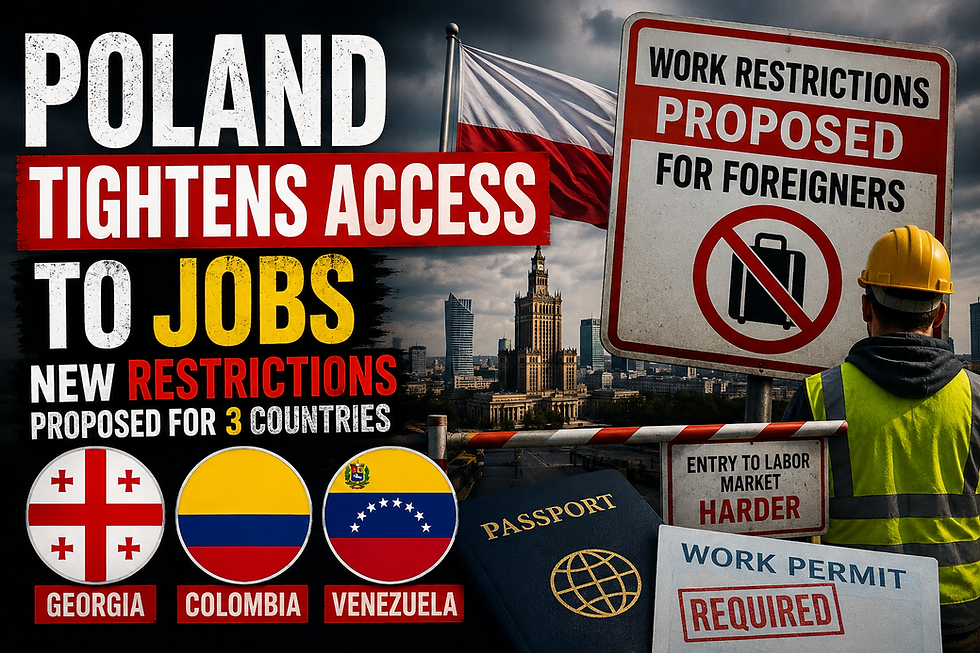
Poland may soon tighten access to its labor market for thousands of foreign nationals.
The Polish government is preparing new rules that would end simplified employment procedures for citizens of Georgia, Colombia, and Venezuela who enter the country under visa-free travel. If approved, the changes could reshape hiring practices in several industries that rely heavily on foreign workers.
While the proposal is still moving through the legislative process, it has already sparked debate among employers, labor organizations, and migration experts.
What Is Changing?
Under the current system, many foreign nationals from selected countries can enter Poland without a visa for short stays and later begin employment through simplified administrative procedures.
The new proposal would remove that possibility for citizens of:
🇬🇪 Georgia
🇨🇴 Colombia
🇻🇪 Venezuela
Instead, they would generally need to obtain the appropriate work visa or another legal residence document before taking up employment.
The government argues that the change is intended to strengthen migration management and reduce potential abuse of visa-free travel rules.
Why These Three Countries?
Officials have not stated that the measure is aimed at limiting migration from these countries altogether.
Instead, authorities point to several factors:
rapid growth in the number of workers arriving under simplified procedures;
increasing pressure on labor market monitoring;
concerns that some people enter Poland under visa-free rules while intending to work immediately;
efforts to better distinguish tourism from labor migration.
The proposal focuses specifically on employment procedures rather than banning entry into Poland.
Who Will Be Affected?
If the proposal becomes law, it would primarily affect:
people planning to travel to Poland in the future to find work;
recruitment agencies hiring workers from these countries;
Polish employers relying on visa-free recruitment;
seasonal industries with high demand for foreign labor.
People already holding valid residence permits or work authorizations may not be affected in the same way, depending on the final wording of the legislation.
Who Is NOT Affected?
At this stage, the proposal does not introduce general restrictions on all foreign workers.
For example, it does not automatically change the legal status of:
foreign nationals already working legally in Poland under valid permits;
individuals holding residence cards;
people with long-term legal residence rights;
beneficiaries of separate legal protection schemes.
As always, the final impact will depend on the version ultimately adopted by Parliament.
Why Employers Are Worried
Many Polish businesses have already expressed concern.
For several years Poland has experienced labor shortages in sectors including:
construction;
manufacturing;
logistics;
warehousing;
agriculture;
hospitality.
Business organizations warn that making recruitment more complicated could increase hiring costs, delay projects, and worsen existing labor shortages.
Some employers argue that Poland's economy still depends heavily on foreign workers, particularly as demographic pressures continue to reduce the domestic workforce.
Why the Government Supports the Proposal
Supporters of the changes argue that immigration policy should become more predictable and secure.
According to government officials, the objectives include:
preventing misuse of visa-free entry;
improving verification of foreign workers;
ensuring employment takes place through appropriate immigration channels;
strengthening control over labor migration.
The proposal is presented as part of a broader modernization of Poland's migration policy rather than a complete closure of the labor market.
What Happens Next?
The proposal has not yet entered into force.
Before the rules can apply nationwide, they must complete Poland's legislative process, including government approval and the adoption of final legal regulations.
The exact implementation date has not yet been announced.
As with many immigration reforms, the final version could still change before becoming law.
What Foreign Workers Should Do Now
If you are planning to move to Poland from Georgia, Colombia, or Venezuela, experts recommend:
✅ Follow official government announcements.
✅ Avoid relying on outdated recruitment advice posted online.
✅ Confirm with your employer which immigration documents will be required.
✅ Do not assume that today's simplified procedures will remain available in the coming months.
Planning ahead may prevent delays if the new rules are adopted.
Why This Matters Beyond Three Countries
Although the proposal targets only three nationalities, many migration analysts believe it signals a broader shift in Poland's immigration strategy.
Over the past two years, several European countries have introduced stricter labor migration controls while simultaneously trying to attract workers in sectors facing chronic shortages.
Poland now appears to be balancing two competing goals:
protecting the integrity of its immigration system;
maintaining access to the foreign workforce needed to support economic growth.
How successfully it manages that balance will likely influence future migration policy across Central Europe.
Editor's Note
This proposal is not yet final. Immigration legislation can change during the parliamentary process, and the final rules may differ from the current draft. Anyone planning to work in Poland should rely on official government information before making travel or employment decisions.

Komentarze