The Global Immigration Backlog Crisis
- 13 lip
- 16 minut(y) czytania
Why Immigration Systems Keep Slowing Down — And Why Millions of People Will Wait Even Longer in 2026
By Immigrants.live Editorial Team
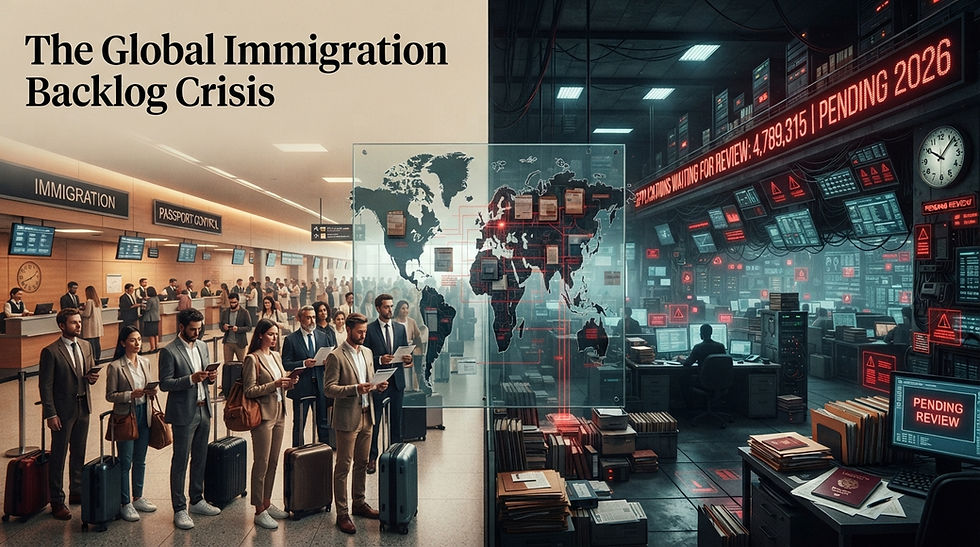
Every Government Says Immigration Is Open. So Why Is Everyone Waiting?
On paper, 2026 should have been one of the best years to immigrate.
Countries facing aging populations are competing for skilled workers. Employers across Europe, North America, Australia, and parts of Asia continue to report labor shortages in industries ranging from healthcare and construction to information technology and logistics. Governments keep announcing new visa pathways, digital nomad programs, regional migration initiatives, and faster routes for highly qualified professionals.
The message is remarkably consistent.
"We need immigrants."
Yet for millions of applicants, reality begins not with an invitation—but with silence.
Applications disappear into online portals for months. Residence permits expire while renewals remain pending. Families postpone reunification because one document has not yet been approved. Skilled workers receive job offers they cannot legally accept because a work authorization is still under review. International graduates lose opportunities while waiting for immigration offices to make decisions that were once expected within weeks.
This contradiction has become one of the defining characteristics of global migration in 2026.
Countries are actively encouraging immigration while simultaneously struggling to process the people they have invited.
It is not one country's problem.
It is not one continent's problem.
It is increasingly becoming a structural feature of modern immigration systems.
Behind every delayed application is a government promising efficiency, an immigration authority operating under growing pressure, and a person whose life remains suspended until someone finally opens their file.
The numbers vary from country to country.
The experience does not.
A Different Kind of Immigration Crisis
When people hear the phrase immigration crisis, public debate usually turns toward borders.
Images of overcrowded crossings.
Political speeches.
Election campaigns.
Asylum.
Illegal migration.
But another crisis has quietly expanded far from television cameras.
It exists inside government offices, immigration databases, processing centers, and digital queues.
Unlike border crises, this one produces very few dramatic headlines.
It unfolds through waiting.
Waiting for biometric appointments.
Waiting for security checks.
Waiting for document verification.
Waiting for residence cards.
Waiting for citizenship ceremonies.
Waiting for appeals.
Waiting for somebody to review a file that has not moved in months.
For applicants, the backlog is not simply an administrative inconvenience.
It changes careers.
It delays education.
It postpones investments.
It separates families.
It prevents travel.
Sometimes it determines whether a person can remain legally employed.
Immigration processing times are no longer a technical issue hidden inside government reports.
They have become a major factor shaping migration itself.
Increasingly, the question is no longer:
"Can I qualify?"
Instead, applicants ask:
"How long will I be stuck?"
The Backlog Is No Longer an Exception
Only a few years ago, significant immigration delays were often explained as temporary disruptions.
The COVID-19 pandemic closed visa offices, reduced staffing, delayed interviews, interrupted international travel, and created enormous administrative bottlenecks.
Governments assured applicants that these problems would gradually disappear once borders reopened and operations normalized.
Some progress has been made.
Yet something unexpected happened.
The backlog never truly disappeared.
Instead, in many countries it evolved into a permanent feature of immigration administration.
Processing systems recovered—but demand recovered even faster.
More workers wanted to relocate.
More students crossed borders.
More companies hired internationally.
More families applied for reunification.
More governments introduced new migration pathways.
Every additional immigration program generated additional applications.
Every new policy announcement created another wave entering systems that were already operating close to capacity.
The result resembles a highway that keeps adding new entrances without expanding the number of lanes.
Traffic inevitably slows.
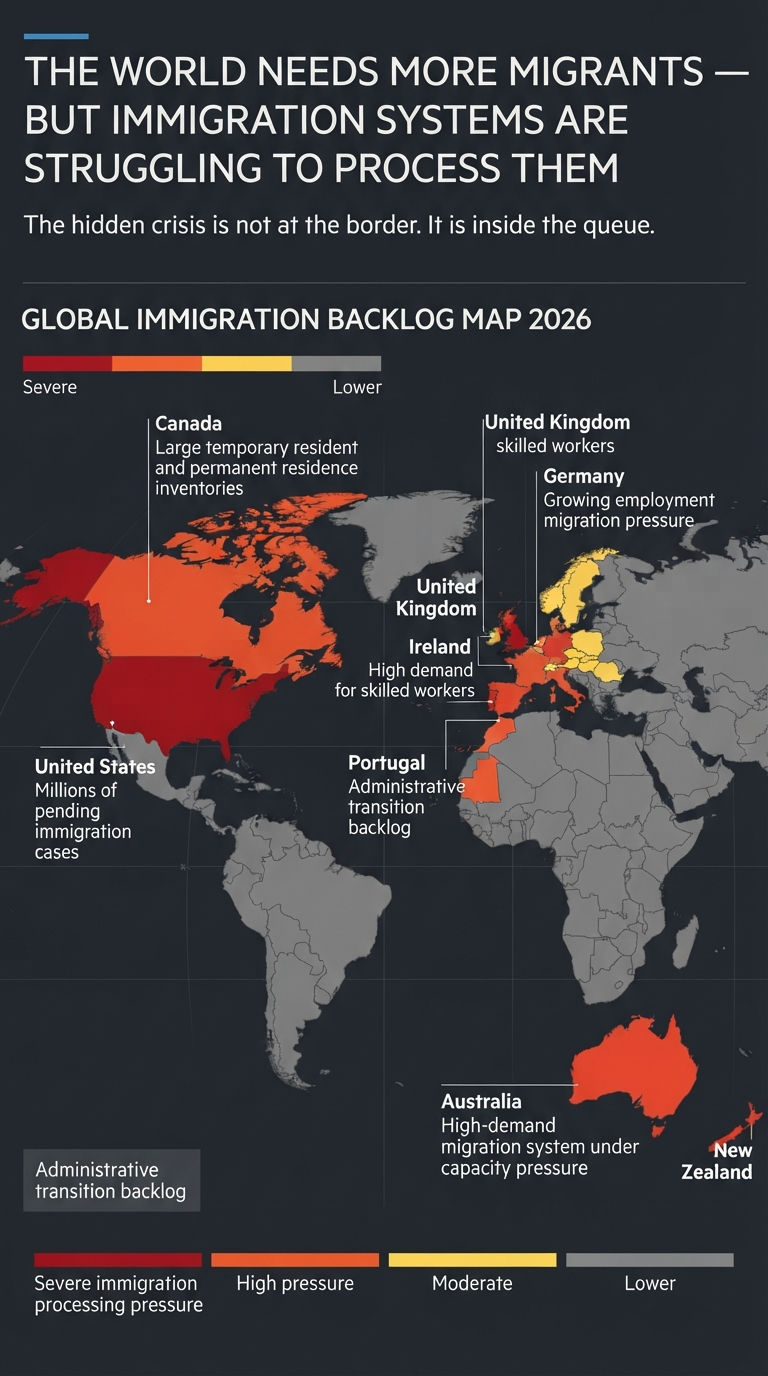
A Global Pattern Is Emerging
Look separately at almost any major immigration destination and the explanations appear different.
Canada speaks about unprecedented demand.
The United States continues to manage one of the world's largest and most complex immigration systems.
Ireland has experienced rapid economic growth that attracts workers from across Europe and beyond.
Portugal's immigration administration has undergone institutional restructuring while demand continued increasing.
Germany faces demographic decline alongside a growing need for qualified foreign labor.
Australia periodically adjusts migration targets while balancing security, labor market needs, and housing pressures.
Viewed individually, each country's situation appears unique.
Viewed together, a different picture emerges.
Across continents, immigration authorities are confronting remarkably similar challenges.
Applications are increasing faster than processing capacity.
Verification procedures are becoming more sophisticated.
Digital transformation remains incomplete.
Political priorities change faster than administrative systems can adapt.
At the same time, societies expect immigration authorities to process applications more carefully than ever before.
Governments are expected to detect fraud.
Protect national security.
Prevent document forgery.
Screen criminal histories.
Verify qualifications.
Confirm employment offers.
Protect labor markets.
Prevent exploitation.
Identify trafficking risks.
Every additional safeguard is understandable.
Every additional safeguard also requires time.
The consequence is predictable.
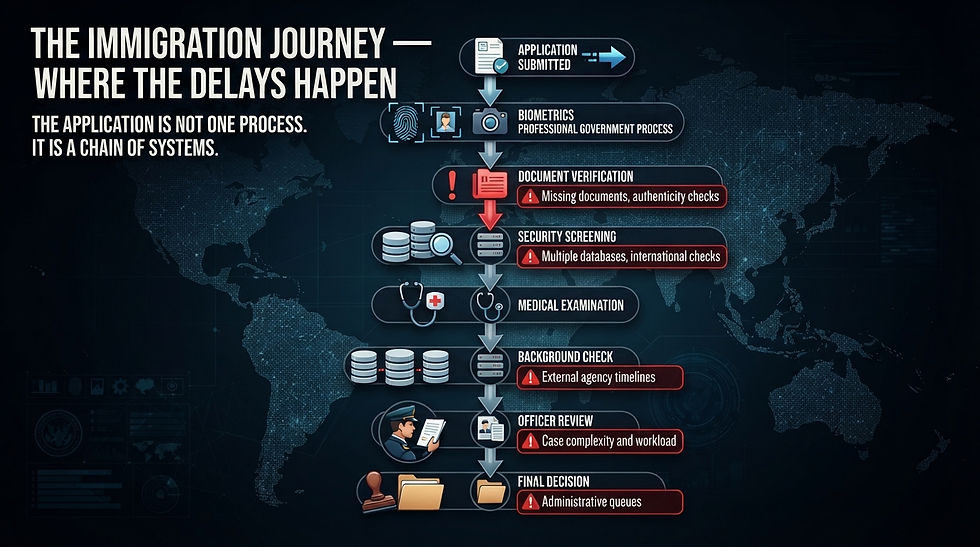
Each application spends longer moving through the system.
Immigration Is Becoming More Complex Than Ever
One common misunderstanding is that immigration officers simply review documents and approve or reject applications.
Reality is considerably more complicated.
A modern immigration application can involve information originating from multiple government agencies, law enforcement databases, educational institutions, employers, financial records, healthcare providers, border authorities, and international partners.
Even relatively straightforward work permit applications may require verification of qualifications, employer compliance, labor market requirements, identity documents, previous immigration history, and security information.
Permanent residence applications frequently involve even more stages.
Family sponsorship requires relationship verification.
Citizenship applications may involve residence calculations stretching back years.
Business migration programs often require financial assessments.
As governments introduce new immigration categories, they also introduce new rules, exemptions, and compliance requirements.
The administrative burden grows with every reform.
Ironically, immigration systems are becoming more attractive while simultaneously becoming more difficult to administer.
Why the Public Rarely Notices
Unlike airport delays or passport queues, immigration backlogs are largely invisible.
Applicants wait at home.
There are no long lines outside immigration headquarters.
Most communication occurs through online portals.
Statuses display messages such as:
"Submitted."
"Under review."
"Processing."
Sometimes these messages remain unchanged for months.
Because the waiting happens privately, it rarely generates public pressure comparable to other government services.
Politicians announce new visa initiatives because announcements create headlines.
Few announce investments in case management software, document verification systems, or additional immigration officers.
Administrative capacity rarely attracts political attention.
Until it fails.
The Human Cost Hidden Behind Statistics
Every backlog report includes numbers.
Hundreds of thousands.
Sometimes millions.
Large figures are useful for measuring institutional performance.
They are less useful for understanding what delay actually means.
For one applicant, six additional months may mean declining a job offer.
For another, it means a child starting school in a different country without one parent.
For a nurse recruited by a public hospital, delay may postpone desperately needed healthcare services.
For a technology company, delayed work authorization can force projects to move elsewhere.
Immigration waiting times do not affect only migrants.
They ripple through labor markets, universities, businesses, housing, healthcare systems, and local economies.
When governments discuss immigration shortages while employers continue searching for workers already approved in principle but still waiting administratively, the backlog itself becomes part of the labor shortage.
The queue is no longer merely an administrative problem.
It has become an economic one.
This Is No Longer About COVID
For years, the pandemic served as the universal explanation for immigration delays.
That explanation is becoming less convincing.
COVID unquestionably disrupted global migration systems.
But six years later, most immigration authorities have resumed regular operations, reopened offices, restored international travel, and implemented new digital services.
If delays continue growing despite these changes, the causes must run deeper.
The evidence increasingly suggests they do.
The backlog crisis of 2026 is not simply the lingering shadow of the pandemic.
It reflects something more fundamental.
Demand for migration has entered a new era, while many immigration institutions are still operating with structures designed for a very different world.
The question is no longer whether governments can reopen immigration systems.
They already have.
The real question is whether those systems were ever rebuilt to handle what came next.
Why Governments Can't Catch Up
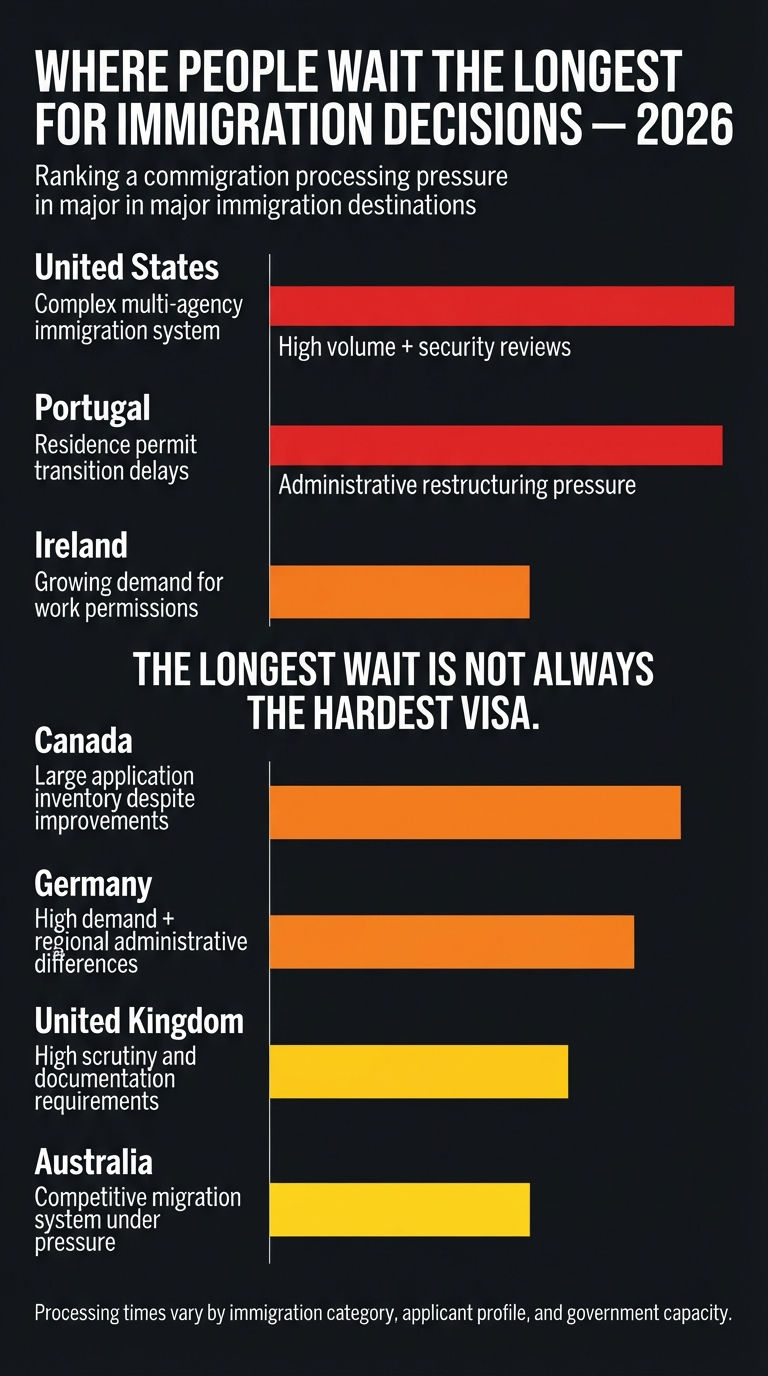
If immigration delays were caused by one isolated problem, governments would have solved it by now.
Hire more officers.
Buy better software.
Open another processing center.
Reduce paperwork.
Instead, backlogs continue to grow—even in countries that have invested heavily in digital services and expanded immigration programs.
That is because today's immigration slowdown is not the result of a single failure.
It is the collision of several global trends, all happening at the same time.
Each trend adds pressure.
Together, they are reshaping immigration administration around the world.
The World Wants More Migrants Than Ever Before
For decades, immigration was often viewed primarily as a political issue.
Today, it is increasingly an economic necessity.
Across Europe, North America and parts of Asia-Pacific, governments are confronting a demographic reality that cannot be ignored.
Populations are aging.
Birth rates remain below replacement levels in many developed economies.
Millions of workers are approaching retirement while too few young people are entering the labor market to replace them.
Hospitals need nurses.
Construction companies need skilled tradespeople.
Technology firms compete globally for engineers.
Agriculture depends on seasonal labor.
Universities rely on international students—not only as learners, but also as future members of the workforce.
The demand for migrants has expanded across nearly every sector of the economy.
Governments have responded by launching new immigration pathways, expanding skilled worker programs, easing eligibility in selected occupations, and promoting international recruitment campaigns.
Every announcement attracts another wave of applications.
Every successful recruitment campaign creates another administrative burden.
Immigration policy has become more ambitious.
Administrative capacity has struggled to keep pace.
More Programs Mean More Complexity
To the public, a new visa program often appears simple.
A government announces a new route.
People apply.
Applications are processed.
Reality is considerably more complicated.
Every new immigration pathway requires its own legal framework.
New eligibility rules.
Updated software.
Training for immigration officers.
Guidance documents.
Appeal mechanisms.
Fraud prevention measures.
Internal quality controls.
Customer support.
Communication with employers.
Coordination with border agencies.
The more specialized immigration becomes, the more specialized the administration must become as well.
Ironically, governments trying to make immigration easier for applicants often make processing far more complicated behind the scenes.
One new visa category can generate hundreds of pages of operational guidance.
Applicants see one application form.
Immigration officers see an entirely new workflow.
The Digital Revolution That Isn't Fully Digital
Governments frequently promote digital immigration systems as evidence of modernization.
Online portals have certainly transformed the applicant experience.
Forms are submitted electronically.
Documents are uploaded online.
Appointments are booked digitally.
Applicants receive notifications through mobile apps or email.
From the outside, the process appears almost fully automated.
Inside immigration authorities, however, many systems remain only partially digital.
Applications often move between multiple databases that were developed years apart and were never designed to communicate seamlessly.
Some records still require manual verification.
Supporting documents frequently need to be reviewed individually.
Information submitted online may still require human validation before it enters the next stage of processing.
In some jurisdictions, officers continue working with a combination of digital files and legacy case-management systems.
The result is a common misconception.
Applicants assume that because they completed an application online, a computer will process it quickly.
In reality, digitizing the front door does not automatically modernize everything behind it.
Many immigration systems have become digital on the surface while remaining labor-intensive underneath.
Security Has Become Far More Demanding
Immigration decisions today involve significantly more than checking passports and verifying employment letters.
Governments are expected to identify document fraud, prevent organized crime, detect identity theft, screen for sanctions risks, monitor changing geopolitical conditions, and protect national security.
Public expectations have also changed.
Few citizens would accept an immigration system that prioritizes speed over security.
Every additional safeguard is reasonable.
Every safeguard also adds another layer of review.
Background checks may involve multiple national and international databases.
Identity verification increasingly relies on biometric information.
Applicants from certain regions may require additional document authentication.
Employment records can require independent confirmation.
Educational qualifications sometimes need external assessment before immigration officers can make a decision.
None of these procedures is inherently unnecessary.
But collectively they transform immigration from a paperwork exercise into a complex risk-management process.
Processing times inevitably increase.
Fraud Has Become More Sophisticated
Immigration authorities are not only dealing with more applications.
They are also confronting increasingly sophisticated attempts to abuse immigration systems.
Fake universities.
Fraudulent employers.
Counterfeit employment contracts.
Forged financial statements.
Artificial language certificates.
Marriage fraud.
Identity manipulation.
The methods evolve constantly.
Each major fraud investigation typically produces new verification requirements.
Those additional checks affect not only fraudulent applications but also genuine ones.
Every honest applicant now spends more time waiting because governments must identify the dishonest few.
It is an unavoidable trade-off.
The stronger the verification process becomes, the slower the overall system tends to move.
Politics Keeps Changing the Rules
Unlike tax systems or civil registries, immigration policy changes frequently.
Sometimes dramatically.
A national election changes government.
A labor shortage appears.
A housing crisis intensifies.
Public opinion shifts.
International conflicts create humanitarian obligations.
Economic conditions deteriorate.
Each development can trigger immigration reform.
New priorities often arrive faster than immigration agencies can adapt.
Officers require retraining.
Guidelines are rewritten.
Application forms are updated.
Existing cases sometimes need to be reassessed under revised legislation.
Applicants see only the new announcement.
Behind the scenes, entire administrative processes are being redesigned.
Policy moves quickly.
Institutions usually move much more slowly.
The Immigration Officer Shortage Nobody Talks About
Governments regularly discuss shortages of doctors, teachers, police officers and engineers.
Far less attention is given to immigration caseworkers.
Yet many countries face exactly the same challenge.
Experienced immigration officers require months—sometimes years—of training.
They must understand legislation, administrative procedures, document verification, interview techniques, fraud indicators, international agreements and constantly evolving regulations.
New staff cannot simply replace experienced officers overnight.
Meanwhile, workloads continue increasing.
Burnout becomes a real concern.
Staff turnover creates additional delays.
Knowledge leaves with experienced employees.
Training absorbs the time of those who remain.
The system slows further.
It is a cycle rarely visible outside government buildings but deeply felt by applicants waiting for decisions.
Every Delay Creates More Work
One of the least understood aspects of immigration administration is that delays generate additional delays.
When applicants wait longer, they contact immigration authorities more frequently.
They submit status enquiries.
Upload updated documents.
Renew expiring passports.
Request emergency travel permissions.
Ask employers for revised contracts.
Update addresses.
Report changes in family circumstances.
Every new submission must be reviewed.
Every enquiry requires staff time.
Every correction reopens a file.
The backlog begins feeding itself.
Instead of processing new applications, officers spend increasing amounts of time managing existing delays.
It becomes a self-reinforcing cycle.
When Governments Succeed, They Create More Demand
Perhaps the greatest irony of modern immigration is this:
Success often makes the backlog worse.
When a country becomes known for offering attractive work opportunities, stable residency pathways and high living standards, more people apply.
When processing becomes faster, confidence increases.
Applications rise.
When governments simplify immigration rules, they expand eligibility.
Again, application numbers grow.
Every improvement in immigration policy can unintentionally increase administrative pressure.
The very reforms designed to attract global talent also generate larger queues unless governments expand processing capacity at the same pace.
Demand does not remain static.
It responds to opportunity.
The Backlog Is No Longer Just an Administrative Issue
Governments often measure immigration performance through processing targets.
Applicants measure it differently.
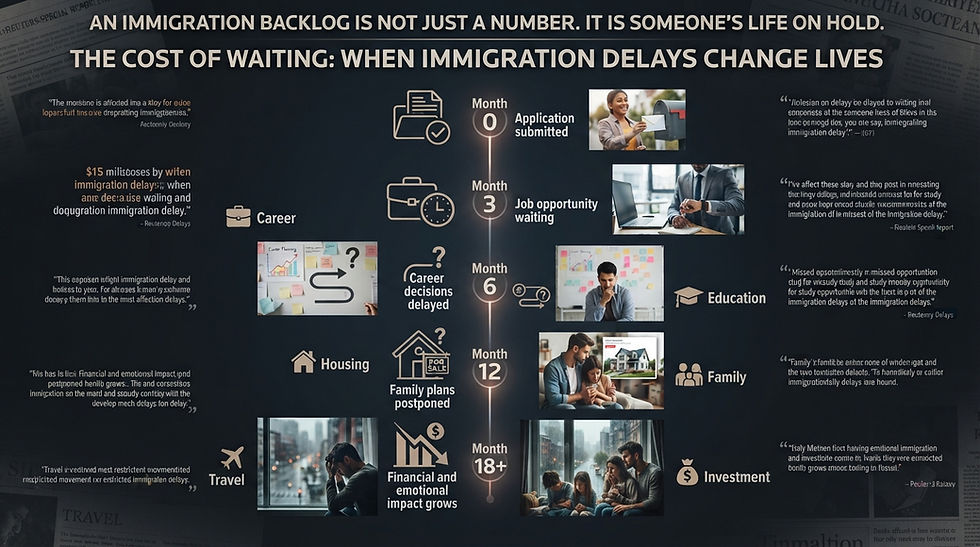
They measure birthdays missed.
Job offers withdrawn.
University semesters postponed.
Children separated from parents.
Businesses unable to hire.
Hospitals unable to fill vacancies.
Entire life plans placed on hold.
Behind every pending file sits a person who has already made one of the biggest decisions of their life.
Migration is rarely spontaneous.
People sell homes.
Leave careers.
Move savings.
Resign from jobs.
Say goodbye to families.
Administrative delay freezes all of those decisions in place.
At some point, a backlog stops being a bureaucratic statistic.
It becomes a social and economic force in its own right.
And that is precisely where many immigration systems find themselves today.
The Countries Under the Greatest Pressure
The global backlog crisis does not affect every immigration system in exactly the same way. Some governments are gradually reducing their queues. Others continue to fall behind despite repeated reforms. Together, they reveal a larger truth: there is no universal immigration crisis—only different versions of the same structural problem.
Canada: A System Learning to Recover
Only two years ago, Canada's immigration backlog symbolized the post-pandemic crisis.
Applications accumulated faster than officers could process them. International students waited. Employers complained. Families watched service standards slip further away.
Today, the picture is more nuanced.
Immigration, Refugees and Citizenship Canada (IRCC) has managed to reduce its overall backlog below one million applications for the first time since mid-2025. As of April 30, 2026, the department reported approximately 922,700 applications outside its service standards out of a total inventory of just over 2.15 million files.
That is genuine progress.
Yet the headline can be misleading.
A backlog of 922,700 applications is still enormous.
Some streams have improved dramatically—Express Entry has reached historically low backlog levels—while study permits, visitor visas and certain work permit categories continue to experience significant pressure. Different applicants are effectively experiencing different immigration systems depending on the pathway they use.
Canada demonstrates an important lesson.
Investment works.
Digital systems help.
Additional staff matter.
But reducing a backlog is very different from eliminating one.
The United States: The World's Largest Immigration Machine
No country processes immigration on the scale of the United States.
The system is vast.
Employment visas.
Family sponsorship.
Green cards.
Citizenship.
Asylum.
Humanitarian programs.
Temporary work authorization.
Student visas.
Each follows its own legislation, quotas, agencies and procedures.
That complexity comes at a price.
Community analyses based on publicly available USCIS data suggest that more than 1.3 million adjustment-of-status (Form I-485) applications alone remain pending, while broader USCIS inventories continue to involve millions of active immigration cases. Public debate increasingly focuses not simply on application numbers, but on how additional policy reviews, security screening and procedural changes affect processing times.
For many applicants, waiting has become part of the immigration process itself.
A lawyer can estimate eligibility.
No one can confidently predict exactly when a decision will arrive.
Europe: Success Has Created New Pressure
Europe's immigration challenge looks different.
The continent is not dealing with one immigration system.
It is managing dozens.
Each country has its own legislation, labour market, digital infrastructure and political priorities.
Yet remarkably similar complaints appear across multiple jurisdictions.
Applicants wait months for appointments.
Residence cards expire before renewals arrive.
Regional immigration offices operate under vastly different workloads.
Demand has grown faster than administrative capacity.
Germany illustrates the contradiction particularly well.
The country urgently needs skilled workers.
Successive governments have simplified legal migration pathways and encouraged international recruitment.
Yet immigration authorities simultaneously face rising workloads, expanding legal responsibilities and persistent staffing challenges.
Simplifying immigration policy does not automatically simplify immigration administration.
Sometimes it produces exactly the opposite effect.
Portugal: Reform Does Not Produce Instant Results
Few countries illustrate institutional transition better than Portugal.
The replacement of SEF by AIMA was intended to modernize immigration administration and improve long-term efficiency.
Instead, the transition initially coincided with one of the largest administrative challenges the country's immigration system had ever experienced.
Institutional restructuring rarely happens without disruption.
Existing files must be transferred.
Staff require retraining.
Technology changes.
Responsibilities move between agencies.
Applicants often experience uncertainty during precisely the period when governments are attempting reform.
Portugal's experience demonstrates another important reality.
Administrative reform is not a switch.
It is a process.
Even well-designed reforms may require years before applicants feel the benefits.
Ireland: Small Country, Global Demand
Ireland presents another interesting case.
Its economy continues attracting international professionals at a remarkable pace.
Technology.
Finance.
Pharmaceuticals.
Healthcare.
Construction.
Demand for foreign workers remains high.
At the same time, the country's immigration services must process increasing numbers of employment permits, residence permissions and renewals while adapting to changing migration patterns.
For many applicants, the greatest challenge is not obtaining approval in principle.
It is waiting for every administrative stage to finish.
The Hidden Economic Cost of Waiting
Governments often calculate the cost of immigration in terms of public expenditure.
The backlog creates a different kind of cost.
One that rarely appears in national budgets.
Consider a hospital waiting for fifty internationally recruited nurses.
Every month of delay means fewer available staff.
Longer patient waiting times.
Higher overtime costs.
Greater pressure on existing employees.
Now multiply that across thousands of employers.
Construction companies postpone projects.
Universities lose researchers.
Technology firms relocate investments.
Restaurants reduce opening hours.
Hotels limit bookings.
Agricultural producers struggle during harvest seasons.
The backlog does not simply delay migrants.
It delays economic activity.
In that sense, immigration processing has become part of national economic infrastructure.
When it slows, other sectors slow with it.
Can Artificial Intelligence Solve the Problem?
Artificial intelligence is increasingly presented as the future of public administration.
Immigration authorities are already experimenting with automated document classification, digital triage, fraud detection and case prioritization. Researchers have also examined how algorithmic systems influence visa processing and applicants' experiences.
These technologies can reduce repetitive work.
They can identify missing documents.
They can flag inconsistencies.
They can help officers focus on more complex cases.
But AI cannot conduct interviews.
It cannot make political decisions.
It cannot rewrite immigration law.
It cannot replace judicial review.
Most importantly, it cannot eliminate the need for human accountability in decisions that fundamentally shape people's lives.
Technology will almost certainly make immigration faster.
It will not make immigration simple.
The Next Crisis May Not Be the Backlog
Ironically, waiting times may not be the greatest long-term risk.
The larger question is whether governments can build immigration systems capable of adapting continuously.
Migration will remain volatile.
Labour markets will continue changing.
Climate events may influence mobility.
Geopolitical instability will reshape migration routes.
Demographic decline will intensify competition for skilled workers.
Immigration systems designed for the realities of 2015 cannot easily manage the realities of 2030.
The countries that invest now—in digital infrastructure, staffing, interoperable systems and evidence-based policy—will almost certainly gain a competitive advantage in attracting global talent.
Those that do not may discover that the greatest barrier to immigration is no longer the law.
It is administrative capacity.
Conclusion
The Real Queue Is Not Outside the Border
For decades, immigration debates have focused on borders.
Who should enter.
How many.
Under what conditions.
Yet one of the defining immigration stories of this decade is unfolding somewhere else entirely.
Inside government databases.
Inside case management systems.
Inside offices where immigration officers work through thousands of files that rarely make the evening news.
The world's immigration systems are not collapsing.
Most continue to function.
Millions of visas, work permits, residence cards and citizenship applications are approved every year.
But they are operating under a level of sustained pressure that few anticipated.
The result is not dramatic.
It is administrative.
And precisely because it is administrative, it often goes unnoticed.
Applicants experience it differently.
They experience postponed weddings.
Cancelled flights.
Delayed careers.
Expired documents.
Years spent refreshing online portals that display the same message:
"Your application is currently being processed."
The immigration backlog is therefore not simply a queue.
It is becoming one of the defining indicators of how effectively countries can compete for global talent in the twenty-first century.
In the years ahead, governments will continue announcing new immigration pathways.
The real question is whether they can process the people they invite.
Because in modern immigration, opportunity no longer begins when a visa program opens.
It begins when the system has the capacity to say "yes" before life moves on.
About This Investigation - The IMMIGRANTS
This investigation was prepared by the Immigrants.live Editorial Team using official government publications, public immigration statistics, policy documents, parliamentary reports, international research, and data released by national immigration authorities.
Our analysis draws on publicly available information from organizations and agencies including USCIS (United States), Immigration, Refugees and Citizenship Canada (IRCC), the UK Home Office, AIMA (Portugal), the Irish immigration authorities, the Australian Department of Home Affairs, the New Zealand immigration authorities, Eurostat, the OECD, and other official government sources, alongside publicly accessible policy papers and expert analysis.
Rather than focusing on a single country or one immigration program, this investigation examines a broader global trend: the growing gap between governments' efforts to attract international talent and their ability to process immigration applications efficiently.
Throughout this report, we distinguish between official processing times, published application inventories, and the broader concept of administrative backlogs, which may vary across immigration categories and are subject to continuous change as governments introduce new policies and allocate additional resources.
Immigration systems evolve rapidly. Processing times, legislation, eligibility requirements, and operational priorities can change with little notice. For that reason, readers should always verify country-specific requirements directly with the relevant immigration authority before making legal, financial, or relocation decisions.
Our goal is not to create unnecessary alarm or false optimism. It is to provide evidence-based reporting that helps immigrants, employers, students, families, and policymakers better understand the structural forces shaping global migration today.
At Immigrants.live, we believe that informed decisions begin with reliable information. Every major investigation we publish is built on the same editorial principles: accuracy, transparency, context, and practical value for people navigating one of the most important decisions of their lives.


Komentarze