Why Jobcenter Delays Payments
The Real Reasons — Explained Honestly, With Evidence
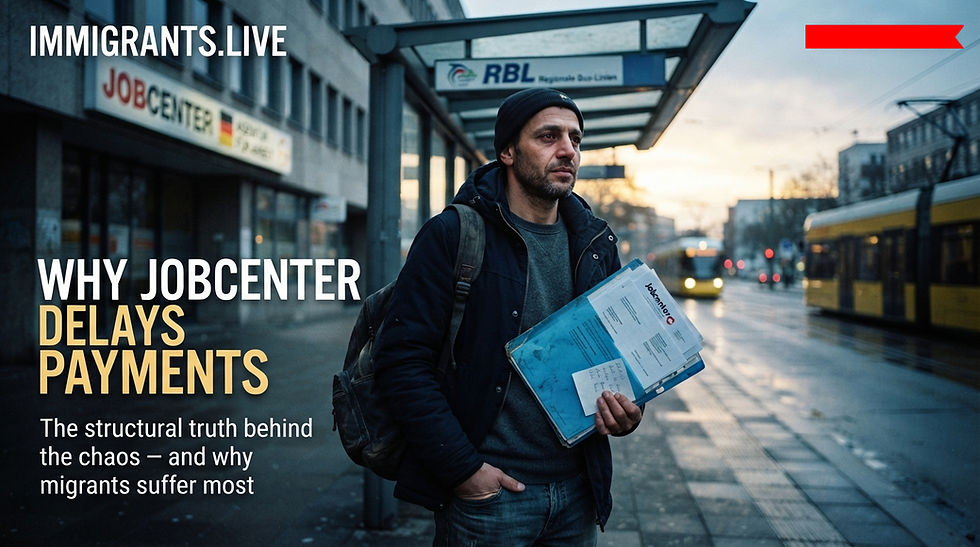
Jobcenter delays payments not because “they don’t care,” but because the system is structurally designed to delay — especially for migrants. This article breaks down the real, research‑supported reasons behind the delays, based on administrative studies, discrimination reports, and frontline interviews with EU migrants in German Jobcenters.
Migrants face informal barriers inside Jobcenters
Research shows that migrants — especially EU citizens — face informal, institutionalized barriers that slow down access to benefits, even when they are legally entitled to them. These include language discrimination, unclear communication, and inconsistent administrative practices.
This means: Even if your documents are correct, your case can still be delayed because the system is not designed for multilingual, mobile, or complex migrant lives.
Administrative overload: Jobcenters are drowning in cases
A major administrative report from Hamburg shows that Jobcenters and related welfare offices received 3,765 problem reports in just over a year — with 85% of all issues concentrated in Jobcenter and migration‑related departments.
This confirms what migrants experience daily: Caseworkers are overloaded, and overloaded systems default to delays, not speed.
Discrimination and unequal treatment slow down processing
A 2024 study on discrimination in Jobcenters found that people from Eastern Europe often face unequal treatment, slower processing, and additional scrutiny.
This doesn’t mean “everyone is racist.” It means the system contains structural biases that create extra friction for certain groups — friction that becomes delays.
Jobcenter prioritizes risk prevention, not fast payouts
Jobcenter’s internal logic is simple:
“Better to delay than to overpay.”
This is reinforced by the new Grundsicherungsgeld system (2026), which increases checks on income, assets, residence status, and household composition. Migrants — who often have foreign bank accounts, unstable employment, or documents in multiple languages — trigger more “risk markers.”
More risk markers → more manual checks → more delays.
Payment cycles are rigid — miss the cutoff, wait another month
Jobcenter pays once a month. If your recalculation or verification lands on the wrong day, you fall into the next cycle.
There is no daily payout. No “we’ll fix it today.” No “we’ll send it tomorrow.”
This is why delays feel random — they’re actually calendar‑driven.
Every life change resets your case
Migrants experience more frequent life changes:
new job
job loss
new rental contract
moving districts
new child
travel abroad
residence permit renewal
Each change forces Jobcenter to recalculate your entire case. Recalculation = delay.
This is not personal. It’s structural.
Missed appointments or unclear documents freeze payments instantly
Jobcenter freezes payments automatically for:
missed appointments
unanswered letters
unclear rent contracts
employer not reporting income
residence permit not updated
missing bank statements
Freeze is automatic. Unfreeze is manual. Manual = slow.
Migrants often don’t know the hidden rules
Research shows that migrants frequently struggle with the informal rules of Jobcenter — rules that are not written anywhere but are enforced in practice.
Examples:
You must report every trip abroad.
You must report every euro of income.
You must report every change in your household.
You must report every document renewal.
If you don’t, the system freezes your case — not because you did something wrong, but because the system doesn’t know what changed.
The system is built on mistrust — not support
Multiple studies show that Jobcenter’s administrative culture treats migrant cases as high‑risk, high‑complexity, and high‑error probability. This leads to more checks, more scrutiny, and more delays.
Jobcenter is not designed to trust you. It is designed to verify you.
The truth people actually share
Jobcenter delays payments because the system is built to delay payments. Not because of you. Not because of migrants. Not because of “lazy workers.”
It’s structural, institutional, and deeply documented.
Until Germany redesigns the system to be:
digital
multilingual
real‑time
transparent
trust‑based
delays will continue — especially for migrants.
Type of Delay | What You See | Real Reason | What Fixes It |
Payment didn’t arrive on 1st of month | “Money not on account” | Missed cutoff date; recalculation pending | Submit missing docs; request Vorschuss |
Payment stopped suddenly | “Zero euros this month” | Automatic freeze due to change in income, rent, or status | Upload updated docs; call caseworker |
Partial payment only | “Rent paid, but no standard rate” | System split payment due to incomplete verification | Provide bank statements; confirm household |
Rent not covered | “KdU missing” | Rent contract unclear or “unreasonable” | Submit full Mietvertrag + Nebenkosten |
Payment delayed after moving | “New address, no money” | Case transferred to new Jobcenter; recalculation | Provide Anmeldung + new rental docs |
Delay after new job | “Started job → payment stopped” | Employer didn’t report income; system freezes | Upload payslip manually |
Delay after job loss | “Lost job → no money” | System waiting for termination proof | Upload Kündigung + last payslip |
Delay after travel abroad | “Went abroad → payment frozen” | System assumes you left Germany permanently | Provide proof of return + Meldebescheinigung |
Delay due to residence permit | “Fiktionsbescheinigung → no payment” | Permit not updated in system | Upload new permit; request manual override |
Delay due to missed appointment | “Missed Termin → no money” | Automatic sanction freeze | Attend next appointment; request reinstatement |
Delay due to employer error | “Employer didn’t send income” | Jobcenter waiting for digital report | Upload payslip yourself |
Delay due to document mismatch | “Names, dates, addresses differ” | System flags inconsistency | Upload corrected docs; add explanation |
Delay due to foreign bank account | “Asked for foreign statements” | System suspects undeclared assets | Provide statements; declare zero income |
Delay due to household change | “New partner/child → payment stopped” | System recalculates entire Bedarfsgemeinschaft | Upload birth/marriage docs; update household |
Delay due to sanctions | “Payment reduced or frozen” | Missed cooperation duties | Attend mandatory meeting; sign Kooperationsplan |
What migrants can do (practical survival rules)
Report every change immediately.
Keep all documents in one folder.
Ask for written confirmation of every submission.
Bring a German‑speaking person to appointments.
Check your residence permit validity monthly.
Avoid travel abroad during recalculation periods.
Request Vorschuss (advance payment) if delays exceed 30 days.
Document everything.
These steps don’t eliminate delays — but they reduce them.
Editorial Conclusion
Why We Published This — And What Every Migrant Should Understand.
Jobcenter payment delays are not a personal failure. They are a structural outcome of a system that was never designed for the realities of modern migration. And that is precisely why this article matters.
Every week, thousands of migrants across Germany experience the same fear: “Will the payment arrive this month?” This fear is not accidental — it is engineered by outdated processes, overloaded offices, and rules that punish complexity instead of supporting people.
As a newsroom focused on migration, we see the same pattern again and again: people with valid documents, valid residence permits, valid claims — yet their payments stop without warning. Not because they did something wrong, but because the system cannot keep up.
What you should take away from this investigation
Delays are systemic, not personal. The architecture of Jobcenter prioritizes risk prevention over human stability.
Migrants face more friction by default. More documents, more changes, more checks — and therefore more delays.
Every life event becomes a bureaucratic event. A new job, a new address, a new permit — each one resets your case.
The system is built on verification, not trust. And verification takes time — often weeks or months.
The burden of clarity falls on the migrant. Even when the system itself is unclear, inconsistent, or contradictory.
Why we believe this story must be told
Because silence protects the system, not the people. Because too many migrants blame themselves for delays that are not their fault. Because families deserve stability, not uncertainty. Because transparency is the first step toward reform.
We believe Germany can — and must — modernize its social support system:
digital processes
multilingual communication
real‑time verification
predictable timelines
human‑centered design
Until that happens, we will continue to explain, investigate, translate, and defend.


Komentarze